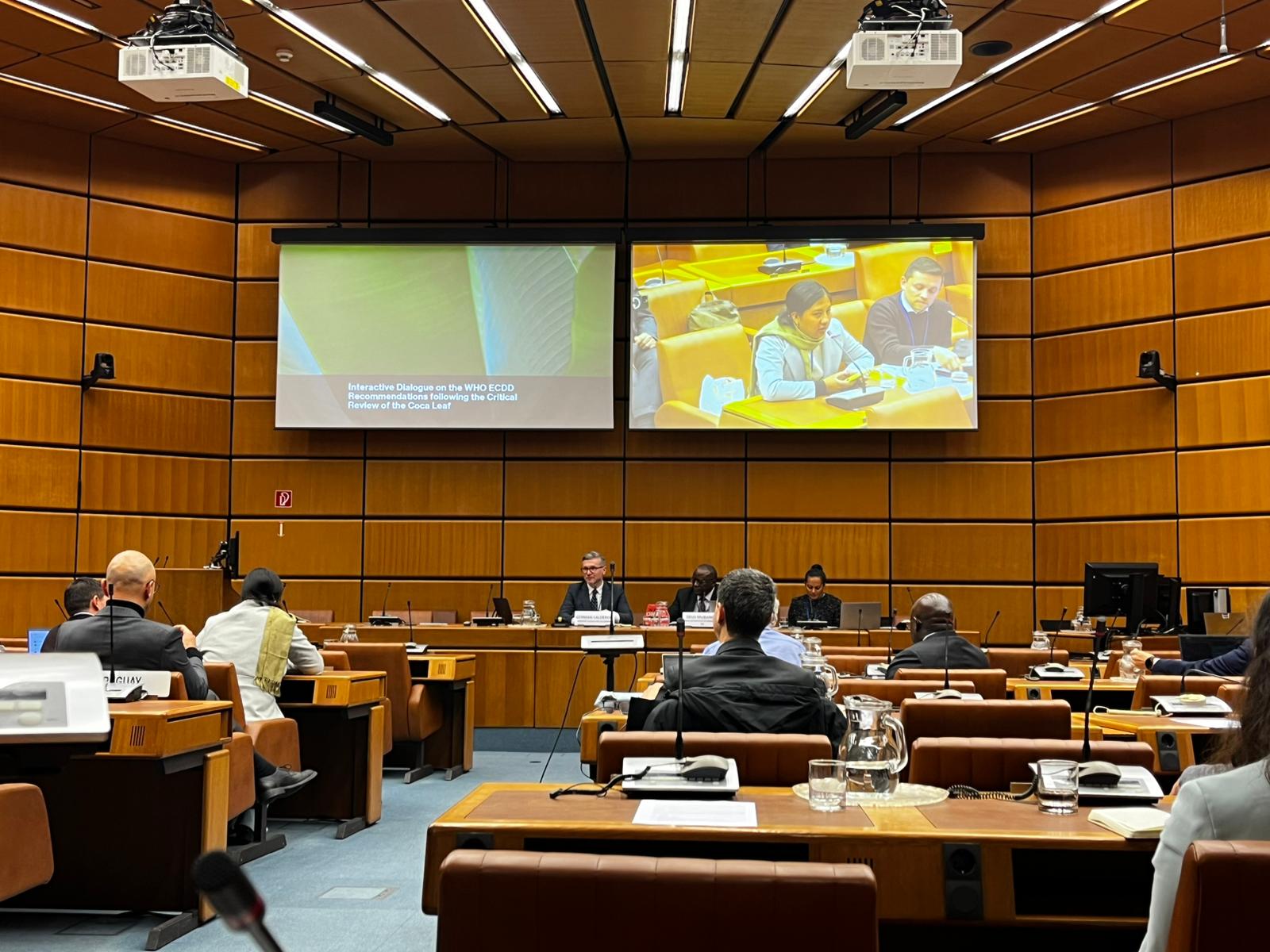
Dr Deus Mubangizi, Director, Health Products Policy and Standards Department, World Health Organization. It will be important to understand the process we went through. For critical reviews, if we need more expertise, we issue a call. In this case, because of the nature of the request, we issued an open call for experts. A number of entities, universities and researchers applied for it. A panel was established to review the applications received. Secondly, we commissioned the review, we interacted with different entities. At the 47th ECDD, we held a public consultation where experts presented their views. We had 15 interventions, 13 of which on the coca review. This was incorporated in the review. The critical review then proceeded and culminated into the draft report posted on the website. In parallel, we sent every member state a questionnaire, asking them to review views and evidence, information. In addition, on the 1st day of the 48th ECDD there was a public hearing. All of this was considered by the ECDD and we came up with the recommendation presented yesterday. This was a transparent and consultative process, with all stakeholders. The presentations of all stakeholders (scientists, NGOs, CSOs) were considered.
The second point I want to highlight is that WHO and the ECDD have a specific mandate – which is to conduct a scientific review of the substances to see whether they present harm, so that they can be placed in the appropriate schedule. If they have scientific use, this is also taken into account. At the WHA, we issued new guidelines on balanced access, because we want to make sure that policies ensure this balance between needs and possible harms.
The last point I want to make is that when it comes to the review, we are basing ourselves on scientific evidence. Because of that, even if the scientific discourse may have different opinions, the ECDD aims to achieve consensus. If we can’t get consensus, then we allow more discussions to take place. In this case, all the recommendations we made had full consensus by the ECDD members. We allowed a two-year discussion to reach this position.
Germán Calderón, Colombia. Thank you for framing our discussion. Now is the moment to exchange views, to understand how the recommendation was reached, and more. I will start with my own question: a lot of reports and information were received by the ECDD. Some of it was scientific evidence, others came from traditional resources and knowledge. Some parts of the rationale for the recommendation said that there is not enough evidence. What is the lack of information that the scientific community should develop for the evidence to be taken into account?
Deus. This is a very loaded question. We received many papers. And many of them were commentaries. Unfortunately, when we emit our recommendations, a commentary does not meet evidence. Some of the studies, the way they were designed, structured, their statistical powers, did not stand the criteria to be considered as robust evidence. When it comes to medical, therapeutic harm, there is clear guidance on how you can establish it. You need a clear control study with criteria and end points. At one point, we talked about therapeutic uses. From the study, you see there is potential, but the data was not robust enough. We acknowledge this in the report. The design and statistical power did not reach our threshold. We need more studies. We received an oral request to link some of the countries that supported the request. But this is based on anecdotal evidence, we need studies that provide the evidence in a standard way. In India, there is a global forum on traditional medicines, they have been invited to engage in this issue.
USA. This is a fascinating topic. I want to build on what you said. You suggest the evidence for therapeutic use is lacking. But under the conventions, the WHO is not charged with assessing what is therapeutic use. If a country were to say that traditional use is therapeutic in nature and therefore falls under the allowable purposes of the conventions, would it be WHO’s position that that would not be a valid therapeutic purpose? Is WHO setting the standard for what is medical use or is that still left to the individual countries to decide?
Deus. We always focus on evidence for medical and therapeutic use. Secondly, if a country says a product is important for traditional use, it could be declared and recognized as a traditional medicine and provided for. If a product is under international control you can declare the quantities needed for those uses and you can have it. It can be accessed as traditional medicine even under the current conditions. What’s important here is national action to claim it as legitimate use. So there are three components: scheduling, terms of accommodation of traditional use, and national action to operationalise that. In the report we recognize that some countries have taken advantage of that and are legitimately using it for those purposes.
Diego García, OSF. Can you expand on the argument regarding the argument of convertibility, and how this relates to extraction, and how this is different or similar to opium poppy.
Germán, Colombia. This is one of the arguments we discussed yesterday at the CND, the difference between conversion and extraction which are two different things. But in the WHO report, this seems to be conflated. The main thing in the report is convertibility.
Deus. Thank you, this is a question we expected. In the first case, the concept of convertibility comes from the conventions. When WHO way back was handed the mandate, it referred to the blue book, the operational procedure, explaining what convertibility means. When you read in the bluebook and try to interpret the Convention, it is defined as a process of transformation of one substance into another, it is not a chemical definition in the convention. In this case, if there is an ease of convertibility, if there is yield and it is practical and profitable. We look at convertibility as a transformation, and it can be any process that transforms one controlled substance into another, or one substance into one that is controlled. That is the definition that the committee has used, and the guidance is available on the ECDD website. This is the principle. There is the law, and there is the spirit of the law. If you have something here and it can be changed easily into something that is dangerous, the spirit of the Convention is that we should control also this one. That is the spirit of convertibility. You have to go back to why we talk about convertibility, it is because you want to make sure that in addition to those substances, also those that can be easily converted into dangerous ones are controlled. That is the principle that was used by the committee and this procedure of the bluebook was approved by the Executive Board and has been in place for decades.
Marie Nougier, IDPC. Does ECDD’s procedure or work methods allow for dissenting opinion? Is there any example of the ECDD adopting a recommendation with a dissenting opinion?
Deus. Our working method is to reach consensus. When there is lack of consensus, we postpone the decision. But before my time, there was a time when the decision was needed, and one of the ECDD members had a dissenting view. This was recorded. It is not the normal practice, however. In this case, there was no dissenting view, and no need to postpone the decision-making.
Andres Lopez. Having in mind that the main ground for the resolution to retain coca leaf was the ease of convertibility, what was the evidence that the committee had considered to conclude that keeping coca leaf in schedule 1 would prevent the illicit production of cocaine, while it has been there for 60 years or more, and we’ve seen a huge increase in cocaine production.
Deus. In terms of what we all do with the measures, there was evidence in the World Drug Report: the increase in cultivation came with an increase in the production of cocaine. So with this evidence, it’s not time to say we will remove the controls. In fact, if I was to react to that, I would say that we need to strengthen the controls. The harms are obvious and well known. In terms of the effectiveness of doing that, we have to look at how we stop this conversion into cocaine. There is no question about the need to enforce the measures on cocaine. I am trying to use plain language, I don’t want to dogmatise this debate. Based on the principle, we ned to maintain the control. We see the increase in cultivation and production. We just need to put our heads together on how to reduce that. We cannot drop it because we are not able to enforce it.
Germán. This was, in a way, a novel critical review, as traditional use was added as an element of the review. A lot of information sent to the Committee was also on the traditional use. Did this have an impact in the way the ECDD analysed the coca leaf. Was this analysed and considered? The guidance had to be followed, but most of the time the traditional knowledge does not follow the scientific approach. How can the committee members address that information to have a comprehensive view of the coca leaf.
Deus. We have clear procedures on the evaluation of traditional medicines. It may not be exactly the same as what is used for chemical medicines. The assessment has to be scientific.
Andres Lopez. The report recognises the industrial uses of the coca leaf, in terms of food, as a fertiliser, etc. The report also includes evidence about the lack of harms related to the coca leaf. The cocaine cannot be recovered from the industrial products made from the coca leaf.
Deus. Member States can put together a system in place how to authorise these legitimate uses. But we don’t have evidence of countries that have put these systems in place and that take advantage of them. Under international level, they have to report back.
USA. The ECDD is entrusted with making scientific determinations. But many of the issues we talked about with this recommendation came down to linguistic or legal interpretation. Does convertible mean extractable? Is it readily recoverable? The conventions don’t define these terms. The bluebook defines some of that. But my question is: did the committee benefit from legal advice from someone who knows the treaties well and knows the history, what these treaties ultimately require, and who could advice on some of these top legal questions that may have came up in the process of determining whether the science meets the legal threshold?
Deus. First of all, throughout, someone from our legal team some days sat full-time at the meeting and was also at the disposal to the committee, so that legal advice was there. I can add that even in the committee there are people that have been associated with the implementation of the conventions and have been on the committee for a long time, so that was the legal input and the committee did not lack the legal expertise that was needed to reach a decision.
Dilkushi Poovendran, WHO. We also had additional legal advisors in the process from the UNODC as the interpreter of the conventions to get legal advice on the interpretation of the conventions as well as the INCB on the implementation of the conventions from a legal perspective. There are legal complexities that come with the assessment of these substances but we had the legal expertise from WHO, UNODC and INCB in this process in cooperation with our legal department to ensure that recommendations of the committee were considering these angles that are not necessarily defined as clinical or scientific expertise.
Gabi, ENCOD. The ex vice president of Bolivia said that there are academic and non-academic medicines. It is holistic, it includes much more than the “academic” medicines.
Deus. We should consult our definitions. There can be a proliferation of definitions. At the moment this is not a classification we have used in the past.
Anyi Ballesteros, Agroarte. Good morning, my name is Anyi Ballesteros. I come from the department of Cauca, Colombia, one of the departments most known for growing coca plants. Please excuse me for using this translation tool, but I do not speak English. I would like to share the following with you. Honourable delegates, while we deliberate in these chambers today, thousands of farming families in Colombia face an existential crossroads: grow coca to survive or abandon their ancestral lands. The recent decision by the WHO not to recommend the reclassification of the coca leaf perpetuates a vicious cycle that condemns entire communities to marginalisation, while denying the world the ancestral and potential benefits of a sacred plant. As you also mention, for millennia, the coca leaf has been medicine, food and a sacred element for the Andean and Amazonian peoples. Its international prohibition in 1961 was not based on scientific evidence about the natural leaf, but on its association with processed cocaine. Today we are paying the price for that historical confusion. What is at stake is school dropout, violence and forced displacement. Loss of sustainable economic opportunities: we offer real alternatives through memories transformed into colour, a new history can be created for future generations who perceive the valuable use of the coca plant. We request the support of this assembly to make a differentiated reclassification: Distinguish between natural coca leaves and cocaine, where the coca plant is recognised for its cultural, medicinal and sustainable value for communities. Investments that include: Quality health and education infrastructure. Road and digital connectivity. Access to land, credit, and technical assistance. Territorial security and protection for social leaders. Creation of regulated legal markets: Allow communities to develop legal value chains with the coca plant. Recognition of cultural rights: Effective protection of traditional and ancestral uses. We cannot continue to condemn entire generations because of the inertia of policies that have failed for decades. Coca-growing communities are not asking for privileges, they are asking for opportunities. They are not asking for simple acceptance, they are asking for dignity and respect for their ancestral knowledge. They are not asking for eternal subsidies, they are asking for the tools to build their own sustainable future. Honourable delegates, the coca-growing communities of Colombia and the Andes extend their hand to you. It is time for the international community to respond with the courage that this historic moment demands. We cannot continue to condemn generations of communities for a failed international policy. We call for dignity and respect for their ancestral knowledge and practices. We see opportunities for resources to be invested to promote the development of these initiatives for communities. If you need papers and investigation, we can bring those to you, not only from Agroarte, but also from the Colombian community. This includes the manufacture of fertilisers in the Cauca, this is used to mitigate the arid lands that have been affected by aerial fumigation. In these lands, what has been affected is the coca, but also food crops. It’s time to identify new approaches. We stand ready to work with you, and a new reality for coca.
Deus. First, thank you for your contributions. Let me say two points. We have gone through two years of comprehensive, transparent critical review. The recommendations of the committee were based on the evidence collected now. Where there is legitimate use, there are provisions in the conventions that can be utilised to undertake these uses. WHO is ready to support in the collection of evidence.
Dilkushi. A large body of evidence and information was transmitted to the ECDD. We are guided by this document which includes 19 headings that structure the critical review report. These headings are very broad. When we do a systematic review of literature, we categorise the studies under these headings. You may have a large body of evidence, but there could still be gaps of information. There is also a process of consolidating the information. The development of the report itself is a complex process, converting this all into one simple document that addresses the questions the ECDD needs to address. It’s not a question of volume of information, it’s more of a complex question on the types of studies we’re receiving and whether that helps to assess the questions we’re asking against our criteria. The ECDD reviews the medical aspects of the substance. For coca, the majority of medical use is not licenced, but more about traditional use. The evidence was included in the epidemiological section.
Farid Ghehioueche, ENCOD. This is a comment rather than a question. The founder of the coca museum in La Paz was telling me that the population suffering is part of the reason why the coca leaf and other products like opium and cannabis have been put under international control. I want to remind you that during this session of the ECDD, we were able to make statements and provide information. At the very end of the meeting, the French representative took the floor to express their rejection of the descheduling of the coca leaf. This underlines the way in which some countries which are trying to rule the rest of the world. In 1998, there was a cocalero shaman who tried to warn participants: you can, you banned the coca leaf. Never touch ayahuasca. Today, we are facing a lot of NPS which are mimicking these old drugs. Those NPS are produced without the plant, just with a lab and money. Maybe it’s time for WHO and other bodies to say that those old treaties should be modernised in a way that it recognises that we don’t have the same knowledge, and have a treaty that fits with the 21st century science, and recognise the plants that have multi-centuries of human use without health problems. When we go to the dentist or other doctors, we are very happy to have these substances. But in other contexts, these substances are considered as a ‘scourge’. We need a new way to conduct our policy and stick to the reality of our times. Thank you and I hope these references will help you in your own reflections.
Germán, Colombia. Thank you WHO for your time and explanations, we will continue this dialogue and hope this exchange has been beneficial.