Chair: Welcome back.
L2. Measures to implement article 13 of the United Nations Convention against Illicit Traffic in Narcotic Drugs and Psychotropic Substances of 1988 to prevent the diversion of equipment and related materials used for illicit drug manufacture
OP1 bis
Mexico: In the morning we had some logistical issues that hampered progress. We will share where we got and hope that brings us somewhere (…) So my proposal was that colleagues take the new wording home and we will see at CoW if we can live with it. Maybe we can confirm that now?
Chair: We have dense language here. “Calls upon parties, that not already done so, to adopt in accordance with article 3 of the 1988 convention such measures as may be neccessary to establish as criminal offences under their domestic law when committed intentionally the manufacture, transport or distribution of materials or equipment …” This came out of informals.
USA: “legal system” instead of “legals” please.
Chair: With that, do we have a text we can accept? I am grabbing my hammer… yay! Accepted.
OP1 ter.
Chair: While I understand all concepts, I needed some help front he colleagues of Mexico to phrase it clearly, so here is my proposal (pic)
China: The last sentence might have a different meaning now than the previous one?
Germany: (…)
Colombia: I would like to refer to both things, maybe a native speaker can put it more eloquently?
China: We have an other proposal – after “licit use of material and equipment” add “guarantee their access and availability worldwide, in particular…”
Chair: I think we are getting there.
USA: This is taking us away from something we can be agreeable with. We have obligations to prevent. We would not be comfortable “guaranteeing”.
Mexico: Without having to clinge on a specific (…) we welcome guidance on professional english on this.
Iran: The beginning of the sentence uses “ensure” is an issue for me legally, because does this mean we have to ensure other countries are doing as well? I dont have a proposal at the moment but nor comfortable with this as is.
Chair: The measures mentioned in article 14 dont indicate responsibility for inter countries.
China: Instead of guarantee, we could do “secure” or “protect”.
Belgium: We have an issue with this. We prefer “ensuring to avoid” since we take out guarantee, the beginning still needs to stay strong.
Russia: We support the chinese proposal. Something is missing though… equipment and materials then switch to substances. So are we talking about manufacturing of controlled substances or is this two parts that are not connected?
USA: We agree that there is a conflation of two elements here that creates an implication to something that is impossible. We cannot ensure that these wont have any negative impact. We can ensure we are designing and implementing in a way that seeks to avoid.
China: We are afraid that if you have measures taken without the interest of the relevant stakeholders, it will have negative impact, so we cannot agree to delete them.
Chair: Seems like we are not quite ready to agree.
Egypt: We are not ready to accept but allow me to propose an alternative. pic tba
Chair: I thank you for not giving up on us. I dont see any immediate negative reactions, so that is a good sign.
China: we are missing “on the licit use of materials and equipment” after “stakeholders”. But we would also like to point out that the USA was present during the informal discussions and these issues were not raised, in fact we have other suggestions implemented… so can you help us?
USA: Thank you, the egyptian proposal is acceptable to us. We see the “interest of relevant stakeholders” and “licit use” would also fall into that category, so if that is not a strong preference from China, we would prefer to keep the sentence at the end. We can go along with how it is now, we are just asking if we can flexibility to separate these concepts.
Iran: We can go along with the new suggestions. As per my previous comment, I would also like to add at the end of the first right “their”.
South Africa: We support the chinese and egyptian proposals and would like to add “accesibility” and “affordability”.
China: There is something here that would lead to ambiguities… can we have “licit use of materials and equipment” before “controlled substances”.
USA: We would like to add “negative impacts” to the last sentence. We cannot accept “affordability”.
Chair: The text as it came to us over lunch was pointing towards a direction and it is not clear to me how the availability is in line.
China: Can we add some changes? We have “negative impacts” already. “Also taking into account their, accessibiilty and availability, in particular the global accessibility and availability of controlled substances used for medical and scientififc…
Chair: I thought we had a chance of getting there but it seems like we are trying to square a circle here.
South Africa: For us, affordability is just as important as accessibility. We insist on keeping that.
Chair: Thank you. We close out debate for now.
Mexico: On this issue, as already mentioned, we were not able to finish our negotiations. We are hopeful to quickly finish informals on this and find consensus.
Chair: Thanks. Yeah, at least we are clear on the concepts floating around.
OP3.
Chair: Can we lift the brackets?
USA: We dont oppose the concepts but oppose the inclusion of them here. We propose a separate paragraph that deals with international human rights obligations.
Chair: Do you have a particular language?
USA: In two minutes.
OP4b ter
Mexico: We came back from informals yesterday afternoon with still some questions open. Today, in the morning, we expressed the reasons behind the formulations and the significance of it. Before opening the floor, please bring us back to OP4, so that we have proper context. We are inviting MS, we are not imposing anything… and we recognize national law, we recognize INCB and interalia. We are including also “as needed”. My poition as sponsor is that there is little to do in terms of wording here. Are delegations agreeable after our explanations?
Chair: Delegations had 24 hours to work on this, so I am asking the CoW: can we lift the brackets?
Germany: Thank you Mexico for the explanation. We are fine with the paragraph.
Chair: Great. Looking around the room, it looks like we agree. (gavel)
Chair: Okay OP4i looks agreed?
China: I cannot make decisions for our customs colleagues.
Chair: We can keep that part pending.
USA: My understanding is that 1bis was agreed? The edit was conditional on that?
Chair: The colleague was referring to OP1 ter that is still open.
China: I am inviting USA also to share their flexibility as we are also showing flexibility.
Chair: What I suggest is that we strike “consider to” and add reservations by China.
USA: We have a proposal for 3bis: “Also underscored the importance of implementing the international drug control conventions, including with regard to the offences required to be established referred in Article 3 of the 1988 Convention, in conformity with MS obligation under applicable international law.”
Chair: So can we accept 3 bis?
South Africa: (something about human rights…bad audio)
USA: Did you mean to agree that in CoW? Im willing to entertain changes to that proposal that implements references to human rights as South Africa suggested if it is strick adoption from the treaty.
EU: We are getting closer to a solution but for us, it is important to keep the reference to international human rights laws. Maybe we can change it to “including international human rights law”.
Iran:
South Africa:
Chair:
Russia: We also have a reservation because we dont want the convention to be subordinate to the international human rights conventions. The three treaties are our guiding documents. We should work more on the language so it underscores compliance with them.
Chair: Okay, let´s give this some more time. I would like to gavel on OP3 tough. Can we agree? Seems to be the case. Thank you. (gavel)
OP5
Iran: We have a caveat at the beginnning. We are not comfortable with “as appropriate”.
USA: We have a couple reactions. “The provision of” before equipment and remove “necessary”.
Mexico: These edits are new to us so we need some time. I also want to flag OP7 is still open.
Colombia: Can maybe UNODC confirm they provide this to MS? If so, this should be kept in the text.
Chair: So there is insistence to keep word technology.
South africa: There are three elements to this and we insist on naming them.
Pakistan: We also support the retention of technology for the reasons explained by SA.
Chair: Clear. Moving on.
OP1 ter.
Mexico: Let us try to agree. If it doesnt work, we go back to the drawing board.
Chair: Okay… which delegation has the way out for us then? Can we accept it as it stands?
Belgium: Sorry chair, we need more time to reflect on this.
Chair: Alright, I tried. We passed the time allotted for this resolution. We continue to L3.
USA: Introducing the resoltuions and the progress made – lets start at PP5.
E/CN.7/2026/L.3/Rev.1 – Enhancing supply chain integrity to prevent the exploitation of licit supply chains and shipping modalities for the illicit manufacture and trafficking of narcotic drugs and psychotropic substances (United States of America)
PP5ter alt.
Chair: What do we think?
India: Is this a separate pp or part of the existing one?
Iran:
Chair: Do you have an alternative laguage
Iran: No.
Mexico: There were many iterations so we would like to appeal to all delegations that if you want to add sepcifications, we can move forward but more alterations are going to mess with the consensus (not verbatim!)
Chair: Okay so we cannot gavel.
France: Just a small remark – we would have preferred the mention of the effects on the environment. We can go along with it as it stands though.
USA: We work closely with Mexico and would appreciate if delegations could accept this as a negotiated compromise that servs the priorities of several delegations in the room. I would also like to move to the less contentious paragraphs and see if we can agree.
Pakistan (?): We would suggest adding parts of the title to the text to clarify a few things. This would not change the parts we have consensus on.
South Africa: In terms of enhancement of supply chain, we really request to add “affordability”.
Italy: (….)
Chair: Can I be so bold to see if PP5 alt, as formulated by Italy, is acceptable?
Iran: I am seeking some clarification on references to the economics and biological impact?
China: PP5 ter and quat are very new for us. I also have the same question. Can we delete these references?
Mexico: We are talking about potential impacts. One of those specific impacts, if the integrity of the supply chain is not ensured, there are environmental impacts.
USA: We would like to echo Mexico´s statement.
China: (…) Peoples health are not just safety problems.
Mexico: The formulation is for the benefit of eventually being able to address all concerns.
Iran: Thank you for explainaing the logic. I would like to study this a bit more, but it is much clearer.
USA: I wanted to move to PP5 because there was consensus and the brackets are a typo.
PP5
Belgium (sorry yall my focus is dwindling)
South Africa: We would like to add the word “affordability”.
USA: Yes, we find it interesting but we dont think it belongs here. WE cannot support the inclusion of affordability, only language we agreed on in informals.
Canada: We echo what was just said. The broad range of measures are considered so we dont unduly restrict ourselves. We would like to return to the text that was agreed in informals.
Egypt: We support the addition but we could say “ensure access to the affordability…”
Chair: Looks like we cannot agree in this poin in time. We have one more day, distinguished delegates and I want to point out the emergence of new topics. I am in your hands.
OP2 alt
USA reservation on the first sentence
India: We propose to talk about the “exchange of information and evidence as appropriate”.
Chine: For what this para is talking about, intelligence would be more appropriate than information. We would also like to invite the sponsors to delete “frequently” in the context of seizures.
Chair: clarification
India: Why are we proposing information – my answer is based on the definition. So intelligence, you cannot disclose publicly. That is why we want information to be shared. If someone wants to share intelligence, they can go beyond, that is fine. But the specific mandate we want to address information.
USA: We would like to clean up this paragraph now. We are pretty flexible here and there are a few variations that would work for us.
China: We need “substantial” before “evidence”. I would like to invite India to think about which word to use here.
Chair: From my perspective, intelligence is also information. If the sponsors can live with this wording, it is appropriate in my eyes. So this seems acceptable? We have an agreed paragraph! (gavel)
(…)
Title
USA: We value our integrity and we will keep it, so we will remove the deletion request.
Chair: Can the original title be accepted
China: integrity is not something cnd should care about. The CND is about preventing diversion. About the conventions. Our suggestion has been opposed by the US. We compromised agan and again: prevent exploitation. Integrity is not cnds business.
Russia: We value integrity as the US. But this is about the CND’s mandate. This is an economic issue for different UN bodies, though. We supported China’s proposal in line with the CND’s mandate on drug control, so we would remove the ‘supply chain integrity’ part.
Brazil: Trying to accommodate both positions. Bridging gaps. The idea of supply chain integrity is vital for the US. But I also hear that the mandate of the commission is not supply chain integrity but rather drugs. I suggest inversing the order. ‘Preventing ….by enhancing supply chain integrity.’ That way we underscore that we’re focusing on preventing the criminal exploitation and the integrity aspect is to achieve that.
India: I suggest stopping at psychotropic substances. It’s always good to have a straightforward title.
China: India has said what we wanted to say. Let’s end it at ‘psychotropic substances’.
Chair: We’ve witnessed an Asian tango! I suggest delegates sleep on this.
PP3
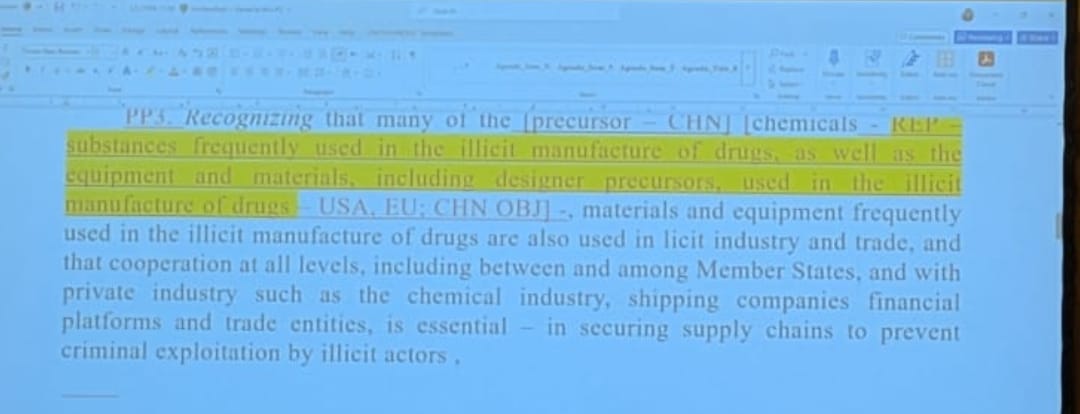
Canada: We would like to retain the wording from OP2alt and insert it here.
Chair: “Recognising that many of the substances including designer precursors frequently used in the illicit manufacture of drugs as well as the materials and equipment used in the illicit manufacture of drugs…”
China: We have suggested that we would like to add ‘frequently’ to ‘materials and equipment’ and also ‘most’ instead of ‘many.’
United States: We rejected that proposal because no other delegation supported the informals. That’s why it’s ‘many’, not ‘most’.
Chair: The idea is to stick to ‘many’? I don’t know why ‘most’ — you’d have to prove it!
India: We could take out ‘many’ and ‘most’. Just say’recognising that substances…’ Just a thought.
United States: This is a good solution. We would point delegations attention to the third line: ‘materials and equipment frequently used’. That’s not a formulation that we proposed or support.
Iran: We have a technical problem. Based on the glossary of the INCB — designer precursors usually have no legitimate use. The current text contradicts this.
Chair: Now it says ‘Recognising that substances including designer precursors frequently used in the illicit manufacture of drugs as well as the materials and equipment used in the illicit manufacture of drugs are also used in licit industry and trade…
China: Yes, ‘frequently used’ is in the title as per the 1988 convention. ‘Materials and equipment’ is not on Article 13. The resolution before us is far beyond the convention. So we would keep the ‘frequently’ after ‘equipment’.
United States: Recognising the comment about ‘designer precursors’ and taking that point, we unfortunately have to revert back to the beginning of the paragraph and retract our support for striking ‘many’.
Chair: The point is whether ‘frequently’ should be there. Right now it’s taken out.
China: If there’s ‘designer precursors’, we can compromise and not have ‘most’, but we would then insist in the ‘frequently’ mention.
Mexico: There’s a repetition of ‘frequently’. Where we say ‘materials and equipment’, we can strike ‘frequently used in the illicit manufacture of drugs’. And say ‘as the related materials and equipment’.
United States: Unfortunately, the language we came up with was the result of tortured development. So we would not be ready to remove this tet based on the opposition of one delegation. We know repetition is not the most eloquent way of saying it, but it seems to be the most consensual. The second ‘frequently’ is not consistent with treaty language.
Mexico: We would withdraw our proposal. We suggested something on the spot to try to move forward. We don’t push for it.
China: We can be flexible and go along with the Mexican proposal. Why is the sponsor not thinking about it? We don’t understand. The same phrases appear again and again. The shortened version, by Mexico, could work to simplify.
Iran: Adding ‘many of’ doesn’t solve the question. Designer precursors are purposely made to circumvent control and usually have no legitimate, recognised use.
United States: We would say this is agreed apart from the ‘frequently’ text.
PP4
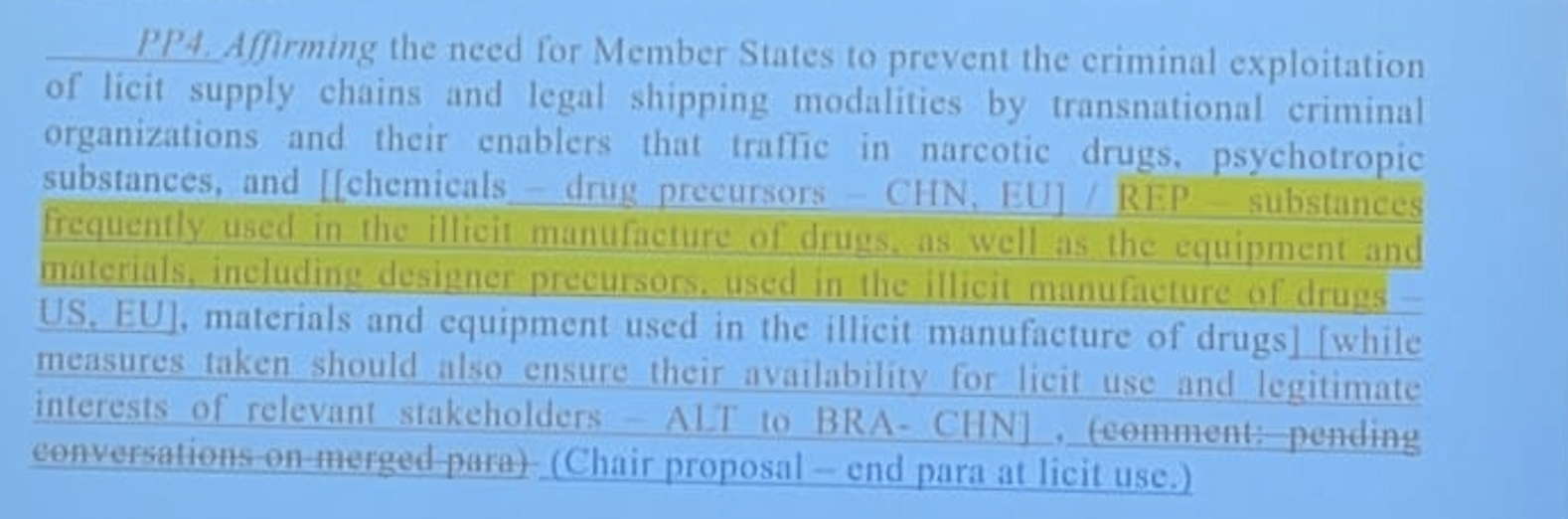
United States: As above, in PP2, we want to replicate that language.
China: If we want to stick to the convention, we would not have ‘designer precursors’ because the text says ‘substances frequently used…’. We can take out ‘including designer precursors’. And just leave ‘substances frequently used in the illicit manufacture of drugs, as well as related materials…’
India: Question of substance. We’re talking about stopping the criminal exploitation of illicit supply chains. I’m not sure there’s a large amount of trafficking of materials and equipment. This paragraph seems to be going in too many directions. Perhaps the sponsors can shed light on this.
European Union The question of designer precursors is important for us because we see a proliferation of designer precursors so we think it’s important to mention them. We can agree to this deletion but just here and then consider on a case by case basis.
India: My proposal is to delete ‘as well as related materials and equipment’. I’m not aware of criminal organisations trafficking tabletting machines…this is licit trade.
Chair: How about the rest of the paragraph?
United States: We can be flexible here and we thank the EU for their flexibility. Some of the China edits we can accept here but we need the ‘as well as related materials and equipment’ here.
European Union: We would also like to keep the reference to materials and equipment. We do have trafficking of machinery and equipment.
India: We can drop the objection.
Mexico: We can keep this. There’s a whole resolution before CND on the trafficking of materials and equipment.
United States: instead of ‘ensure’, say ‘protect the availability of controlled substances for licit use’, and end the paragraph there.
China: We would be comfortable with the previous proposal. We can delete ‘frequently’. We don’t want a paradox where one phrase is related to the convention and the other one isn’t. The sponsors said before that they agreed with the last part of the paragraph but now they changed their mind.
India: We can say ‘protect their availability for licit use’.
China: I spoke too fast. We should add ‘and legitimate interest of relevant stakeholders’.
United States: we could end the paragraph at ‘as related materials and equipment’.
Belgium: We agree with the deletion here because otherwise the content of PP5 is repeated.
PP3bis
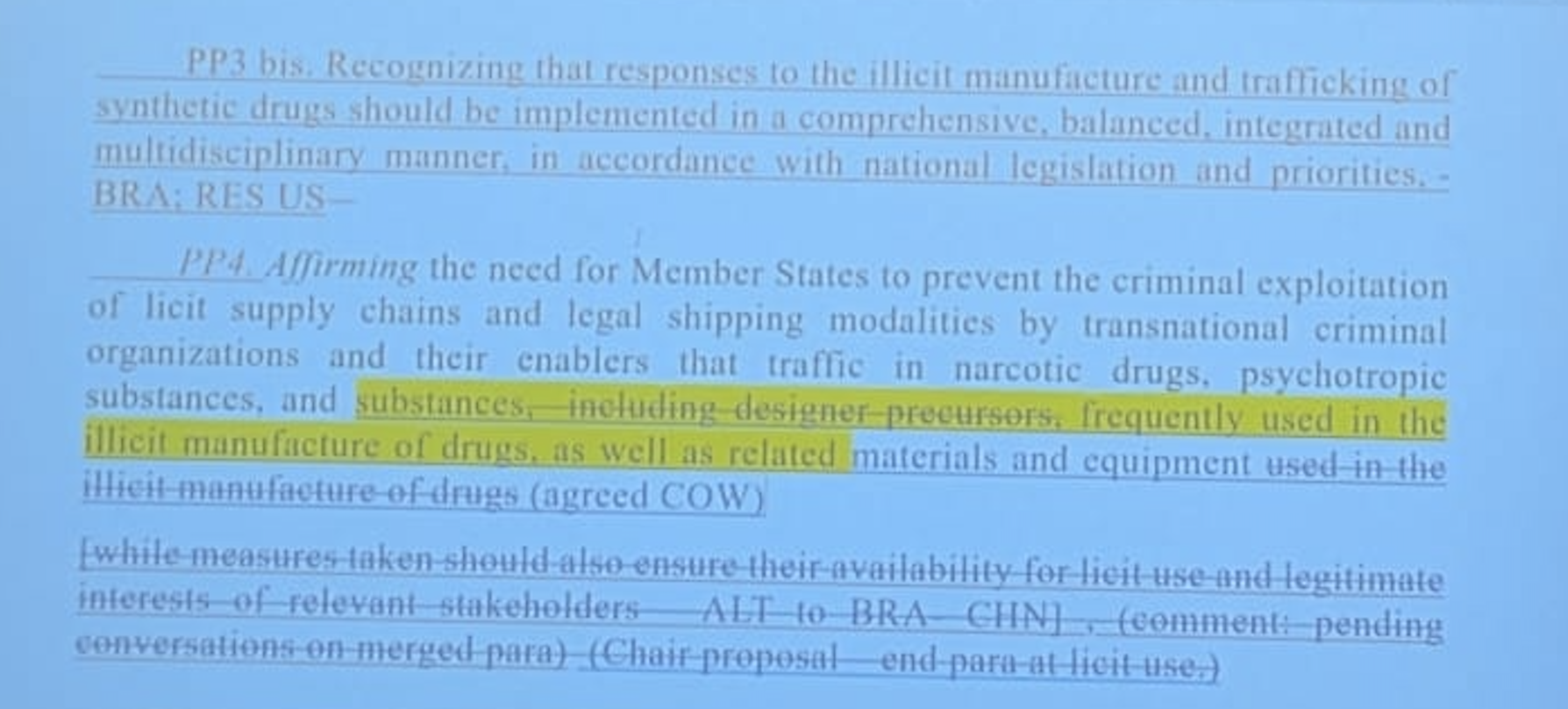
Chair: Agreed in CoW.
United States: Our political leadership has asked us to delete this paragraph to streamline this text.
PP5quat
United States: We would want to hear from other delegations.
China: We thought we were going to discuss PP5. Why did we go to PP5quat?
United States: We thought focusing on PP5 was not productive.
India: I suggest that this paragraph, definitionally, is vague. Not sure what is intended to be done. Frankly, I’m not sure how many countries have discretionary powers. I know there’s this language in the conventions. In most law enforcement jurisdictions, I’m not sure what discretionary powers are. Specific legal powers exist but they’re not discretionary. There’s also the question of prosecution, then offences on the exploitation of the supply chain. What laws are there that prosecute you for exploiting a supply chain? Then it talks about maximising the effectiveness of law enforcement measures in respect of those offences, which I imagine it’s about those offences. The language is vague. Complicated temonilogoy. I would propose the paragraph’s deletion.
Germany: We would support ‘including offences related to exploitation of the supply chain are proportionate to uphold law enforcement…’
Mexico: With the ideas originally placed by my delegation placed here on criminal justice and such. Trying to work with what we have on the screen, I’d request replacing ‘drug related’ with ‘drug trafficking’. Then replace ‘including’ by ‘duly ensure the prosecution of…’. Then ‘offences related to…’. We’d remove the word ‘of’ before ‘supply chain’ and say ‘exploitation along the entire supply chain’. Duly ensure the prosecution of offences related to offences along the entire supply chain. Then ‘in respect of those offences, especially those with specific criminal intent…’. This way we keep wording from the convention. We can look at the different parts of the supply chain. If we see the supply chain in a vacuum it is hard for law enforcement to understand at which stage.
Canada: We would suggest ‘recalling that member states should endeavour to ensure, in accordance with article 3 of the 1988 convention,’ and then the rest of the paragraph would follow. This would tie it back to the convention commitment that we have and it’s paragraph 6 under article 3 where the majority of this is from. We would also have to check the ‘duly ensure’ and other language for consistency but we think this is a start.
Australia: We’ll have to have a look at the whole paragraph because there’s been suggestions to change this. Having prosecutions and offences makes sense but we want to make sure that the question of proportionality is reflected and we will make a contribution later.
Egypt: In line with the proposal from Canada, we prefer that the reference to article 3 of the 1988 convention is moved down in the text. So i would be ‘to ensure that any discretionary legal powers under their domestic law relating to the rposectuoon of persons for offences, estalsihed in accordance with article 3 of the 1988 Convention,…’
Mexico: not sure the ‘Recalling’ makes sense any more so we could tweak that. As long as we understand that we are explaining a bit further some of these exploitation of the supply chain in relation to article 3 with regard to paragraph 6.
China: There’s viable elements in the proposals and we will consider them.
Chair: Thanks for that curiosity.
India: The way I interpret this reference is that member states should ensure discretionary legal powers available under domestic law to prosecute offences related to drug trafficking should extend alogn the supply chain. That’s how I see this working. I’m trying to say the law does not prosecute someone because of their participation in the supply chain but their involvement in activities related to trafficking or supporting activities to create substances. The concept of ‘entire supply chain’ is hard to capture in a law. So what are we talking about when we say ‘related to exploitation along the entire supply chain’. The Convention is binding. We don’t need to reiterate the articles of the convention in resolutions where they don’t add particular value. I would agree with a simple formulation that captures what we are trying to say.
Chair: Curiosity. Questions. Redemption from the United States?
United States: We would like to review this text to simplify. We would like to know if China would still like to delete so that we know how to move forward.
OP1
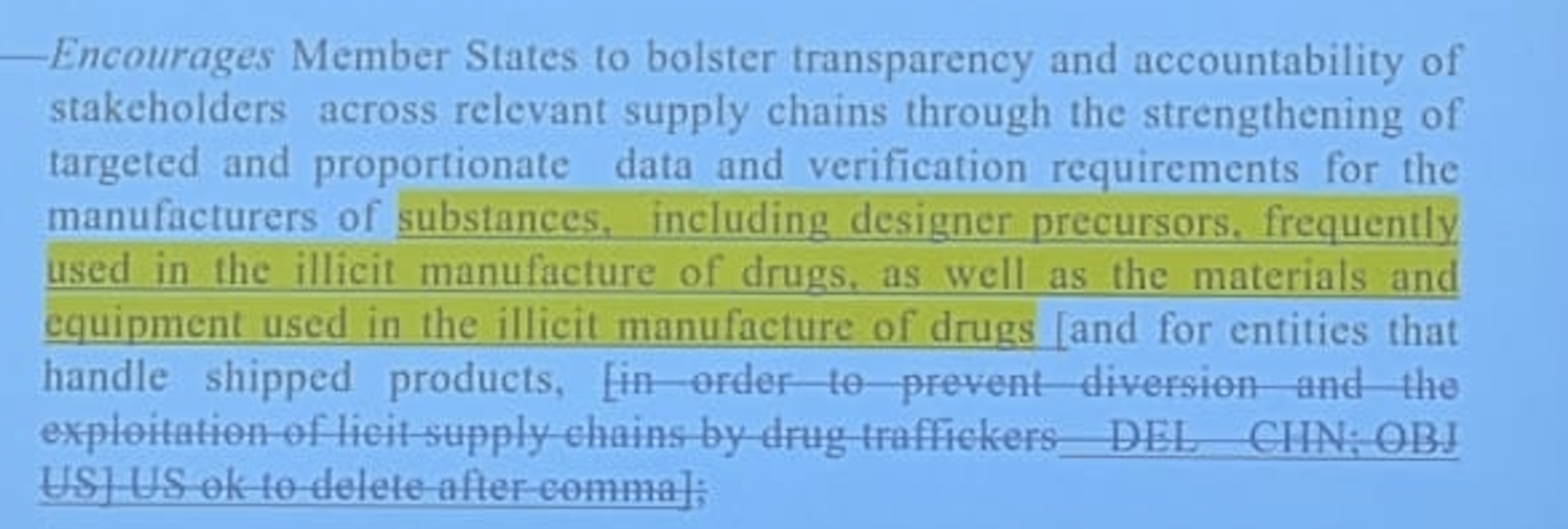
United States: Same edits made to OP2 and agreement to delete the last portion of the text.
India: In the second line ‘relevant’ is too sweeping an adjective. We would add ‘implicated’. What we’re trying to capture is that we will not be able to, as a system, bring in transparency and accountability in the entire supply chain. Limited to some kind of indication of involvement, like ‘implicated’ makes it more targeted. So ‘Member states to bolster transparency and accountability of stakeholders across implicated supply chains by strengthening targeted and proportionate data and verification requirements…
China: Misunderstanding between sponsors and us. We just wanted to delete the first part of the paragraph. We suggest: ‘Encourage member states to cooperate with stakeholders across…’. We also suggest keeping ‘in order to prevent diversion and the exploitation of licit supply chains by drug traffickers’. WE suggest deleting ‘including designer precursors’. And say ‘substances frequently used in the illicit manufacture of drugs, as well as related materials and equipment….’.
European Union: Indeed, we attach great importance to the mention of ‘designer precursors’, so we would keep it. In PP3, it was inconsistent. In that case, we agreed to remove. Otherwise, we would like to keep. Including here. In PP4, there was a deletion of ‘designer precursors’. It was too fast for me but I want to make sure the mention is there.
Chair: We will check on PP4. We note your flexibility was limited to one paragraph.
United States: We had similar edits to the EU.
Chair: We made some progress. We complicated our lives somewhat. We will give it a final push. Today, I ask sponsors to come forward and discuss how we can distribute the timeslots for tomorrow. There’s going to be elections at the Plenary tomorrow at 10:00. We will meet at 10:30. We will let you know what we will take up. That’s time for sponsors to come together with interested delegations. I’m aware informals have been intensive. It happens however that consensus achieved there doesn’t persist, which brings discussions to the CoW. We have one more day. 5.5 hours of the CoW to get 5 resolutions across the finish line. We have to be disciplined. Sponsors could start informals tomorrow at 8:30am / 9am. But you are also welcome to bring not agreed resolutions to the Plenary. It would be a pity.
Secretariat: Virginia Patton Prugh has withdrawn her run for co-chair of the Independent Expert Panel. The remaining ones are as follows: Natalie Y- Lin MORRIS SHARMA, of Singapore and Khalid TINASTI, of Morocco.