L.5. Strengthening early warning mechanisms consisting of monitoring and assessment systems to enable effective responses to the emergence of new synthetic drugs, new psychoactive substances, precursors and precursor substitutes
Chair: Only 4 more COW sessions to go. Ask that you work with us to get this done. If required can go into smaller setting, through the course of the afternoon. Would be good at least if there are representatives from all regional groups in each of the rooms. We’ll take up L5 until 11am.
OP2
Chair: Discussion yesterday on drug checking outputs ‘where they exist’. Can we live with ‘drug checking outputs where they exist’?
Russia: Wish COW a productive meeting today, we will contribute constructively. But our position hasn’t changed. We have strong concerns on drug checking outputs – not only us, but also the INCB who has open concerns that such facilities can promote drug use. These services are covered by ‘toxicological services’
Canada: ‘where they exist’ is a good compromise. Drug checking not limited to safe consumption sites, can be done at any public event, they are legitimate to provide data.
Switzerland: We’d also like to retain drug checking – a good way to understand when new drugs are appearing on the market. We have detected multiple new drugs through drug checking, and understand what name, for example, they are being sold under.
Chair: Suggested ‘public health monitoring’ – for consideration to come back to.
OP3 bis alt
Chair: Russia’s additions yesterday
Colombia: Understand Russia only send to health providers. However EWS are broader than this. Prevention component is devoid of relevance. This is why it’s important to keep ‘affected communities and individuals’
Russia: How will alerts be sent to individuals – what is the mechanism to send to individuals?
Colombia: Invite Russia to check Colombian Drug Observatory website – available to all public and individuals.
Canada: Chair’s proposal quite useful. Specific communities and individuals – specific to ‘including’ – so that we would have specific communities and general communities. Affected communities and individuals – could be a way forward to us.
Switzerland: Background on our experience. We give warnings not only to communities but also individuals through different means: websites, newsletters, etc. People who buy substances that they think of as medicines, on the internet, can access websites and newsletters to know if there’s adulteration or misrepresentation. WE could benefit from exchange and information on this matter.
Chair: “Development and dissemination of general and specific drug related public health alerts”. It may not be Nobel prize literature but I’m trying to get us from A to B.
Russia: This is an excellent proposal and captures Russia’s concerns perfectly and we ask for flexibility from other delegations.
Colombia: Thank you for your creativity in finding solutions. Flexibilit comes both way. We have provided solutions and explanations. WE will be flexible but ask others to do the same.
Canada: I will discuss with my delegation. We want to see references to affected and relevant communities but I will get back to you.
Chair: We still have questions about ‘relevant communities’. Hope we can get to a point where we can all be equally unhappy.
OP4
Chair: There was an alternative and then bracket soup. When I was rereading it this morning, I didn’t know what the problem was or how it would be solved. How about ‘encouraging member states as appropriate and in accordance with domestic law to strengthen regional and international cooperation including with regional and intergovernmental organisations in areas of monitoring and assessment as well as in relation to the following:…’
Colombia: Acceptable. There’s just one element missing: international law. Let’s say ‘in accordance with domestic and international law’.
Chair: Acceptable?
United States: We suggest moving ‘within their mandates’ to after ‘organisations’. We have concerns about ‘international law’. We would say ‘in accordance with domestic law and relevant international obligations’
Australia: We would appreciate the original formulation, keeping ‘international law’. On ‘international obligations’, we would rather say ‘in accordance with domestic law and relevant international legal obligations’.
Chair: Agreed? How about the ‘web monitoring insights’? Would the explanation provided yesterday be acceptable?
Russia: We have carefully listened to the sponsors’ explanation and we consulted experts and we are ready to show flexibility in response to calls in the room who underscore the importance of reach consensus and adopt the text
Chair: I love the smell of consensus in the morning. I appreciate the Russian Federation’s flexibility. Do we have agreement on this paragraph? Agreed in CoW.
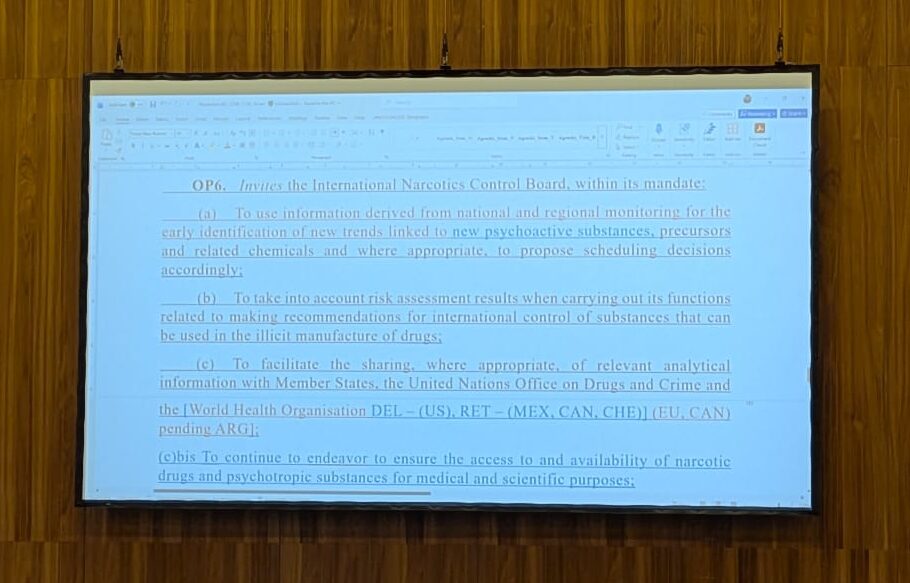
OP6
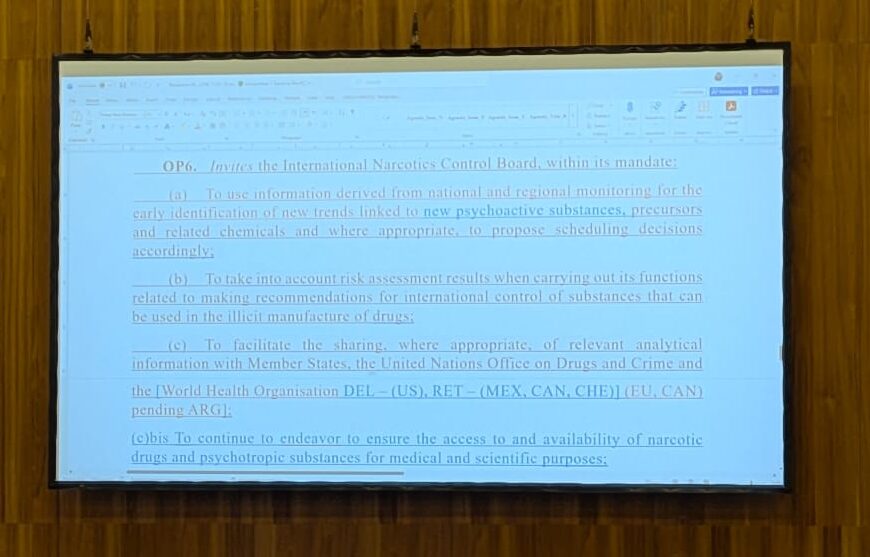
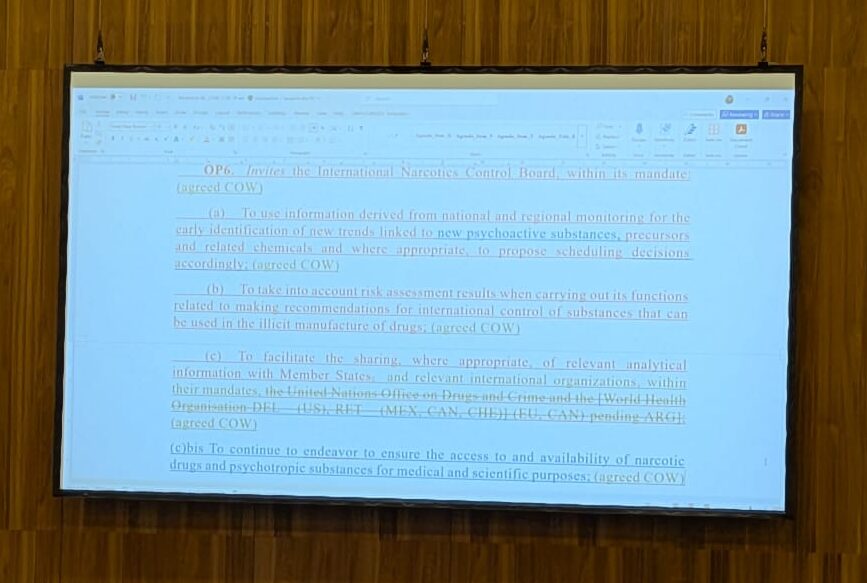
Chair: I wonder if we could say ‘and relevant international organizations within their mandates’. Making it generic to avoid enumerating so that experts know where to turn to. Agreed on this? Yes. Agreed in CoW.
United States: We thought we were agreeing on that segment not the whole paragraph.
Chair: You’re right.
United States: (…)
Chair: The INCB is with us.
INCB: There is Article 35, para f and g of the 1961 conventions that gives INCB power to request information from member states about drugs beyond article 18. Several resolutions of GA. INCB to prioritise the review of the most relevant, persistence, and harmful new psychoactive substances and facilitate informed scheduling decisions by the CND.
Chair: Still have to agree on paragraph 5.
China: On OP6(b), we would like to add in the second para ‘that frequently be used’ rather than ‘that can be used’. A lot of things can be used and we need to focus on what is used.
Chair: Agreed?
European Union: Quick comment on ‘frequently’. It is language in the Conventions. We’re talking here about early warning systems, detecting new substances used in manufacture. At this point, the ‘frequently’ does not match the objective of the resolutions.
Chair: Perhaps China can think about this and then tell us what it thinks.
OP7

Iran: The formula is something we can work on and accept, provided that we actually remove ‘according to their needs’ and leave it to ‘upon request’.
Chair:
United States: This was our proposal. We wanted to underscore that ‘developing countries’ are not the only countries where EWS are needed. Focusing on developing countries is inappropriate. The room believes ‘according to their needs’ isn’t appropriate. If so, we would delete ‘in particular developing countries’’ to avoid singling out particular countries.
Colombia: I have to respond to this. It’s not about whether EWS are relevant or not. It’s for developing countries who need it the most. We would retain this wording. I asked for the floor because when you put ‘upon request’ it is not clear who makes the request. We need to include ‘upon their request’ to clarify that this is the country asking for it. And, of course it would be according to their needs because they would be asking for it.
Chair: We have two options ‘developing countries upon their request and according to their needs’ or ‘upon their request’. We are not moving forward on this.
Egypt: We support the position of Colombia. This is about technical assistance and developing countries are the party that needs this assistance the most. Without mentioning developing countries, then how would this work? It’s not clear.
South Africa: We support what Egypt and Colombia said.
Chair: I suggest we take this to informal consultations to work something out and I call upon you for creativity to see if there’s an elegant way to phrase this.
OP8 & OP8bis
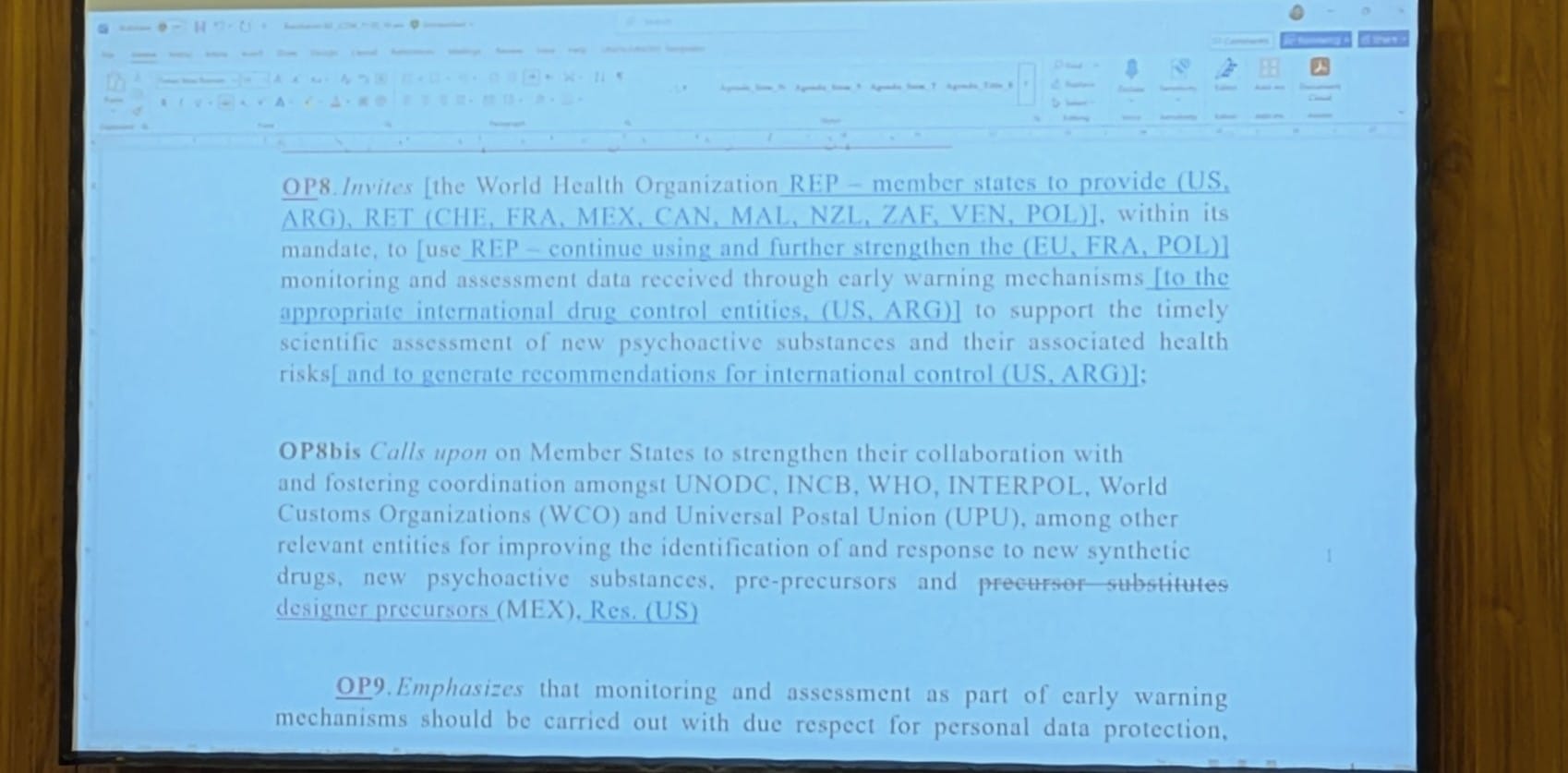
Chair: Could we start by looking at the possibility of merging the two concepts we have here? Asking both international organisations and Member States?
Colombia: In this para, we have a fundamental question. WHO has a specific mandate by the conventions. Do we agree with the conventions? We cannot agree just with some parts of it. We have bigger discussions in other rooms about this. The 1961 convention says that the first body to say whether a substance should be controlled or not is the WHO through its ECDD. Changing the scope of the paragraphs would be to change the wording of the conventions, which we are not here to do.
Chair: could we say ‘WHO, as per its mandate in the 1961 convention,…to use monitoring and assessment data….’. More specific to the mandate of the convention. While I have the floor, I suggest we see this in relation to OP8bis too, where we might cut some corners, so that the whole enumeration we have there, we would delete. I don’t want to confuse people too much. Clarity and flexibility so that we retain the wording of the Convention, but be more generic on the question of cooperation with relevant entities. Think about this.
European Union: For OP8 we support the statement by Colombia. We agreed to delete references to WHO in his resolution. In OP8, it’s hard to merge concepts that are different. We want to reflect EWS and the importance of WHO in them. WHO is an important aspect of the 1988 convention too. So we could say ‘international drug control conventions’. We would support retaining OP8 as proposed by the sponsor. We proposed a change ‘continue assessing, monitoring, etc.’. WHO is doing it already. We would be flexible to make changes.
Mexico: Issue is simple. Either we respect the conventions and refer to the treaty functions of WHO and its primacy on medical and scientific purposes, or we don’t pretend we respect the conventions by sidelining the role of WHO. Because we respect the conventions, we have to consider the role of WHO, and also, EWS is linked to health systems, so we cannot sideline the mandate of WHO. Constructive ambiguity can be good, but this is not that, it’s promoting ignorance by not being clear who are the relevant entities — we’re not referring to national entities but international organisations. Are we at a low point where we cannot even refer to international organisations? INTERPOL is not a UN entity but it’s crucial for these purposes. In this case, we need to reflect that. In this case, honestly, by being so unexplicit we’re going beyond constructive ambiguity… We must reflect all these entities relevant to EWS, including WHO.
United States: We are fully supportive of the international drug control conventions and the roles of different international organisations mandated by them. This text mischaracterises the role of WHO. WHO carries out assessments of substances, scientific assessments and generates recommendations for the CND to consider. The organizations do not mention that WHO operates early warning mechanisms for these purposes. One delegation said that the process of scheduling begins with WHO but that’s not fully accurate. Scheduling beings that a party or WHO has information justifying a change in the scope of a controlled substance. CND should not invite WHO to take action beyond the mandate of the Conventions, like using monitoring and assessment data received through early warning mechanisms… Member states can take action to use the data received by early warning mechanisms to support the timely assessment of NPS in support of their recommendations. The Conventions also implicate the INCB in the process of scheduling so this paragraph should be about Member States using these systems to provide info to international agencies to support the scientific assessment of these substances and generate recommendations for international control. That is consistent with the mandate of the conventions. We don’t want to inappropriately mischaracterise the mandated role of these entities.
Malta: We would keep references to WHO. Our EWS relies on WHO data. And we support what Mexico said about OP8bis.
Chile: Maybe a way forward is not to acknowledge the role of member states in providing the information but also in the line deleted to the drug control entities, and name them as per the Treaties. Acknowledging the role of member states without disregarding the role of WHO and perhaps INCB. We would be amenable to that.
Chair: Maybe we could merge into a paragraph, condensing everyone’s responsibilities. Use the time after we close this resolution for consideration today if they can come up with language that takes all of this into account.
Argentina: We can accept the Chair proposal for OP8 and OP8bis.
Chair: These paragraphs are related, and we have heard a number of reflections on the centrality of WHO and Member States. We try to find language that each, according to their Treaty mandate can do to support early warning mechanisms to achieve results. I wanted to briefly look at O
OP9
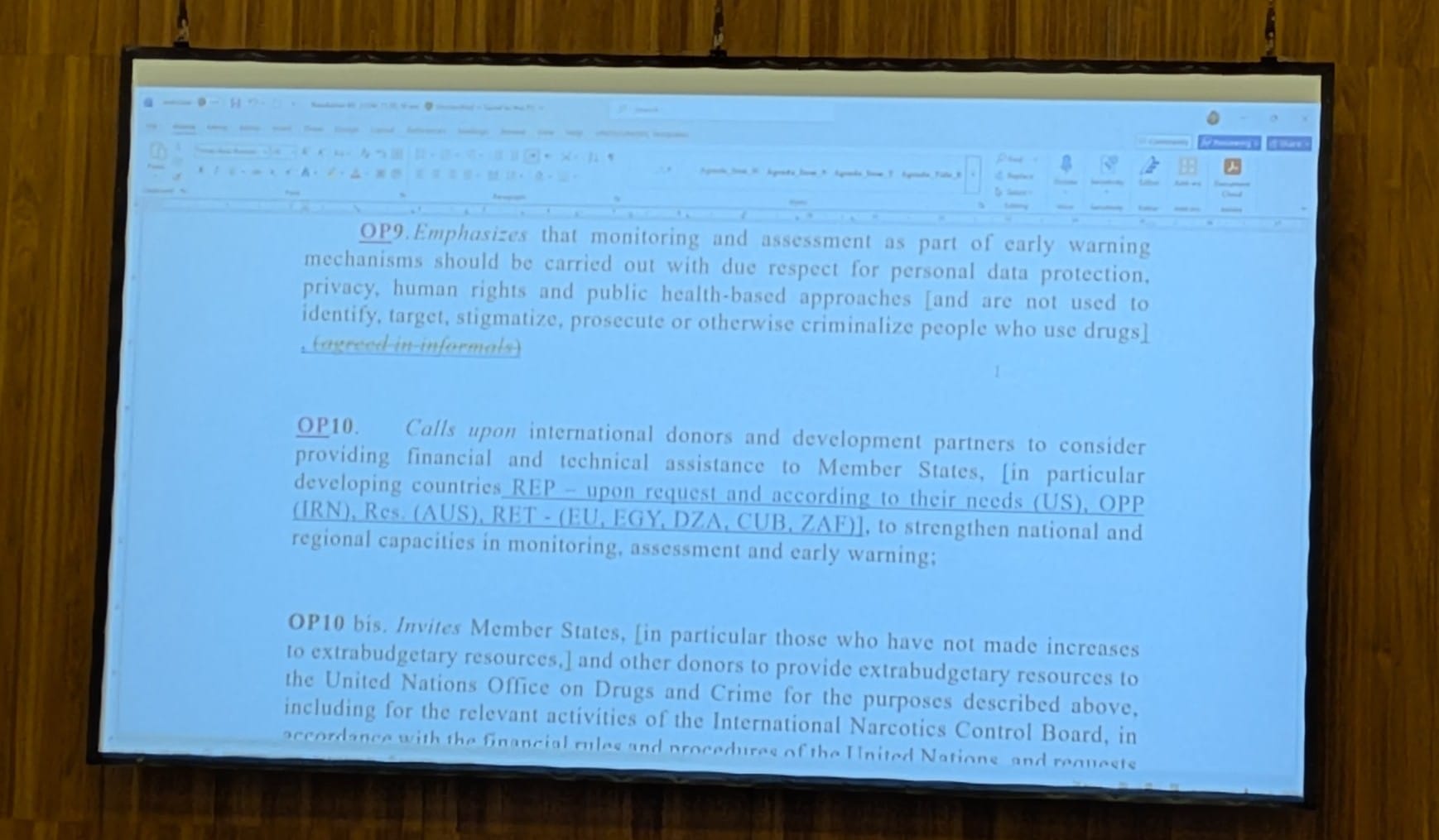
Chair: Can we lift the brackets?
USA: We didn’t have the opportunity to discuss this in informals yet so we need a bit more time.
Chair: Yesterday I made a proposal, sort of a horizontal one, that would say “invites, also with a view to broadening the donorbase” – for your consideration.
I thank the sponsors. I know you continue in informal consultations so we will figure out what can be done afterwards.
Colombia: Informals start at 12.30 – just to clarify.
L.4. Appendix to Complement the United Nations Guiding Principles on Alternative Development
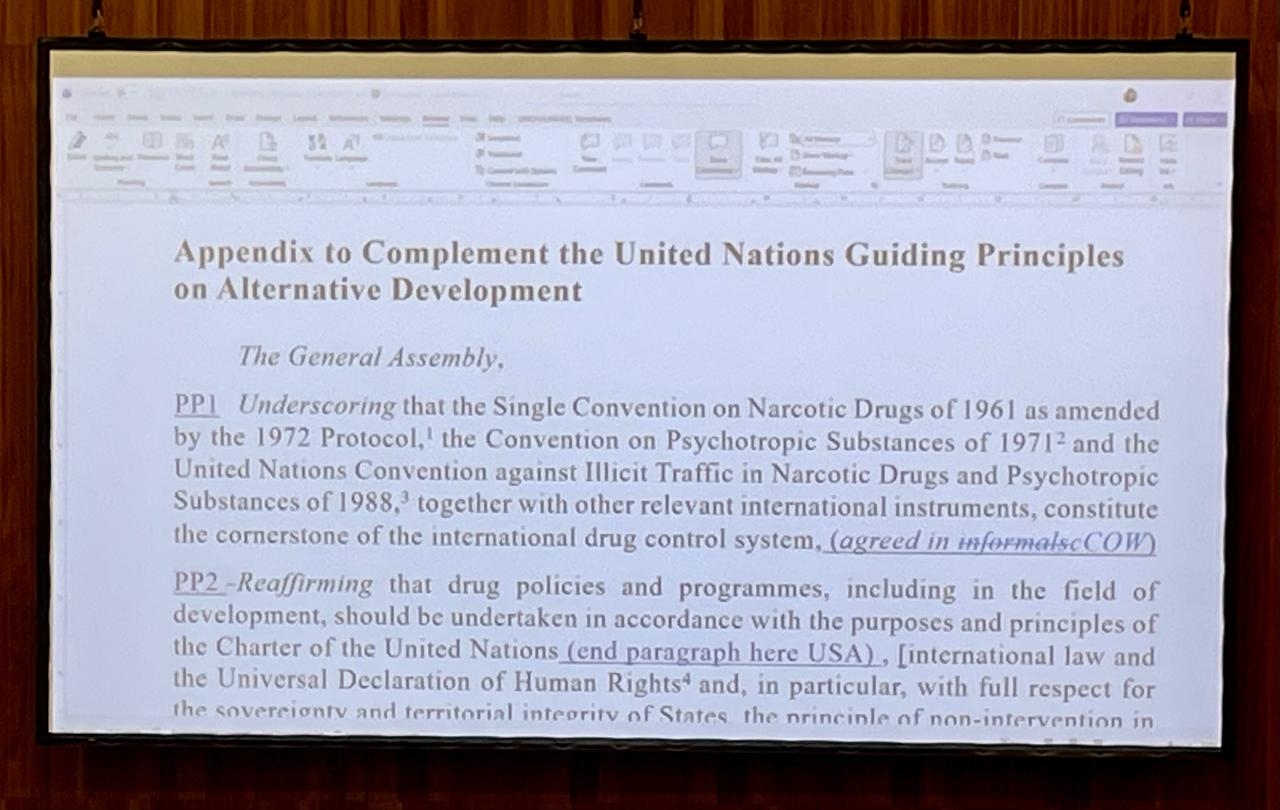
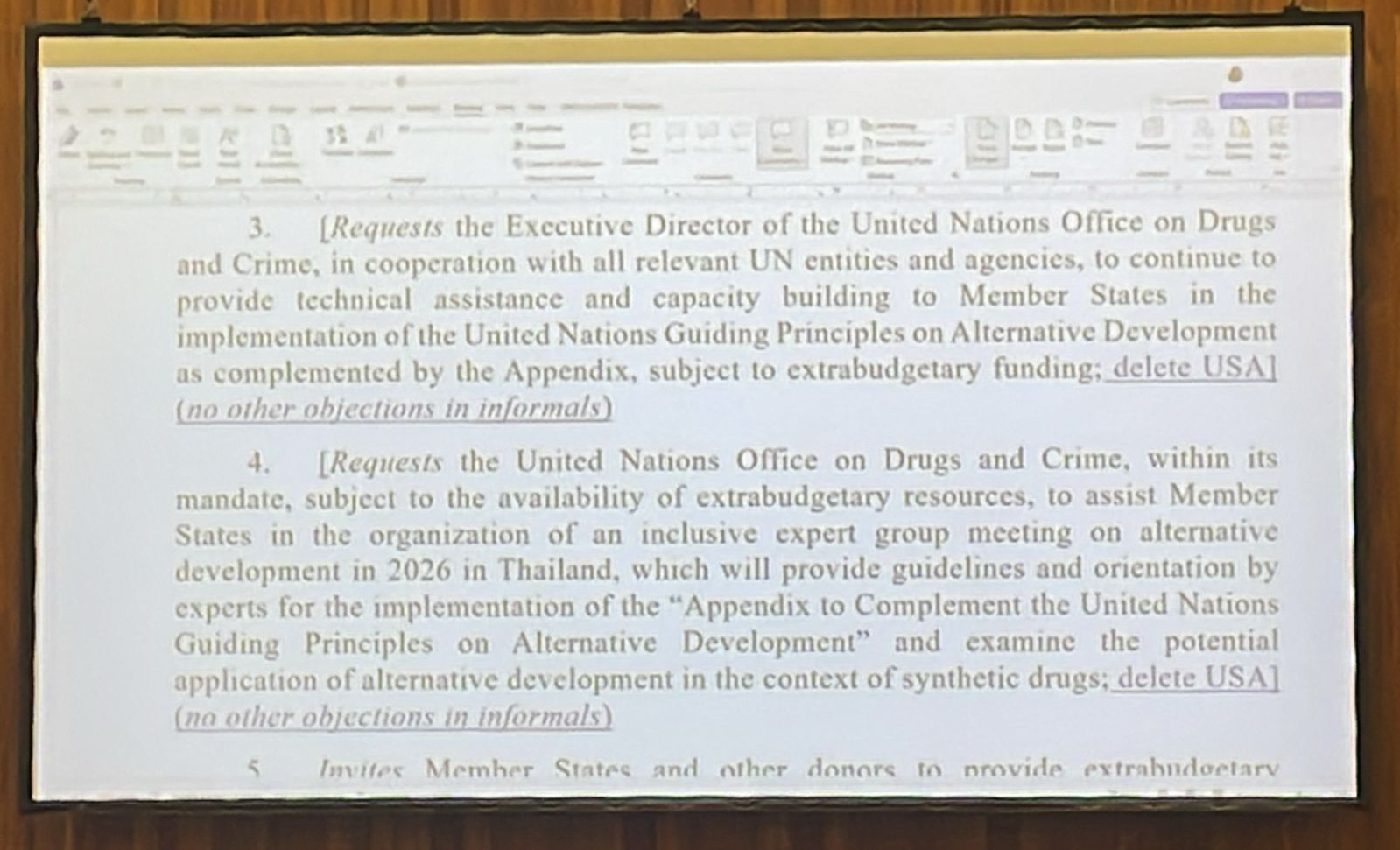
Chair: So we are ready to consider L4. I am looking at the sponsors to give us an update.
Thailand: The sponsors concluded another round on informals to secure the broadest possible consensus. Most delegations were able to agree on OP2, OP3, OP4. However, we haven’t reached further agreement on the other paragraphs. We request this draft resoltuoin to be considered in the Plenary. We have rev1. Thank you to Germany and Peru for getting there. We remain confident that the Plenary will support this resolution.
Chair: Thank you – there seems to be no further work for the Committee on this resolution then.
Russia: We appreciate the efforts of the cosponsors to bringing it as close to consensus as possible. We respect the decision to bring this resolution to the Plenary. We seek clarification on the steps that need to be taken regarding the appendix to complement the guiding principles on AD – at what stage do the sponsors intend to allow MS to participate in the discussion on this?
Thailand: Throughout the consultations, although we did not have the appendix open, the sponsors accepted comments and proposals of all delegations. We did our best to cooperate. We believe that at the EcoSoc and GA will consider it, and our work doesn’t affect that deliberation.
Germany: I can only echo Thailand – we tried to make the process as inclusive as possible.
Peru: We decided to include the issue of synthetic drugs in the resolution, even though it was not addressed in Lima last year, and we did not originally intend to. We realize this is an important issue for many delegations and needs to be addressed. I would like to recall the message I sent through you to the USA – you used to be a very strong supporter of AD in the past. We know they turned their priorities to other important issues, but there are interesting possibilities here as well that we can discuss together. This could be an opportunity to engage the current administration to reevaluate its stance.
Chair: I made a proposal to bridge the gap (…) So we pause and return at 11.30 to discuss L6.
L.6. Promoting integrated and coherent systems of scientific evidence-based public health responses to drug use
Chair: Welcome back. We agreed on some paras and so I am looking at the sponsors – what can we cosider?
Norway: Thank you to all delegates, we had a constructive informal, session we have 5 paragraphs that we are able to present and some more to maybe consider later.
PP1bis
Agreed in CoW.
PP2
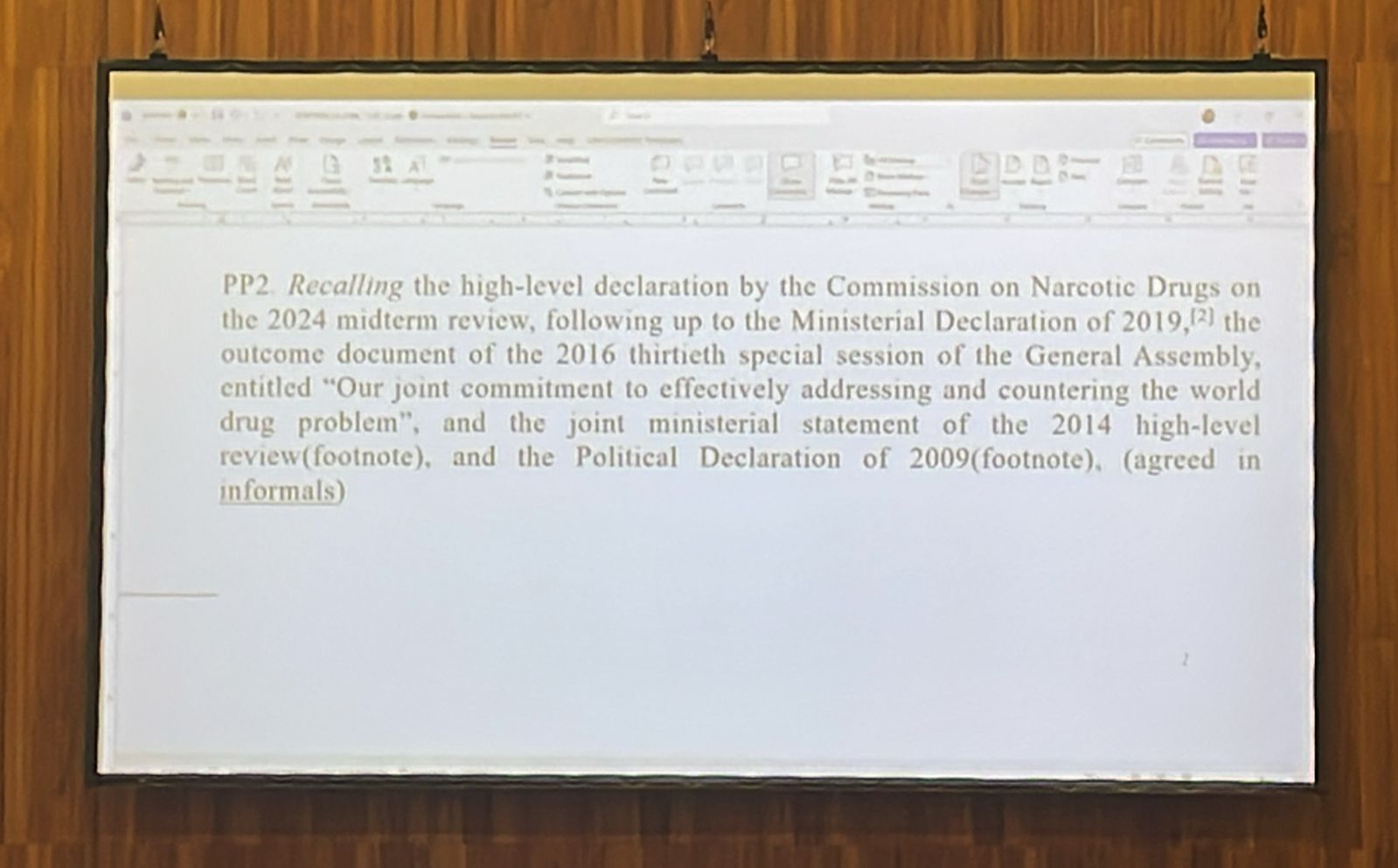
Norway: There is a little editing needed here, as indicated in the text, the insertion of footnotes.
Chair: Neither Russia nor China, and other important delegations are in the room. I would like to assume they were involved in the informal discussions so… Agreed in CoW.
PP8
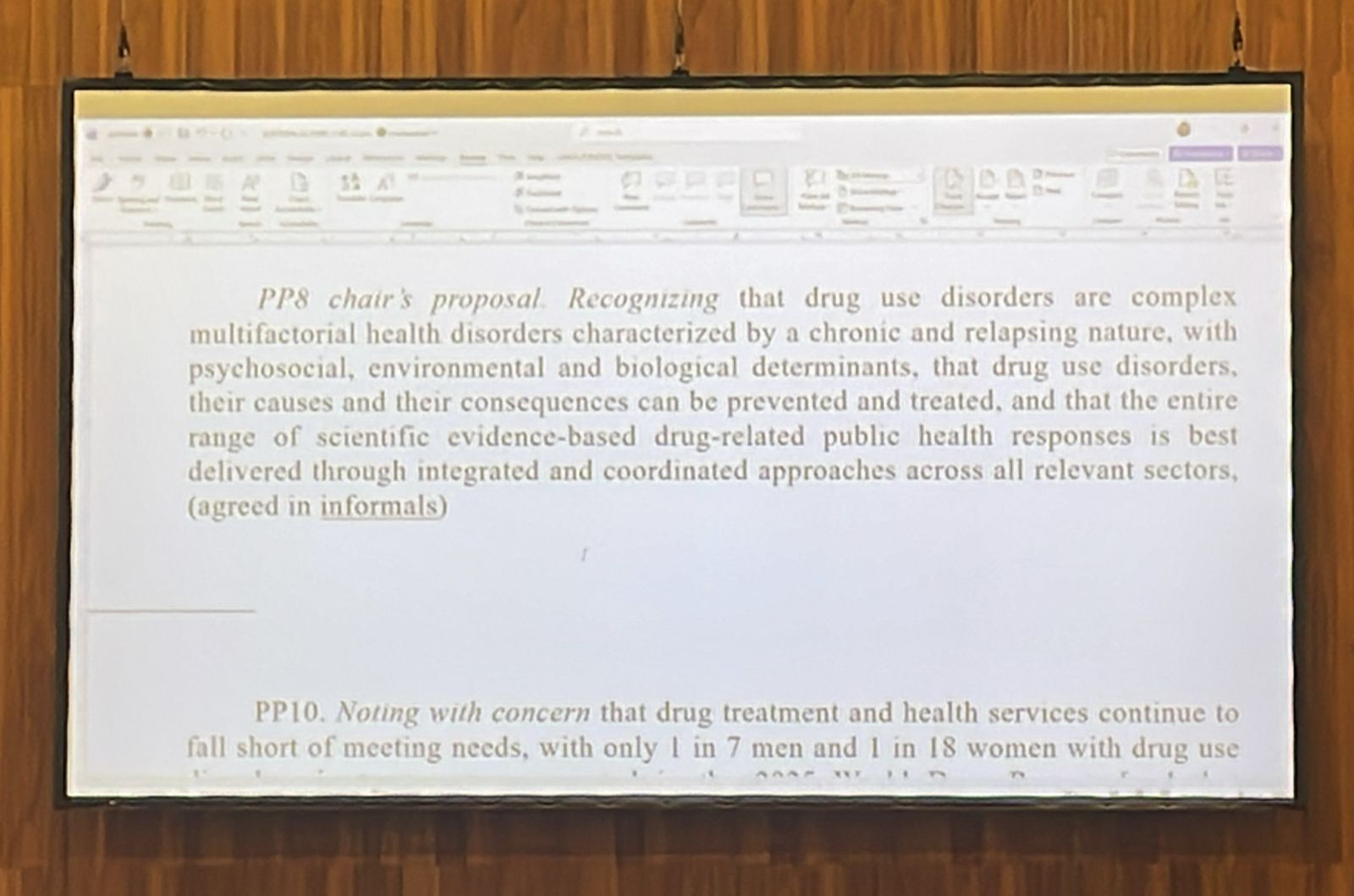
Chair: Agreed in CoW.
Norway: We can perhaps ask the Secretariat to remove the Chair´s proposal.
PP12
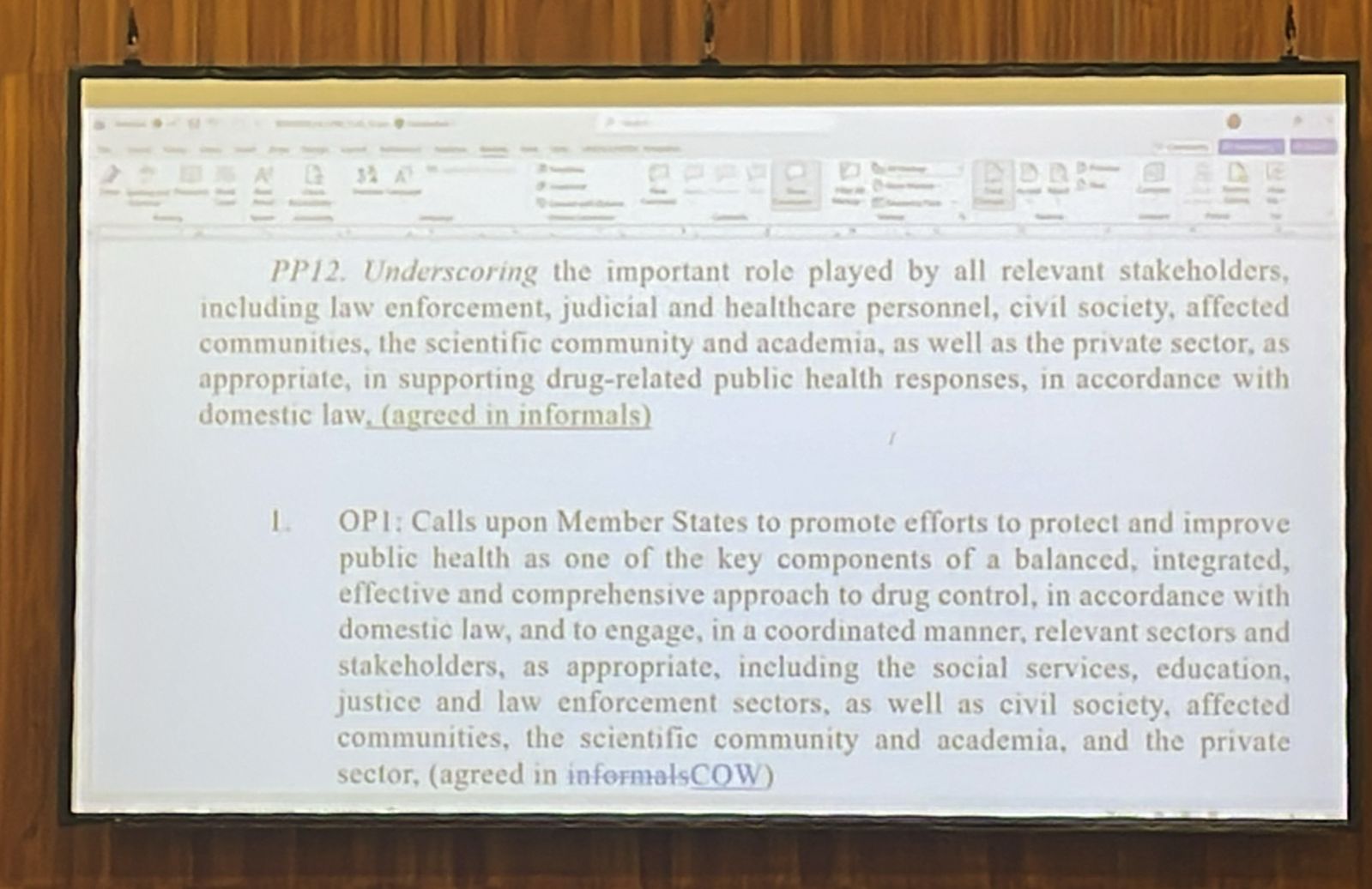
Agreed in CoW.
OP4
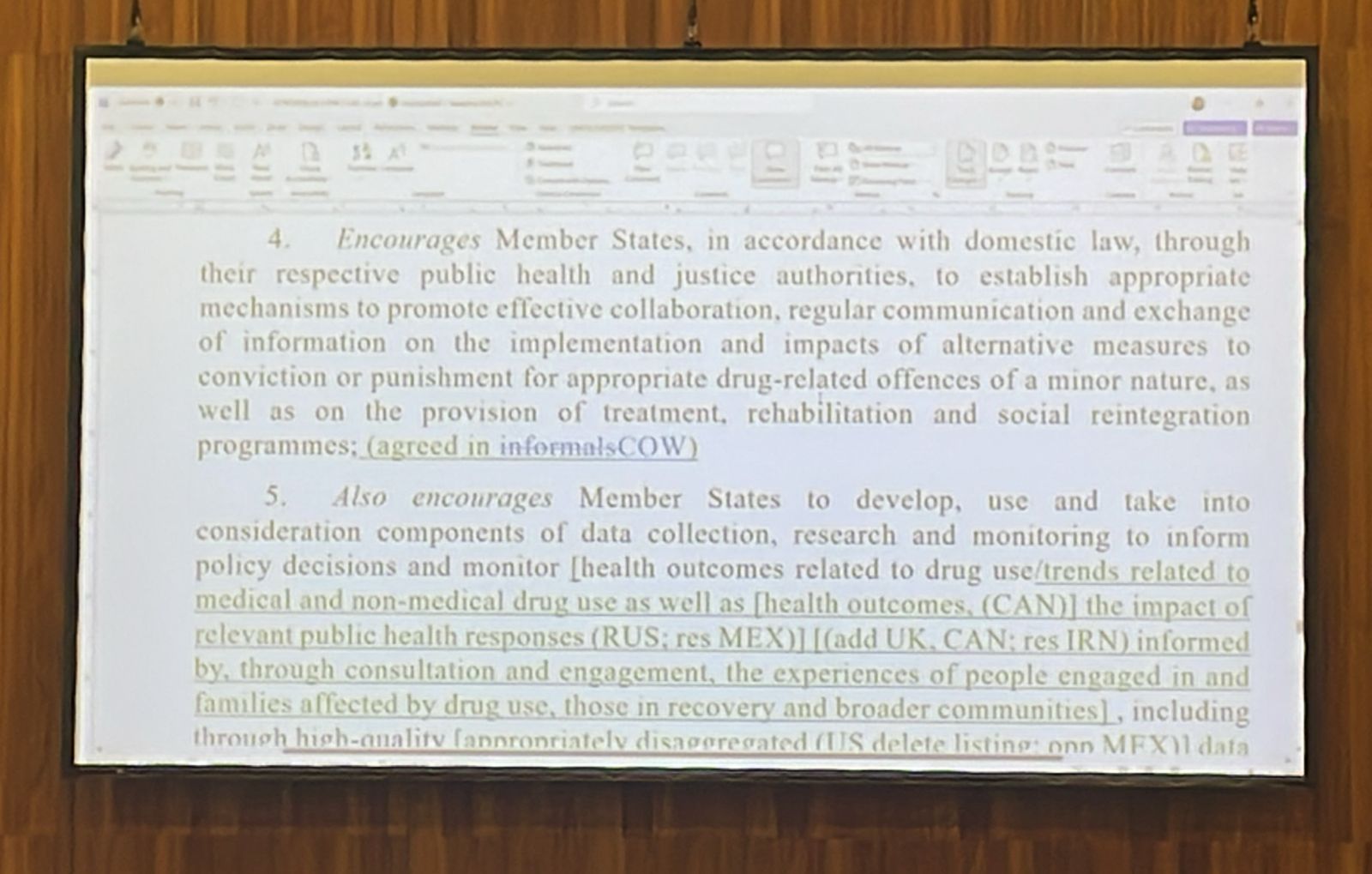
Agreed in CoW.
Norway: That concludes the list of agreed paragraphs. We have some that we think are close to agreement. Let us look at the title.
Chair: So, can we agree? I see no objections. Agreed in CoW.
Norway: We can look at the small reservations next. This depends on the delegations to be present who have reservations.
PP6bis
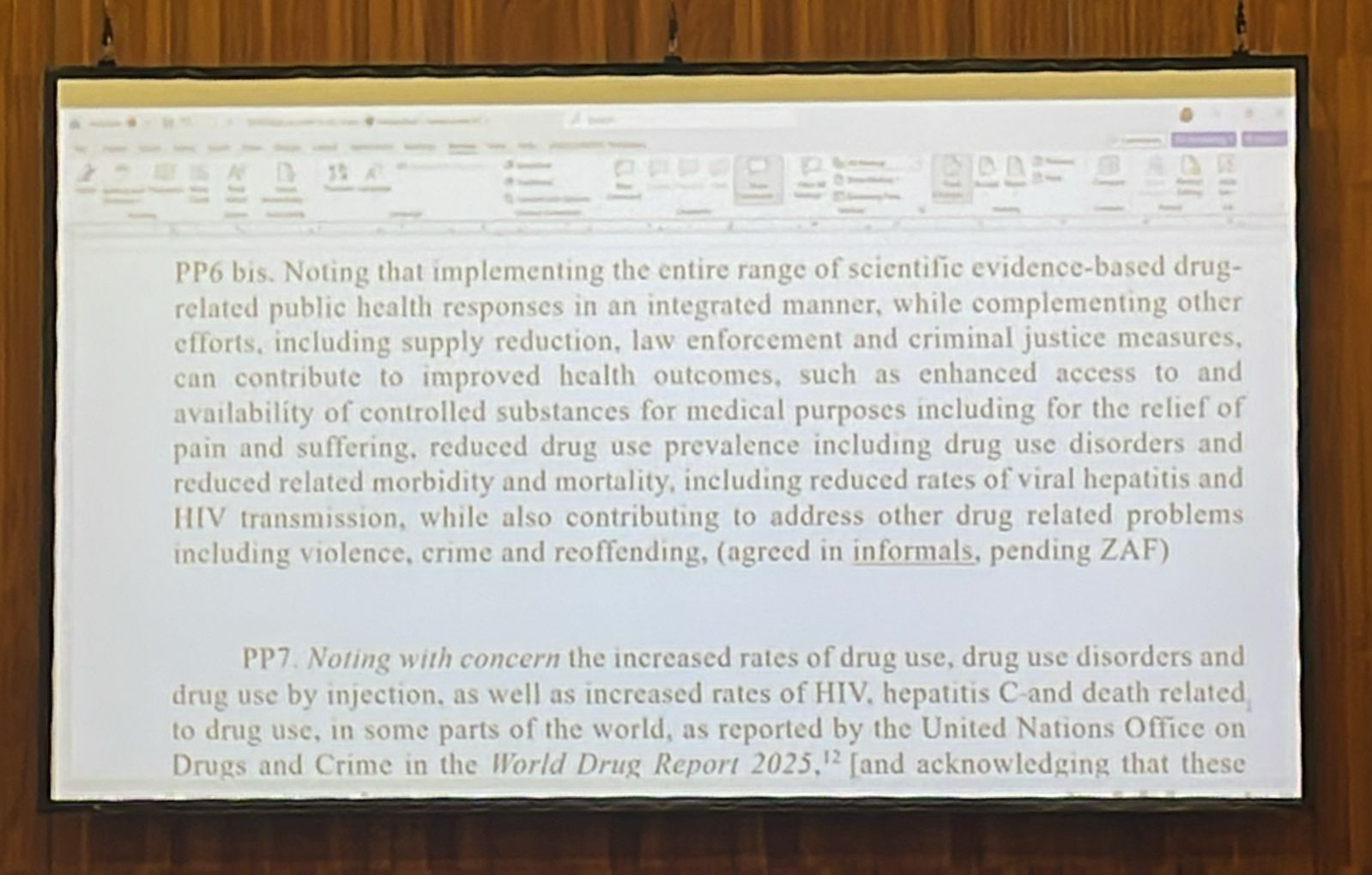
Australia: It is related to PP10 so if we can’t find a compromise there, we would remove our reservation.
Norway: Let’s look at this later, there are other reservations we are considering.
OP5
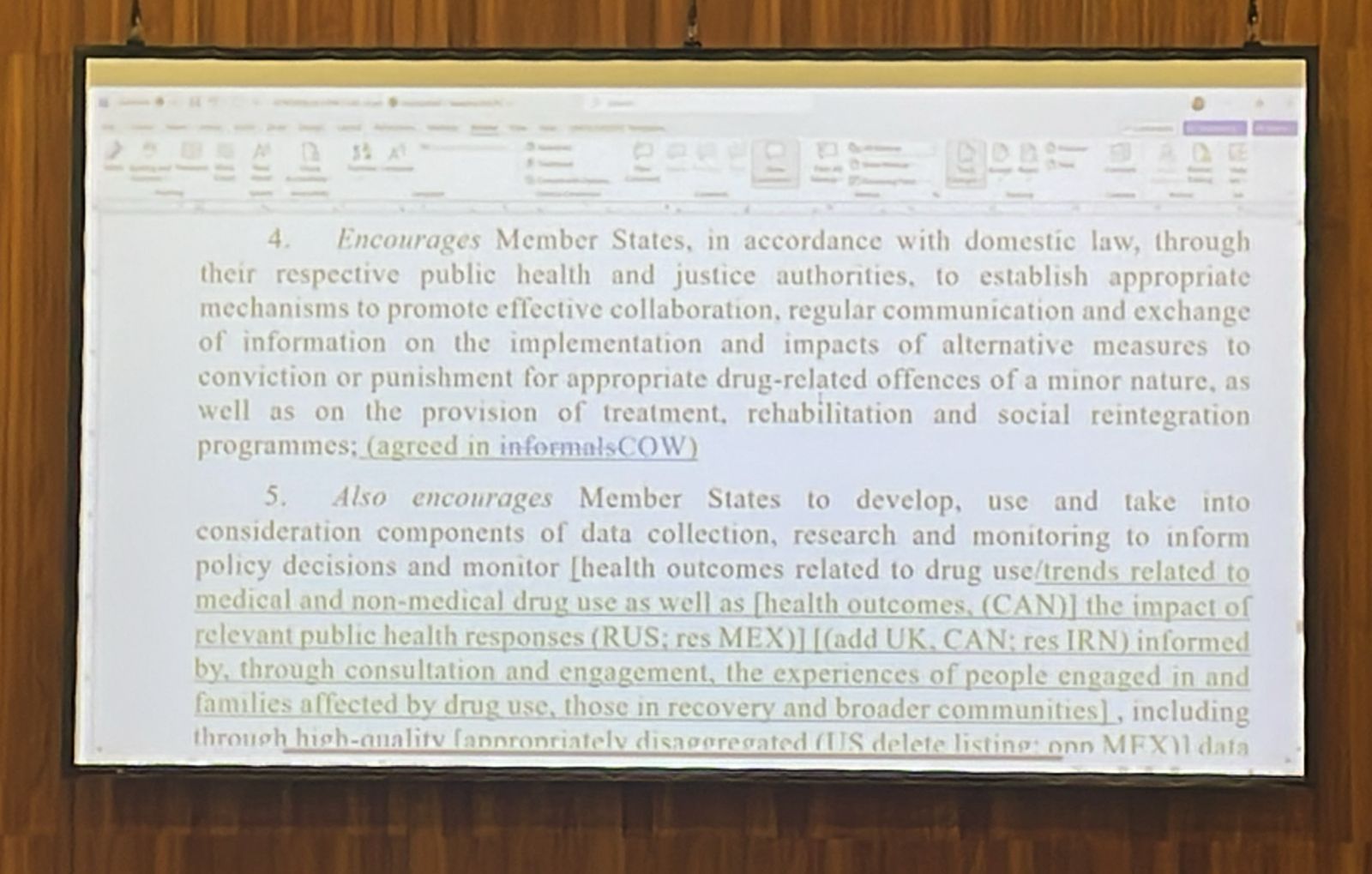
Norway: We suggest removing “gender” after “sex”, pending Uruguay – see picture.
Chair: Is Uruguay in the room? Appears, as not. So this is the only thing pending agreement in CoW. They were not in the consultations, as I understand. It is indeed a bit awkward to lift this without the party present. So let us wait until noon and give them the chance.
Norway: I believe they were in agreement to lift the brackets. We suggest to make the amendments as we understand and agree on it pending Uruguay.
Chair: Yes. I agree. I believe there are efforts on the way to get Uruguay to the room. Oh here she is!
Norway: We would just remove “gender” from the sentence.
Uruguay: Apologize for not being in the room, we are very little people. But yeah, we can lift our reservation.
Chair: Wonderful. Let this be an example to you all.
(laughter)
Canada: We reserve our reservation.
Colombia: After discussion, we want to retain this as well. We understand the process of negotiation so in a show of flexibility, we are willing to lift the reservation.
Netherlands: I understand the position of MS who put reservations here, and I would like to explain why we lifted ours – of course, gender is important, but in this specific OP, we feel that gender could be interpreted under other relevant factors. Another reason is that most countries seem to collect data on sex rather than gender. Third, gender is mentioned elsewhere in this resolution. That is why we are okay with no reservations specifically here.
Chair: Thank you.
Canada: We had many discussions on segregated data over the years. For us, it is highly relevant. Appreciating the work and the recent comments, we can make a compromise – retain references elsewhere to gender and say here “high-quality segregated data”.
New Zeland: We would also like to retain references to gender but in the spirit of compromise, we can go with Canada’s suggestion.
Chair: Can we all live with the proposal of Canada? Seems we have an other para cleared.
Norway: Delete old OP5 so no confusion. We have a few other paras that we maybe can see if find agreement.
PP1 ter.
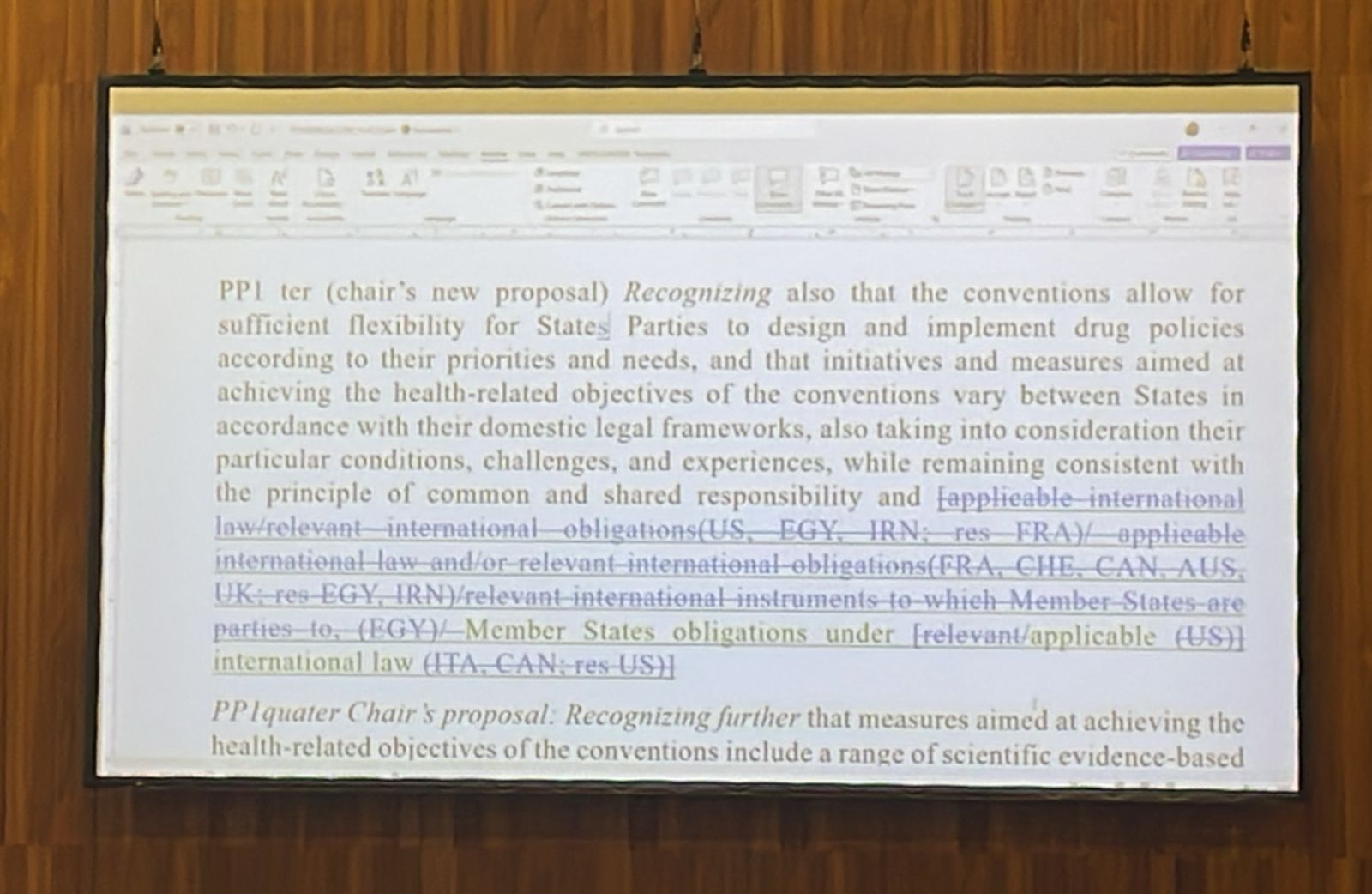
Norway: Considering the last proposal from Italy (…)
Chair: Thank you.
Egypt: We can go along with this. We don’t find it neat, we are talking about the applicability of obligations while the issue of relevancy is missing which is a legal concern, but we will not stop the consensus.
USA: We had reserved on this latest formulation. We can remove that reservation. We support the Egyptian proposal if that is more acceptable.
Chair: Can we live with “relevant”?
Canada: Our preference is “applicable” in the sense that “relevant” can be read as some international law is less relevant or irrelevant.
Chair: Something to think about during lunch. Thank you.
PP7
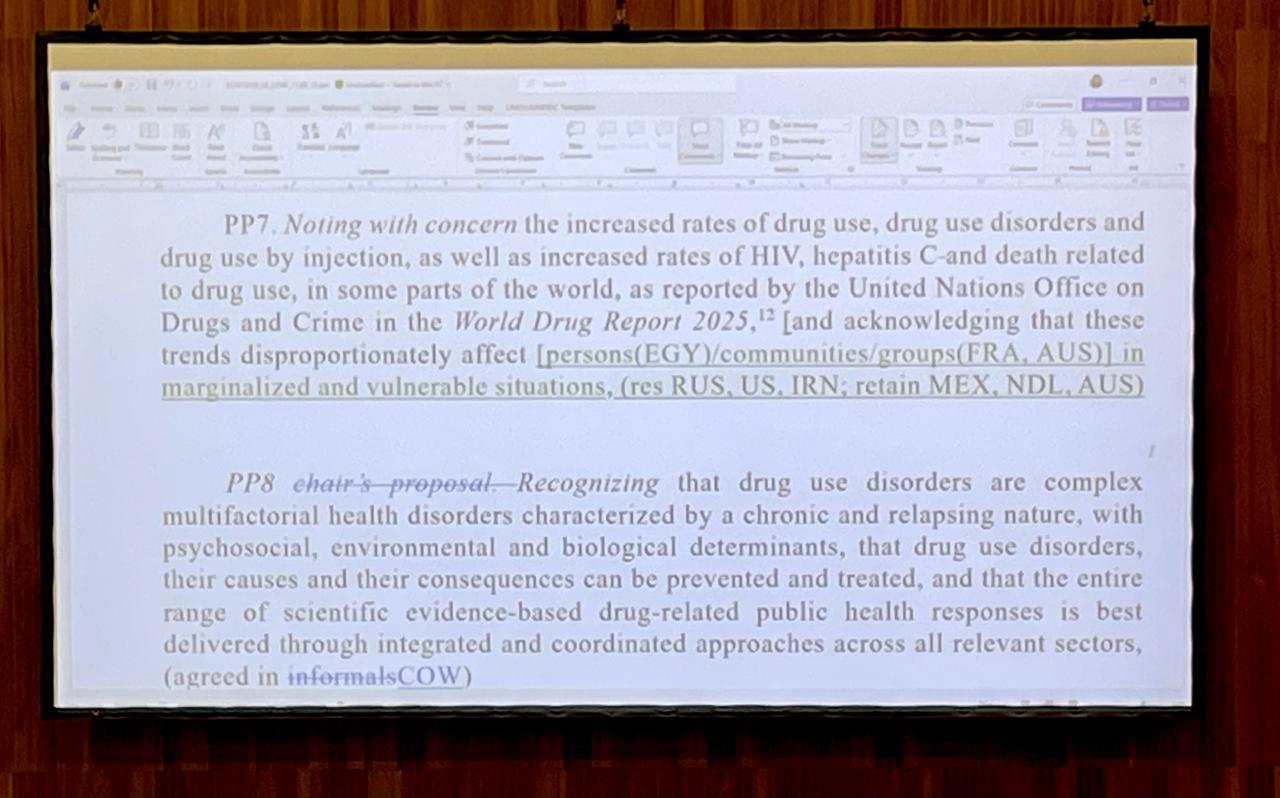
Norway: A reference to data from WDR in the 4th line – we have no issue with this proposal. The last sentence saw some more discussions, and in our opinion, we have two options – pick the best or keep them all.
Egypt: We are not in a position to accept this formulation. We would like to see “persons in vulnerable situations” as is the agreed language.
Chair: Is there a way forward, Norway?
Norway: Yes, this is a good option to consider.
USA: One of our problems is that there is no universal understanding of vulnerability. We don’t fully understand what is meant by the sentence on the screen and we are not in a position to go along with it.
Russia: We also reserve our position here. We haven’t found any evidence related to these trends in the WDR (World Drug Report), and we don’t want to create evidence via a resolution. We can work on a softer language. Our preference would be “vulnerable members of society” as is worded in the UNGASS document. This would not require a definition of vulnerable.
USA: We need more time to discuss this. We acknowledge the language, but our concern is with the concept, not the phrasing.
Egypt:
Iran: We need more time. Our preference is to end the paragraph after the mention of WDR (World Drug Report).
Norway: The proposal from Iran can be considered by the CoW to see if this is a solution.
Chair: Great. Agreed. What can we consider next?
OP5bis
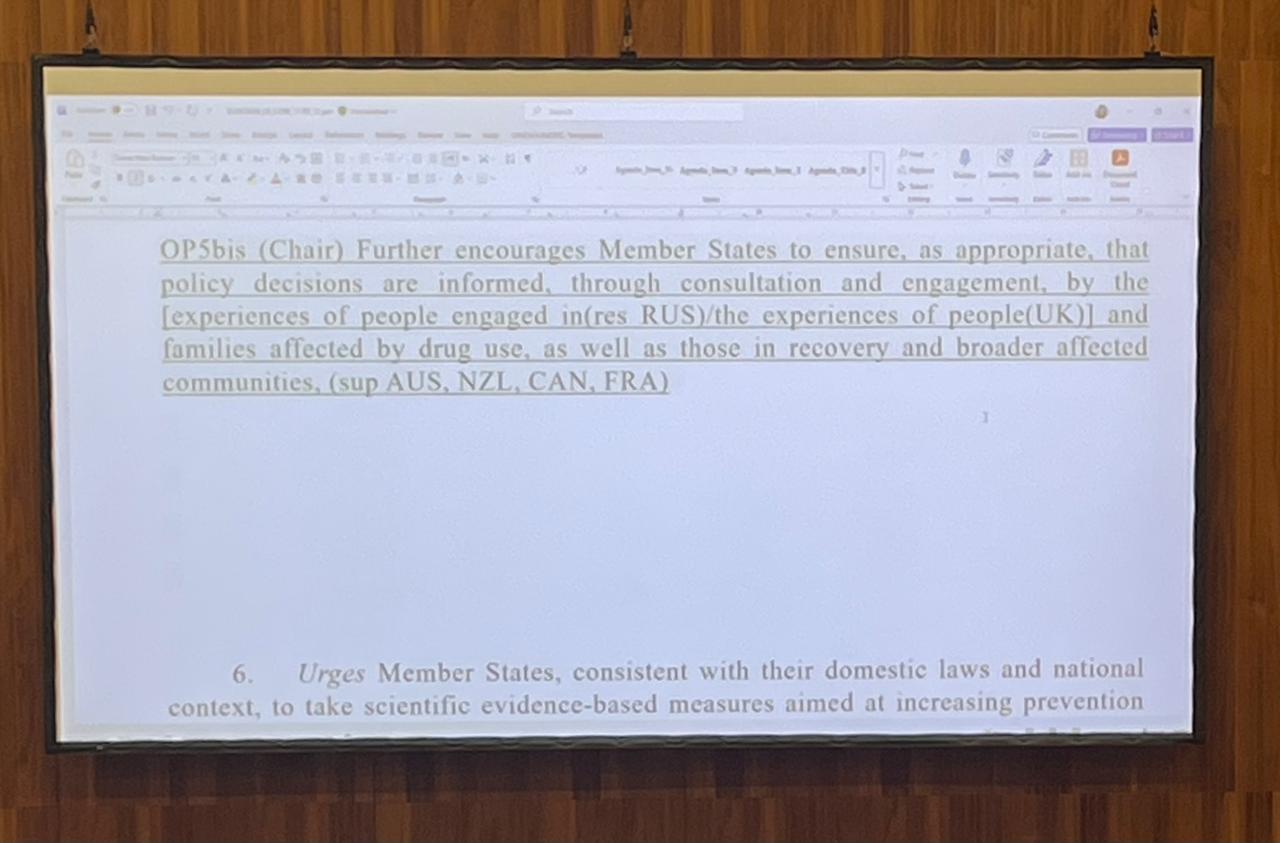
Norway: This was a proposal from the UK, which we see on the screen, and we can lift the brackets.
Chair: Great. “..engagement by the experiences of people and families affected by drug use…”
Russia: We do not understand whether we are talking about experiences, engagement, or consultation of these people; the formulation is not clear, and we need to consider how it can be applicable in our national context.
Chair: Seems clear to me.
Norway: It was a UK proposal, so if they are in the room, that would be the best option.
Chair: We are looking desperately for a Brit.
Chile: Could we propose “further encourages MS that policy decisions are informed through consultation, as appropriate, with affected communities, including families and people in recovery.
Chair: Okay. This introduces some new concepts, but what can come to a consensus?
USA: We can support the text as is on the screen. There may be another issue; however, this is far too broad and has little connection to the title. Proposal: “…policy decision relating to the development and delivery of the entire range of scientific evidence based-drug -related public health responses…”
Chair: Feels like we are going downhill. The US proposal is useful to point out what it is aimed at. Can we agree? Seems to be the case. Agreed in CoW. Thank you, Chile.
Norway: We run out of paragraphs that are close to agreement. I wonder if it would be useful to consider a conceptual issue that has been mentioned in informals repeatedly… is there time available for that?
Chair: Excellent idea. The spirit in the room is excellent, so lets try toclear up situations.
PP1
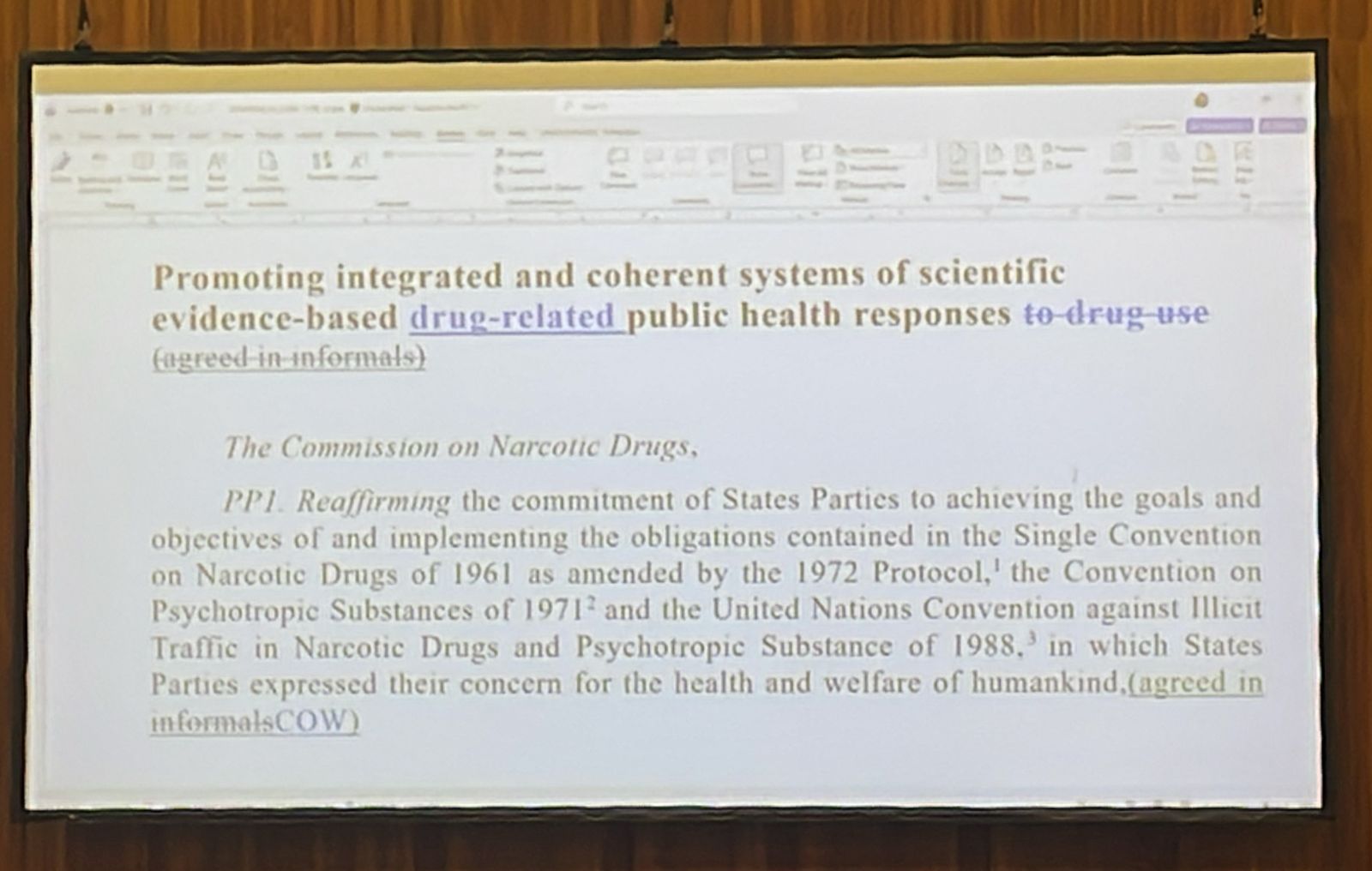
Norway: We are establishing what this phrasing of drug-related health responses means. We don’t have to repeat the negotiation; the disagreement is whether we should use “initiatives… health and social consequences of the nonmedical use of …” or “harm reduction” or keep the phrase but reference that in many states it is known as, or is called, harm reduction.
Chair: Yes, this is a well-known debate. There were resolutions or a resolution adopted by CND in the past on harm reduction. I am not an expert, but would like to recall that we have dealt with this question before. So just a word of caution that we dont have to refight an old battle.
Norway: Yes, that would be Resolution 67/4 and is in the UNGASS 2016 language. This resolution was not adopted by consensus, however.
USA: As the main sponsor of 67/4 I have to object that it is a resolution of harm reduction, it was on overdose prevention, and it is not an overall acknowledgement by CND of this term, and it was not an approval by CND on harm reduction. We agreed on responding to overdoses.
Chair: Thank you for the clarification on our history.
Russia: I emphasize that the resolution was a nonconsensual resolution; my country voted against it. We believe that a middle ground would be using language from policy documents, and we would like to not have a debate about (…). This broadens the scope and cannot be linked to the previous resolution that was about countering overdoses. From a practical perspective, this language allows MS to implement all practices so we don’t see why we should phrase it differently. This is more of an ideological discussion, and the resolution should help national authorities… This work has nothing to do with that.
Chair: Thank you for the clear statement. I look at the sponsors – it is quite clear there will be no consensus on introducing harm reduction.
Czechia: Even though I agree that the resolution 67/4 was on overdose, the paragraphs in which harm reduction is mentioned talk about measures to effectively address public health threats by nonmedical and nonscientific drug-related harms, including overdose. So it is not only referring to overdose.
Chair: Thank you for that further clarification, but that does not change the conclusion (on the lack of consensus). I think we brought it as far as we can, so I look at the sponsors for next steps. We have half an hour left, let’s try to crack some other nuts? Or do you prefer to do it in informal consultations?
Norway: Thank you to everyone. We strive for consensus on all paragraphs and the mentioned concepts. We could try to go further….
PP10 bis
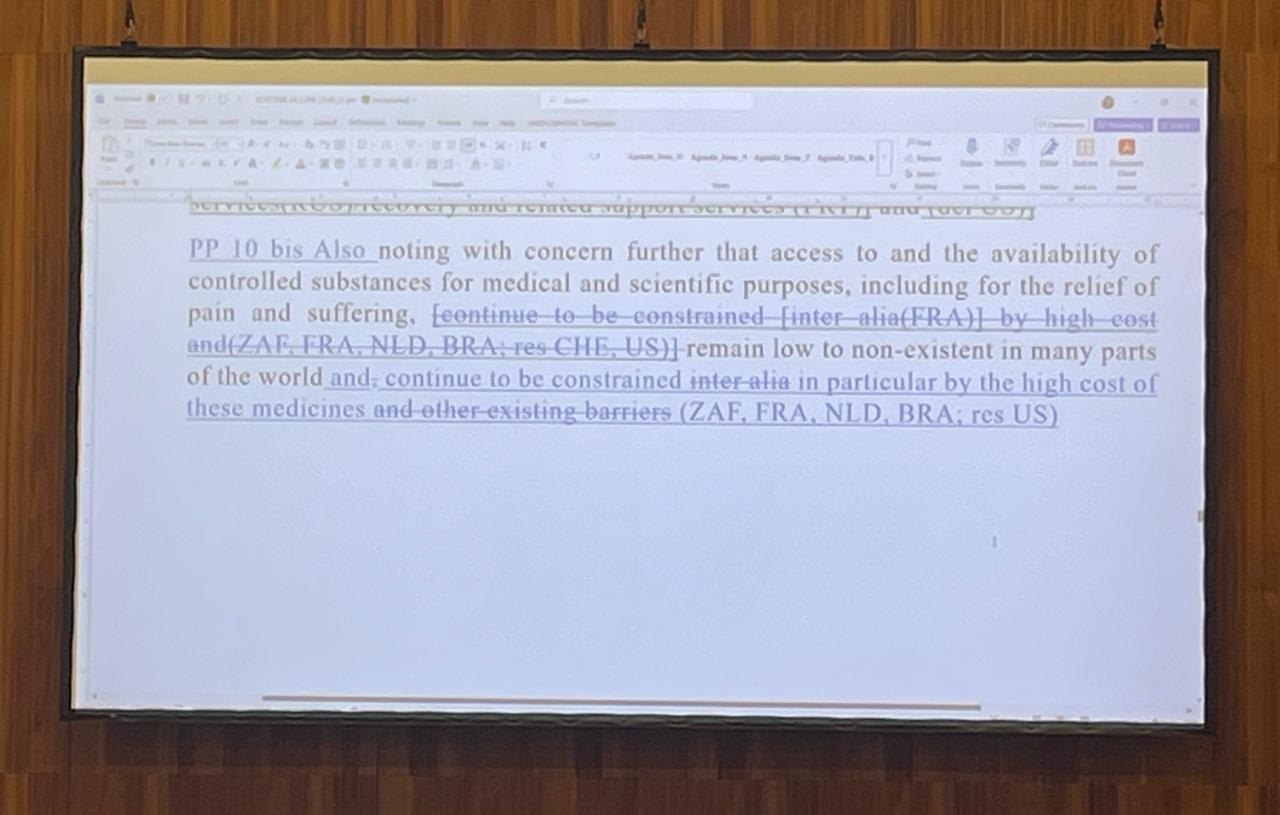
Norway: We are on a common quest to find the best formulation.
Chair: Can we accept the notion of “stigmatizing attitudes”? Seems to be the case, so we remove the bracket?
USA: We are not comfortable with the text beginning with “And that..” because there are many factors contributing to the low statistics of people needing treatment. We acknowledge that there are many factors but to highlight only a few of them would be inappropriate.
Iran: Concerning “multiple and intersecting forms” – this is very new to us. Are we narrowing down the scope of discrimination? We need more time to consider the text.
Colombia: A good way out for us would be to develop the issues around discrimination. The WDR made emphasis on several factors, actually, mainly socioeconomic issues that we talked about in informals. We think we have to go further than just noting WDR. We have to take into account its findings. That is the whole point. We would like to retain the paragraph as is, and we can engage in further formulation.
Chair: Understandable. I don’t see how we can move forward through… One last try on my part is: point into other factors that are more generic, like societal factors…
Norway: This issue of stigmatizing attitudes is a recurring topic, and my sense is that it has been given up in many paragraphs but has to be kept in the resolution as a whole, and the sponsors agree. To go along with your approach, we can say “socio-economic factors such as stigmatizing attitude and discrimination, …” If I understand correctly, the reservation at the end was not lifted… the USA suggested to split it into another paragraphs which we think could be a good way forward, but resolutions need to be lifted first.
Colombia: For us, it is not acceptable. Stigma and discrimination are not only societal factors. There are different forms of discrimination that don’t fit into these factors, and that is why we were working on developing the wording. We heard the rationale that this is being taken into consideration in other parts of the resolution, but those are still open. We are open to finding agreement on those, but this, as it is, for us is fundamental to keep.
USA: We are generally not comfortable with speculating on the disparity. We can reference what could be done to address the disparity and “note the importance of promoting nonstigmatizing attitudes in the delivery of relevant services as well as the training of professionals and enhancing service capacity in order to increase access to treatment.”
Chair: Thank you for trying to bridge the gap.
Norway: We are down to two MS reservations.
Belgium: “including for the relief of pain and suffering (…) and continues to be constrained inter alia by many existing barriers, among which high cost of these medicines.”
Australia: Thank you to all delegations. We support the new formulation.
Switzerland: You can lift our reservation. We had similar concerns as Belgium, we need to stress that there are other barriers. We can otherwise go with the previous formulation inter alia.
South Africa: Thank you to all colleagues. I want to highlight the concerns about the cost of medicine – this is highly relevant to developing countries. And in 2024 we have removed reference to developing countries and changed it to “all over the world” but concerns regarding medicines… you need to have finance and medicine that people can afford. In many developing countries, medicine is the last priority. We need to be aware how important affordable medication is. I appreciate the formulation on the screen, but when we look at the WDR, high cost has been highlighted… I understand how the formulation works but I would prefer to name “…what…” first. If the room is agreeable, we can lift our reservation.
Chair: I understand.
Belgium: Maybe we can reformulate as “continued to be constrained by the high cost of these medicines and other existing barriers”.
South Africa: We can accept. Thank you.
USA: We need to retain our reservation for the time being. We prefer the “inter alia” phrasing. We refer to the barriers in other paragraphs of the resolution so we don’t see it necessary here. We can discuss this but we cannot agree.
France: As a novel suggestion, can we use “in particular”?
Iran: A minor amendment – at the end of the para we refer to medicines, we would prefer “substances”.
Chair: Is the USA comfortable taking this to their Capitol? I see a yes.
Belgium: We are uneasy with “in particular” as it refers to one of the barriers, but in all other languages, we highlight many barriers. So we could be comfortable with “…as one of the barriers…”. I know this is not a solution, I heard what the colleague from South Africa is saying, I am just trying to reformulate… I would prefer to keep “barriers” in this paragraph.
Chair: You could say “prime among the barriers”
France: “… among our existing barriers”
Chair: We might have found a way out. I suggest everyone look at this.
Norway: Thank you.
PP6alt
Norway: We have an alternative that works USA and AUS suggestion into the text. “Urges MS to take scientific evidence based measures aimed at reducing risk factors and enhancing protective factors against illicit drug use”
Iran: “illicit use of drugs”
Iran: for 6alt bis we need more time and are ready to discuss in informals.
Russia: We can go along with this, but would like to strengthen the statement by adding “preventing and reducing risks”.
Chair: The charm of logic! With this, we break for lunch. You have earned some sunshine. See you at 3pm.