L.6. Promoting integrated and coherent systems of scientific evidence-based public health responses to drug use
Chair: Informal discussions this morning on a number of resolutions. We will continue until 5:45pm, so that I can discuss with the sponsors during the last 15 minutes. Tomorrow morning, we will suspend our work during the CND’s votes on decisions. CoW works in English with no interpretation. It is my firm intention to wrap it up Thursday at 5pm. Resolutions not resolved will go to the Plenary as they stand. As I speak, informal consultations are going on. Sponsors of the resolution can request them during the day in the M building and evening in the C building. If you plan to submit formal documents, such as amendments, please contact the Secretariat. This evening after we have congregated with the sponsors, we will inform you of informals tomorrow. The CoW will resume tomorrow, Tuesday, at 3pm. There is a whole morning available for sponsors to consult. As agreed last week, we will start deliberations this afternoon with draft resolution L.6. I invite Norway to tell me where we are.
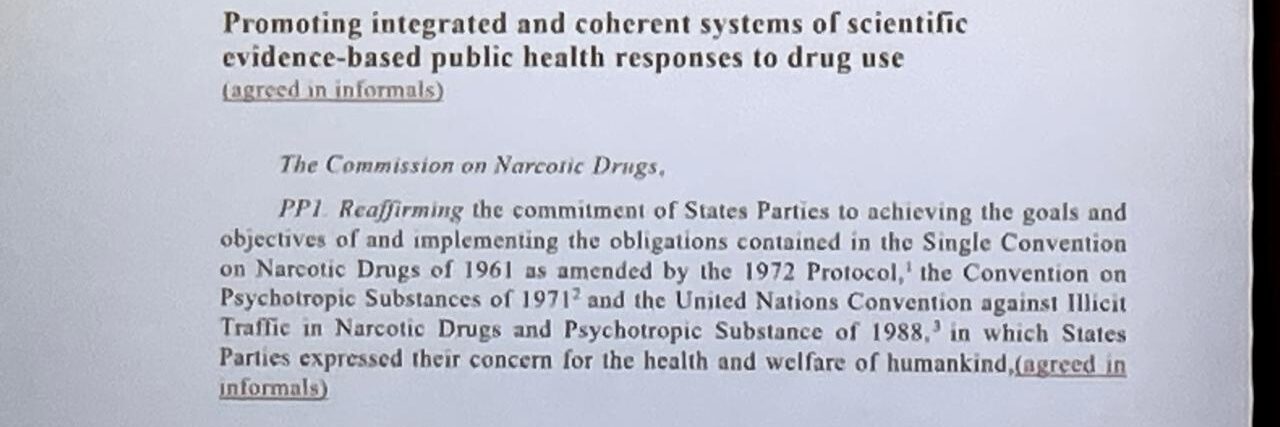
Norway: We had informals this morning and had very constructive engagement from all delegates. We agreed to an additional paragraph this morning and have a few others that are close to agreement. Let’s start with the title, which has been agreed upon in informals.
Title
Chair: Can we gavel it in?
Russia: We thank the cosponsors for the constructive process. After consultations with the expert in the Ministry of Health, we want to propose the following amendment before ‘public health’: ‘drug-related public health responses’. There is no unanimous understanding of what ‘drug use’ means, which is why ‘drug-related’ is more comprehensive. Please delete ‘to drug use’ at the end of the current title.
Norway: Interesting and constructive proposal. We would like to hear how others respond to this. We have had discussions on different terminology.
Chair: This is a new text, so I suggest we take it as it is and you think about it, and we discuss further tomorrow. Next paragraph to address?
Colombia: We would highlight that it’s not the same to say ‘drug-related’ because the responses are not just ‘drug-related’ but some refer to the general wellbeing of the population. We prefer the original title.
Chair: Not agreed, so I leave it to sponsors to consider alternatives.
Australia: We want to point out how the text now uses different terminology so we introduce a reservation on the change suggested by Russia.
PP1
Norway: This paragraph was agreed in informals.
Chair: Agreed? Agreed.
PP12

Norway: This paragraph was agreed in informals.
Chair: Agree?
Russia: In line with our comment on the title, we propose here also to introduce ‘drug-related public health responses’ instead of ‘responses to drug use’. We believe it’s a broad formulation and actually when some delegations say that the scope of the resolution is broader than ‘drug related public health responses’ that CND could deal with, we remind other delegations that we are at the CND and this is the Commission’s mandate.
Norway: Keeping in mind the earlier comments in response to the same amendment, perhaps this is best to discuss in informals.
Chair: Agree. Next paragraph.
OP1
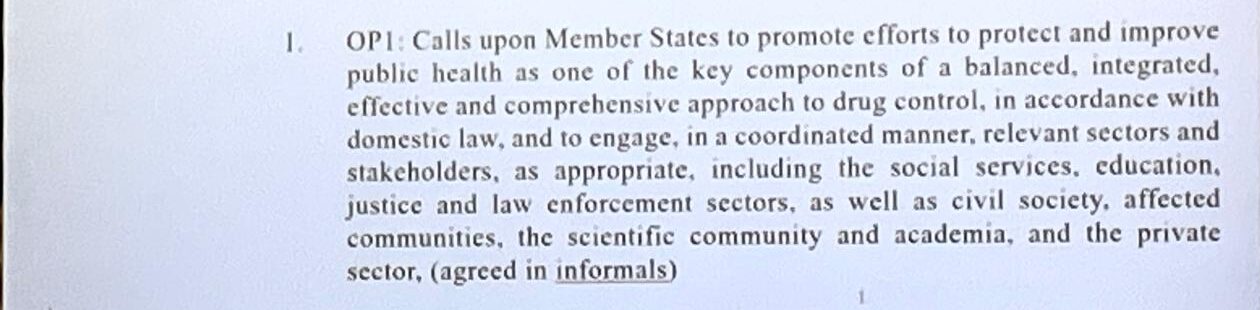
Norway: It was agreed in informals.
Chair: Can we uphold that informal agreement? It is so decided.
OP2bis
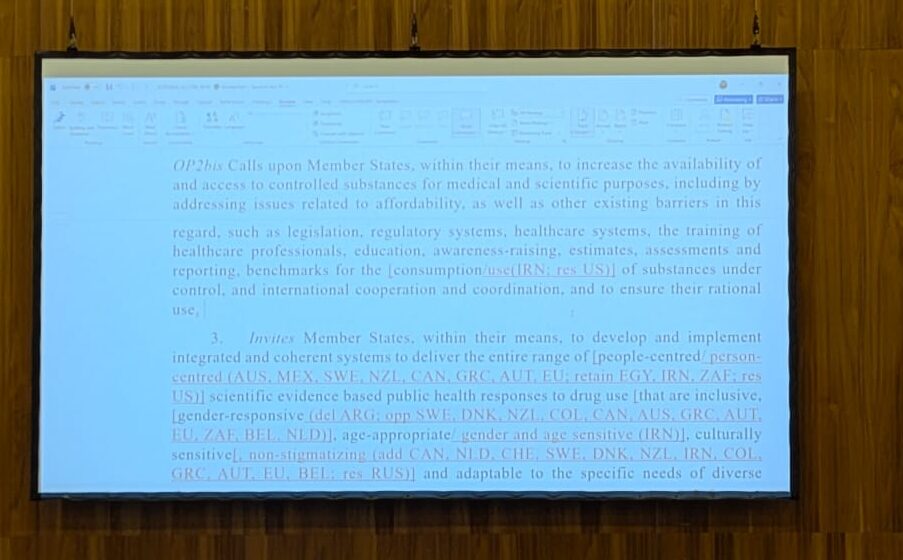
Norway: Not yet agreed in informals but just one proposal made, which is why through you we ask the delegate of Iran, so that we can keep ‘consumption’.
Iran: We believe ‘use’ makes better sense and it’s more in agreement with the resolution but we can be flexible.
Chair: Agreed at referendum in the CoW? Yes.
OP9
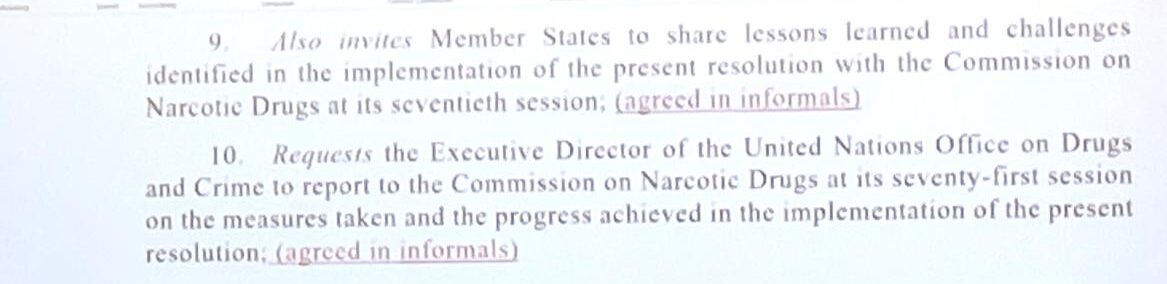
Chair: Agreed in informals — does that agreement still stand? Yes, agreed in CoW.
OP10
Chair: Agreed in informals — does that agreement still stand? Yes, agreed in CoW. Any other where we can give this resolution 6 minutes?
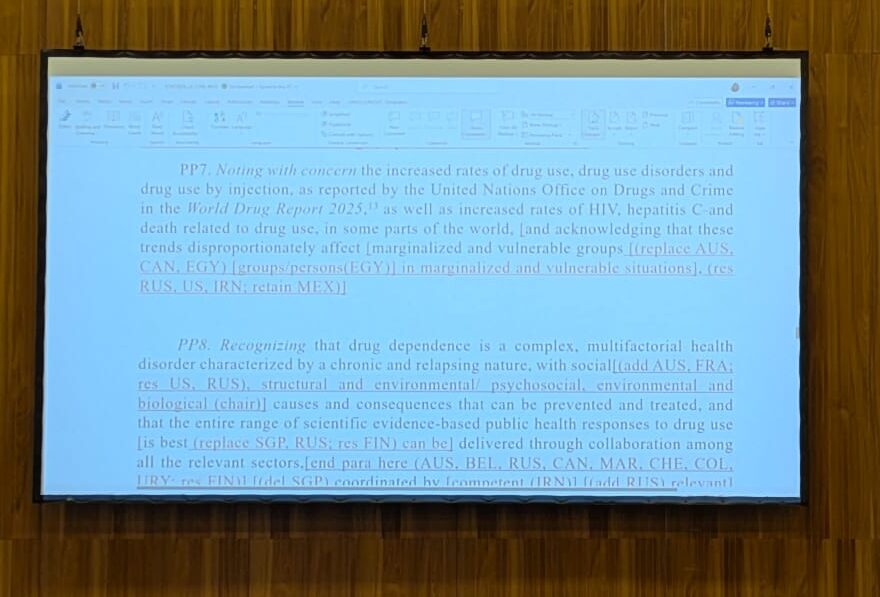
PP7
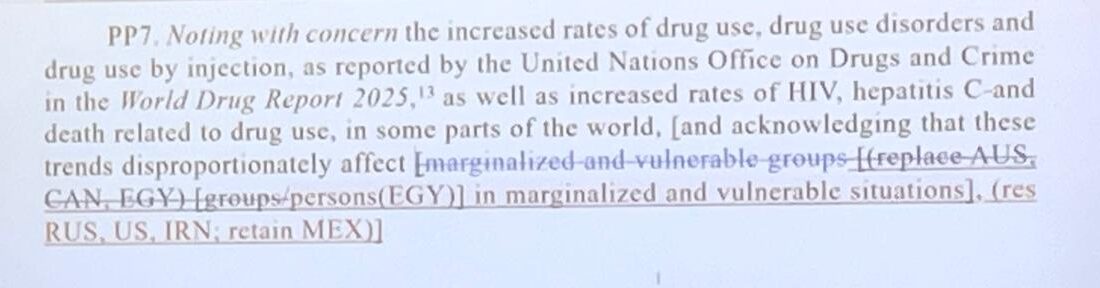
Norway: We’re very close to agreement. Could we use Egypt’s proposal, which reads: ‘Acknowledging that these trends disproportionately affect persons in marginalized and vulnerable situations’?
United States: We would need to retain our reservation on his language.
Chair: For my own curiosity, what is your preference?
United States: We would like to avoid discussing particular groups in this paragraph. Instead, end it in ‘in some parts of the world’.
Chair: Could we clear the text so that we have either ‘in some part of the world [full stop]’ or the alternative with ‘persons in marginalised and vulnerable situations’? Ok. Anything else before we move on to the next resolution?
OP11
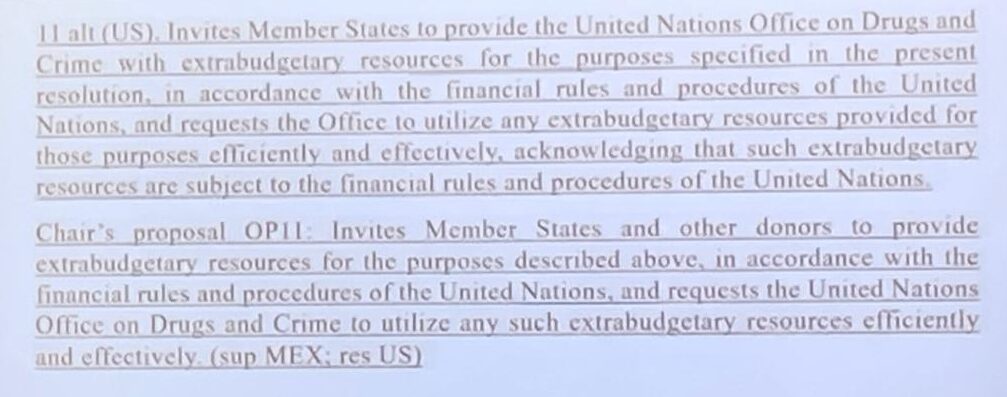
Norway: There’s a Chair’s proposal. My request is that we, through you, delete the alt and keep the Chair’s proposal.
Chair: Sponsors propose that we look at the Chair’s proposal — not me! — and for now ignore the alt.
United States: We have a proposed amendment: following ‘member states’, writing ‘in particular those who have not made increases in extrabudgetary resources,…’
Chair: Can we agree on this?
France: We have reservations on this proposal. Specific member states should not be pointed out, especially on their financial contributions to UNODC. This should not be a criteria to be pointed out in this resolution.
Chair: Let’s leave this bracketed and come back to it at a later stage. Looking at the sponsors and aware of the time, are we as far as we can be?
Norway: We’ll continue conversations in informals.
Chair: I call on delegations to be flexible if language is dear to you but not essential.
L.5. Strengthening early warning mechanisms consisting of monitoring and assessment systems to enable effective responses to the emergence of new synthetic drugs, new psychoactive substances, precursors and precursor substitutes
Kyrgyzstan: We have considered all Member States’ contributions. A significant portion of the text has been agreed. First, let’s address the title, agreed in informals on Friday.
Title
Chair: Let’s look at the title, it was agreed.
United States: This resolution is still at regarding as a whole, at what substances are being mentioned.
PP1, PP2, PP3
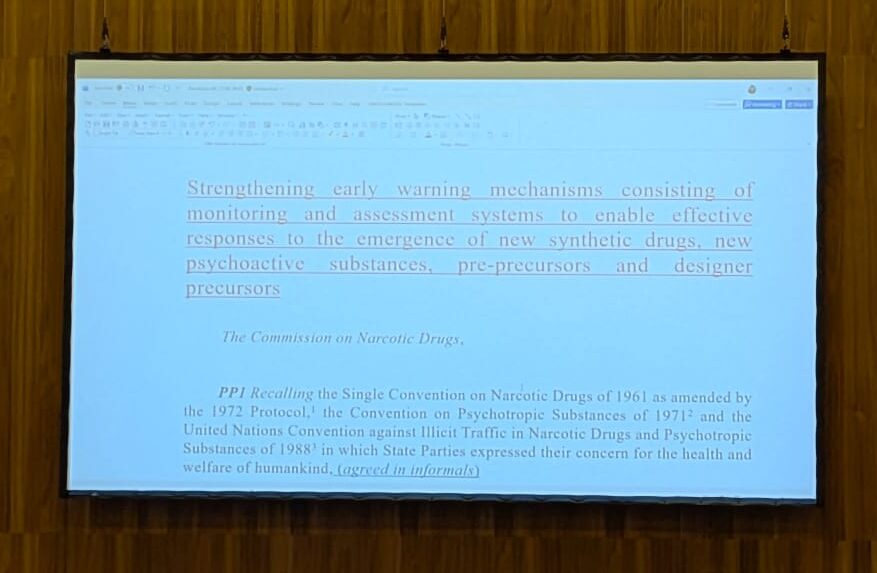
Chair: Once the resolution is cleared, the title will be agreed. Looking at PP1, we agreed on informals. Then we look at PP2, agreed in informals on the CoW. That seems to be the case. Then we go to PP3, we have agreed in informals on the CoW
Russia: Minor amendment will be more suitable to put documents in chronological order and to add a reference to 2014 Ministerial declarations and correctly and give a tittle because of this documents of 2009, and 2016 should be correctly added.
PP5Bis, PP6, PP7, PP7bis
 Chair: PP5Bis: Agreed in informals, agreed in the CoW, PP6: Agreed in informals, agreed in the CoW, PP7: Agreed in informals, agreed in the CoW, PP7bis: Agreed in informals, agreed in the CoW. Move to OP1, Agreed in informals, agreed in the CoW, then we go to OP2
OP1
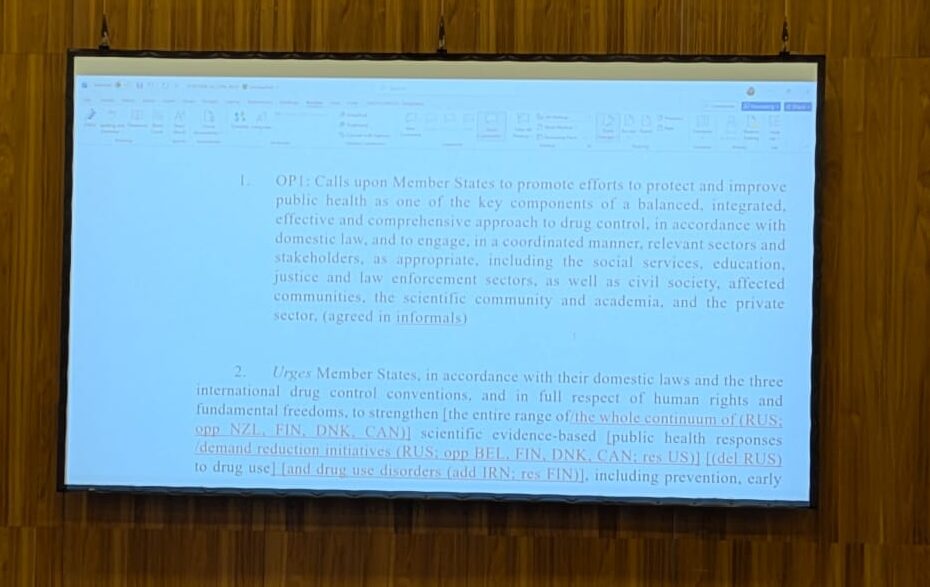
United States: Can we review the language on OP1 because the language, regarding the scope chemicals that are being discussed. With your indulgence we would like to keep this paragraph open while we continue the discussion.
Chair: Then OP1 is not agreed.
Chair: We can mark it as agreed in informals pending US.
Russia: We cannot support the idea of keeping ‘drug checking outputs’, because this is something related to drug consumption rooms, so we need to keep it more general and mention those countries that have this practice.
Chair: So, it was not agreed in informals.
Colombia: Because this is a new addition we will have to consult and come back.
Chair: So not agreed on informals and pending on Colombia. So now looking at OP3 also agreed on informals and on CoW, then OP3 was agreed on informals.
OP3
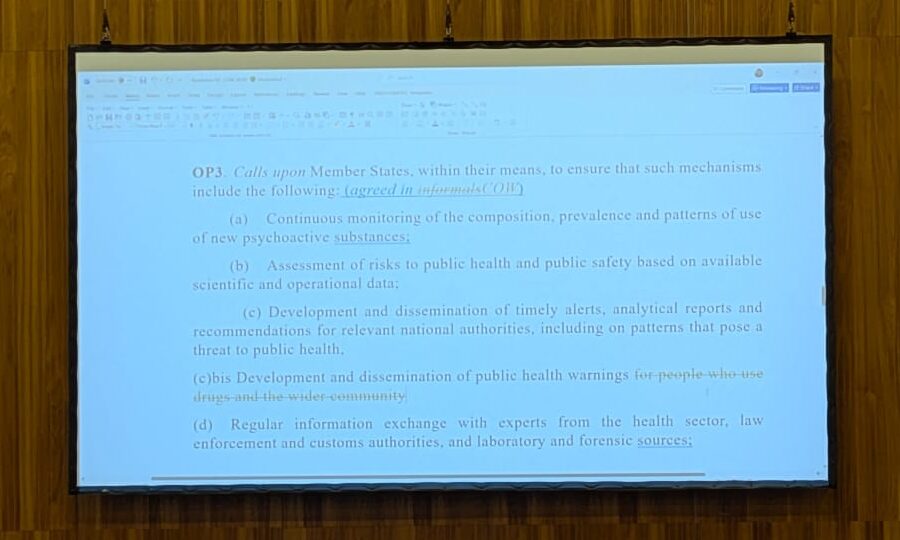
Russia: on OP3bis, would like to take out everything until ‘warnings’ so anyone can use those “warnings”; we do not want to keep out any specific groups mentioned.
Switzerland: We would like to consult, it was my delegation who presented this change so we will consult and come back.
Colombia: We would also like its retention, because it has no specific population groups as the Russian Federation suggests.
Chair: So it will be retained. Now we go to OP3 bis. Russia, you have the floor
OP3 bis
Russia: We believe that we should talk about not only risk associated to drug use but countering illicit drug use becasue as such we will never resolve, so we propose to say: “to prevent and counter illicit drug use” and to take out all the rest.
Chair: I would like to stop this discussion because is clear was not agreed in informals
Colombia: We would like the reaction on that language too.
Chair: At this point we refer back to the sponsors, there is more time needed. Now we go to OP4
OP4
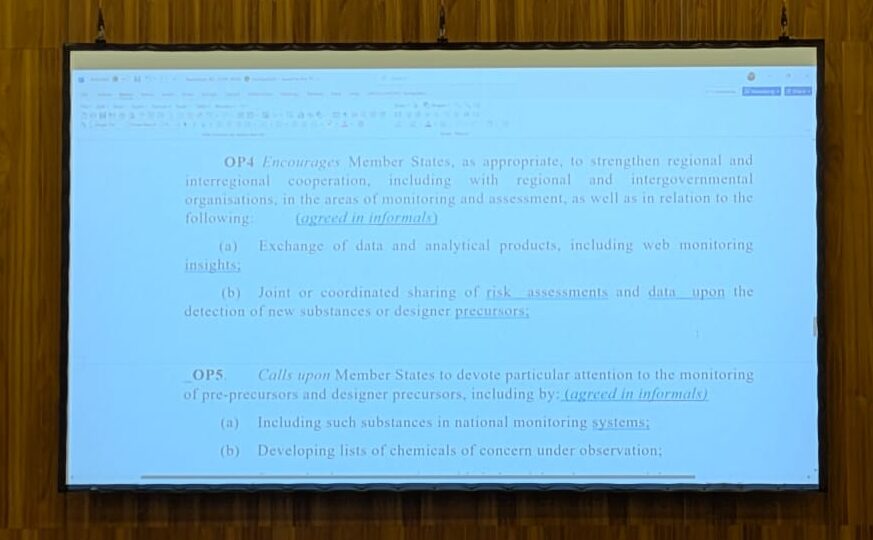
China: After ‘assessment’, introduce ‘based on domestic and international laws and legislation’. We want to know more about what ‘web monitoring insights’ means.
Chair: This is for the sponsors to address.
OP5
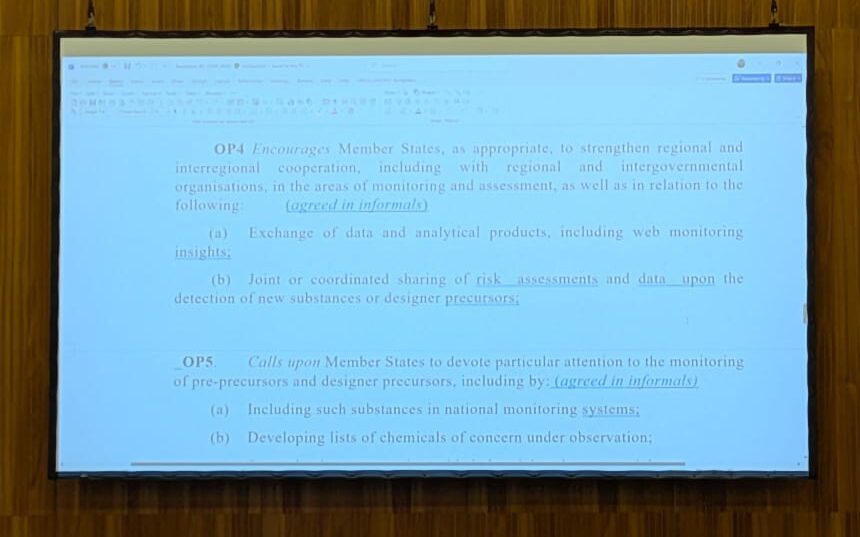
United States: We would like pre-precursors and designer precursors to be bracketed.
OP9
Chair: Agreed?
United States: We need to reserve our position on this paragraph for further consultation.
Chair: Any specific text?
United States: ‘and are not used to…’, that whole line.
OP10bis
France: We would like to bracket ‘in particular those who have not made increases to extrabudgetary resources’. This is new language and we have reservations.
OP11
Chair: Agreed? Agreed in CoW. We could go back to PP4 as we have some minutes.
PP4
Chair: Says ‘pending ARGENTINA’. Could a representative take the floor?
United States: We would introduce a reservation on this entire paragraph, with Argentina.
Chair: Question from China on the exchange of data including ‘web monitoring insights’.
Kyrgyzstan: We talk about monitoring from internet, darknet, maybe, includes information from other platforms, like INCB platforms, maybe. We collect this information and then use it for some analytical reports. To have information about NPS, we collect information available.
Chair: Would UNODC add anything?
UNODC: This language was proposed by the UK. From an early warning perspective, this generally relates to some of the countries who already openly share this information. I was unaware this also concerned INCB platforms but we can seek further clarifications.
China: I’m not an internet expert, but this is the first time I’ve seen this narrative. We need countries to implement this resolution so it would be good to have something more understandable. We would suggest ‘exchange of data and analytical products’, without the ‘web monitoring insights’. Or seek a clearer formulation.
China: We will consult further with our experts and come back later.
Russia: Briefly, we share the concerns of China on this. We want to be specific for our experts. There was a reference here about INCB. Darknet was mentioned — that has nothing to do with INCB platforms. We need to discuss this idea in a more detailed way in informals.
Chair: It shall be done.
L.2. Measures to implement article 13 of the United Nations Convention against Illicit Traffic in Narcotic Drugs and Psychotropic Substances of 1988 to prevent the diversion of equipment and related materials used for illicit drug manufacture
Mexico: We have built a common platform of understanding and then reflect on a number of issues in wording. We have agreed in various paragraphs. Some issues are pending, and conversations are pending. We ask you to address the issues where there’s agreement.
Title
Mexico: No comments on the title. It’s about better implementation of Article 13 of the 1988 Convention.
Chair: Agreed in CoW? Agreed.
PP1
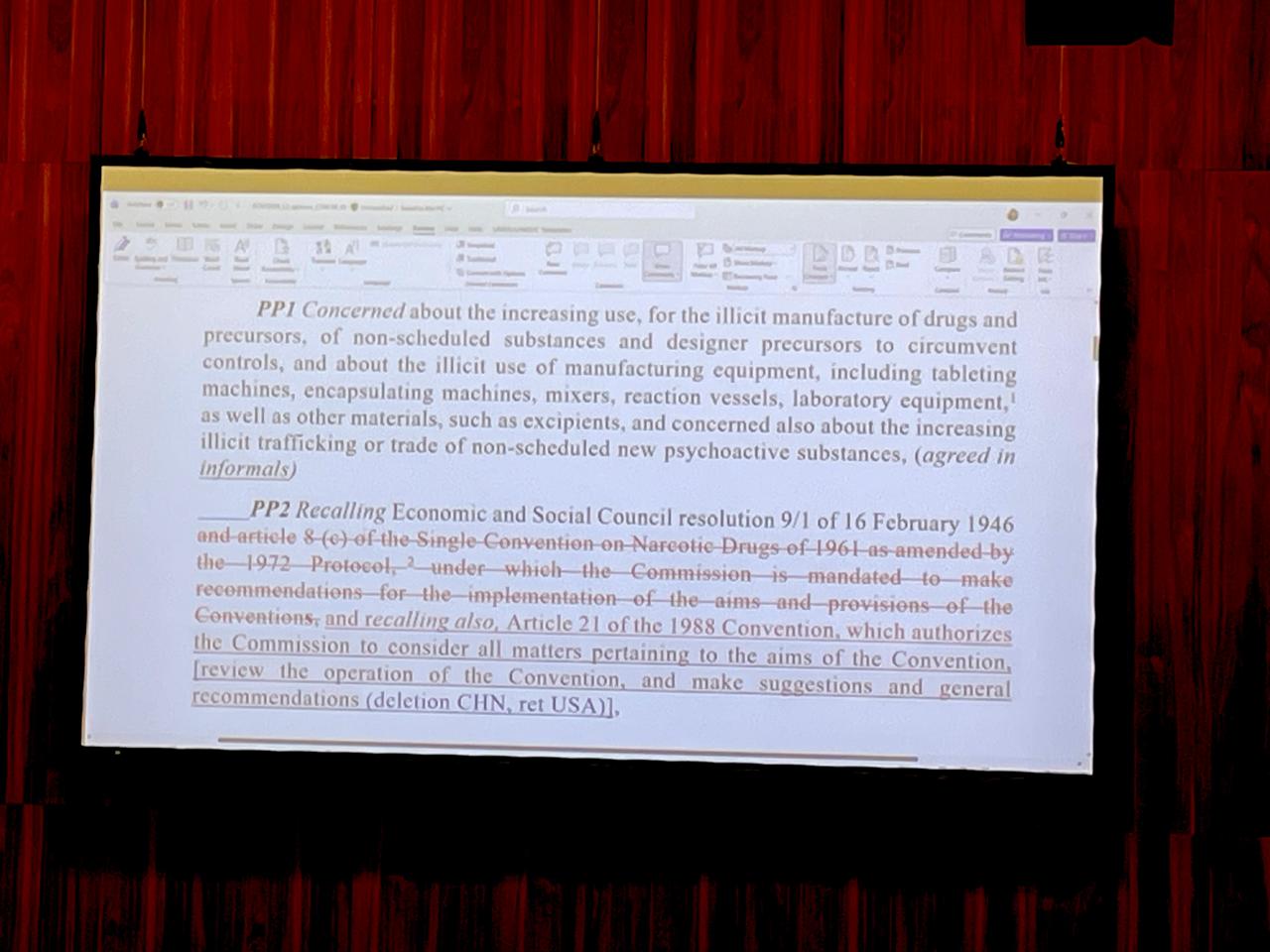
Mexico: This is a revised and improved version.
Chair: Agreed? Agreed in CoW.
Mexico: PP2, PP3 almost there but let’s come back later.
PP3bis
Mexico: Straightforward proposition agreed in informals.
Chair: Agreed?
China: Very sorry. I was late just now. Could we go back to the title?
Chair: Yes, after the PPs. PP3 bis agreed? Yes.
PP4
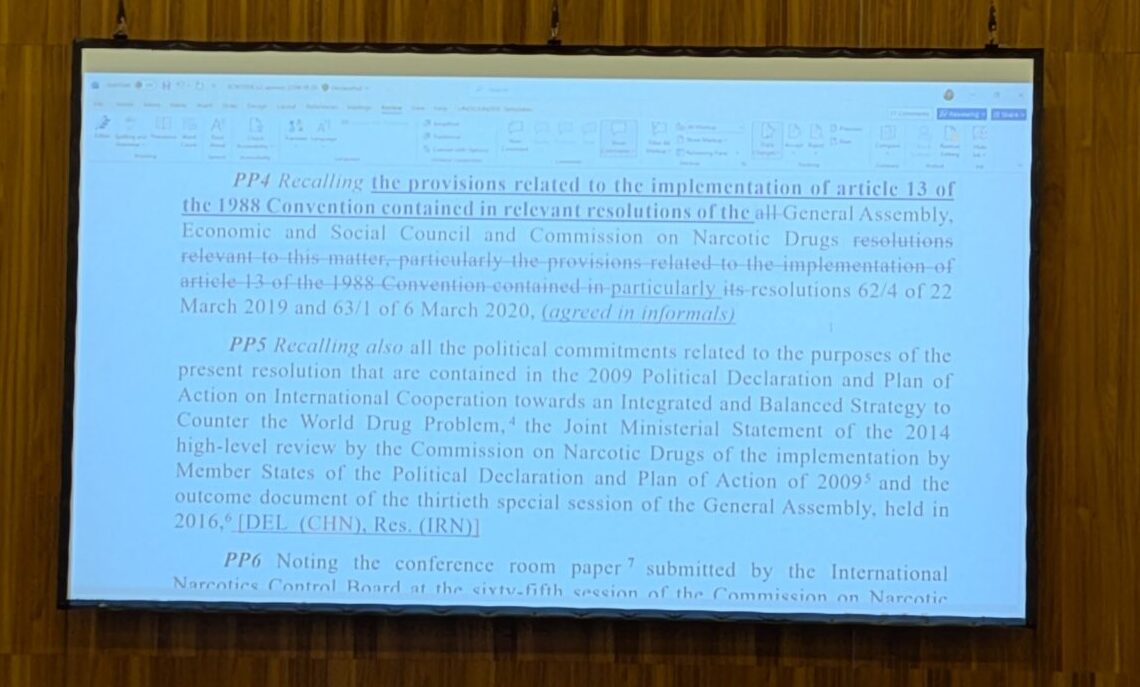
Mexico: Fine tuning allowed us to reach agreement in informals.
Chair: Agreed in CoW? Yes.
PP6
Chair: Agreed in informals. Agreed in CoW? Yes.
OP1
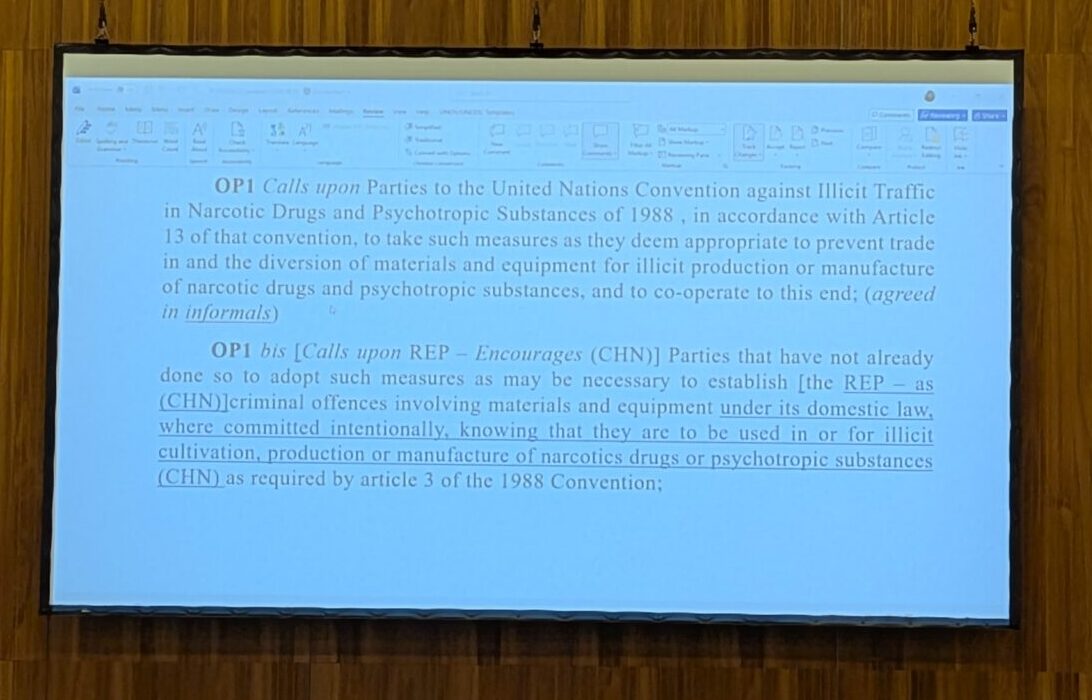
Mexico: Different approach to the originally planned but we had positive constructive engagement.
China: We don’t have time to attend all informals. We have a slight suggestion: we want to prevent ‘trafficking’, not ‘trade’.
Mexico: At this point, we will wait for the reaction of the room.
United States: We agree with the sentiment that we’re trying to prevent trafficking, but we’re speaking in accordance to Article 13, so we would keep the exact text and not imply an obligation that doesn’t exist — so we would keep ‘trade’ as agreed in informals.
Chair: Not sure how this translates into Chinese. Maybe China can check the translation of the conventions and use the same translation.
China: We would like ‘trafficking’ instead of ‘trade’ because in a different discussion, we were told we don’t need to stick to the wording of the Conventions. We can be flexible on OP1. But we would like this to be considered for the discussion of OP1 bis.
Chair: Agreed in CoW? Yes. We wish you all success in negotiating OP1bis.
OP2
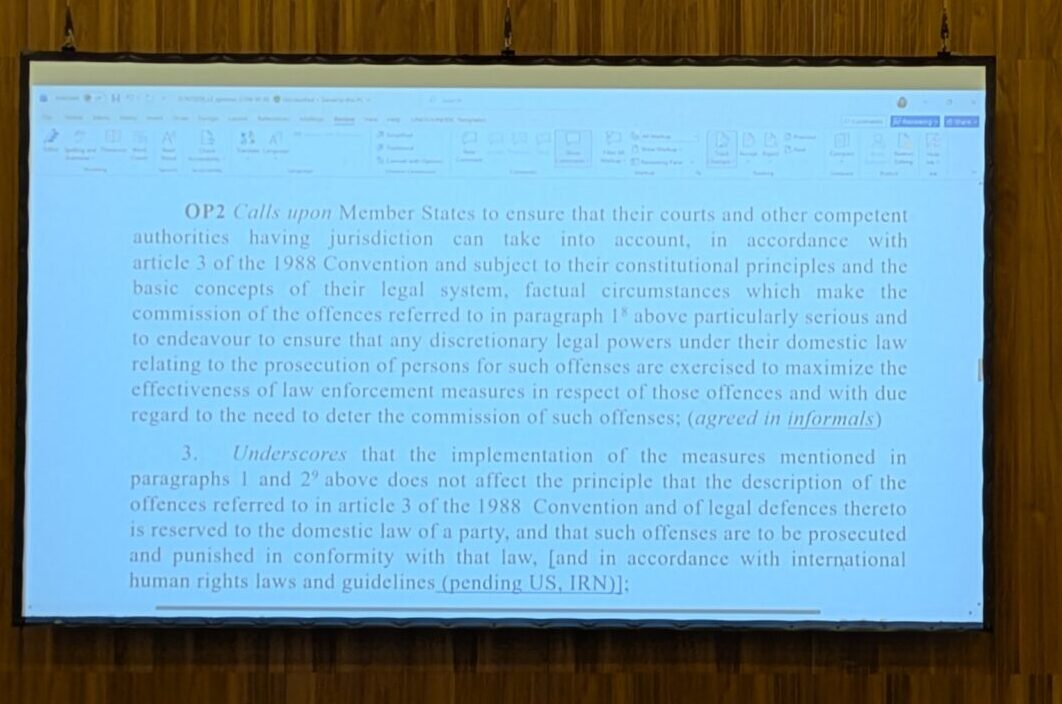
Chair: Agreeable to the CoW? Agreed.
OP4ter
Chair: Agreeable to the CoW? Agreed.
OP6
Chair: Agreeable in informals. Agreeable in CoW? Agreed.
OP7
Chair: Agreeable in informals. Agreeable in CoW?
Egypt: In line with the same comment pertaining to the last paragraph on ‘countries who have not made increases to extrabudgetary resources’. We should bracket this in the interest of consistency.
Chair: Horizontal issue. Always bad news.
Mexico: Just to point out that in this formulation, it makes sense because of the mention of INCB and UNODC. When we’re addressing UNODC and INCB, we should be able to use this.
Chair: This is still apending issue so we cannot move forward. Let’s keep that in brackets.
Title
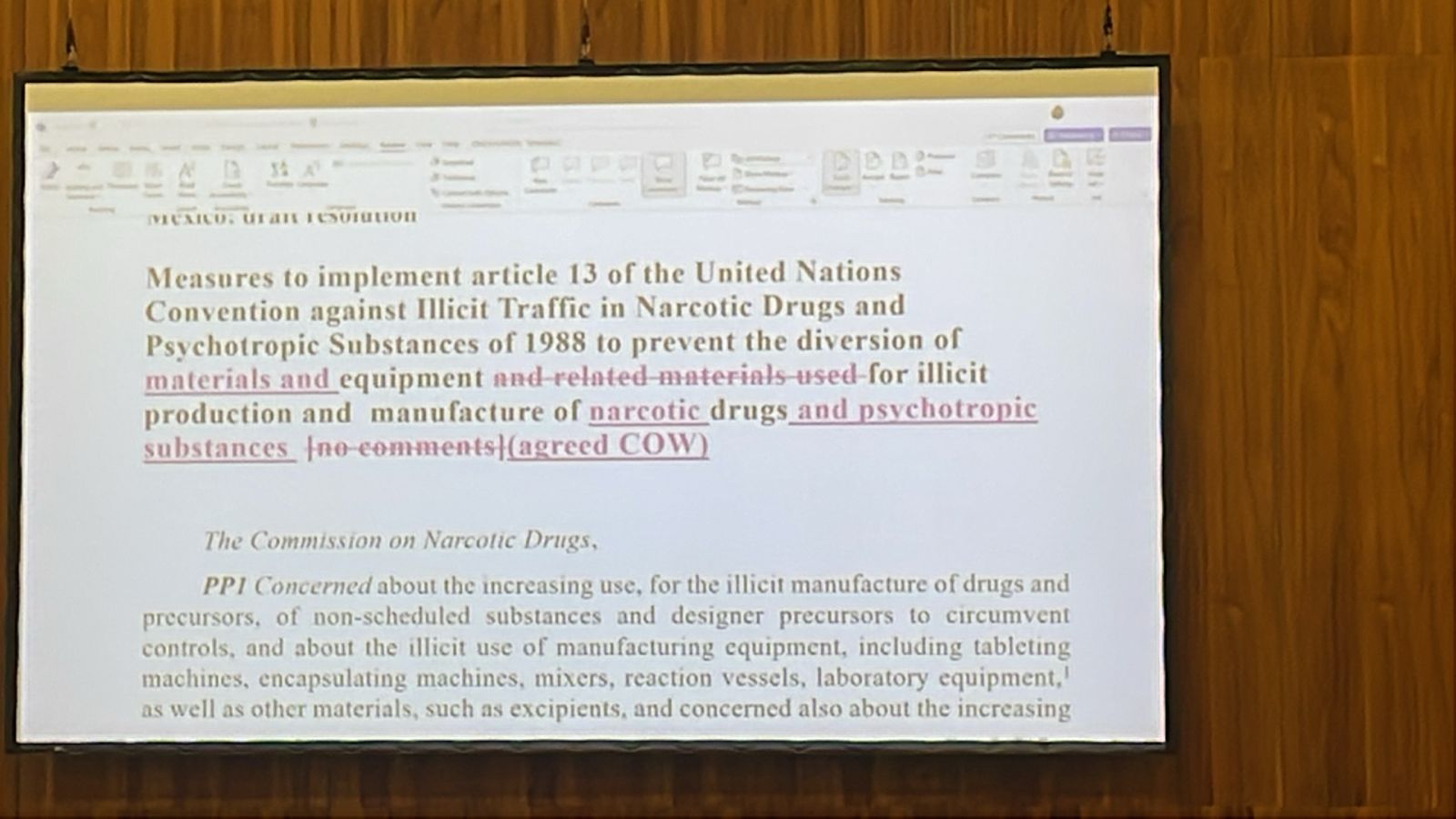
China: Suggestion: ‘prevent the diversion of equipment and related materials *frequently* used for…’. There are so many substances, materials and equipments, so we need a qualifier here.
Chair: We had gaveled it down but you were not here so we are now considering the addition of the word ‘frequently’.
United States: This resolution is about Article 13, not 12. ‘Frequently’ isn’t in article 13. It would mischaracterise our obligations according to the conventions.
Mexico: Our approach with all delegations is to be technically accurate. In this case, because we are focused on article 13, without qualifiers. This is for illicit production and manufacturer — there’s no qualifier. This proposal diverts from the wording of the conventions. We ask for China to be flexible on this. We include qualifiers in the body of the text where needed but not on this issue.
Colombia: Article 13 refers to materials and equipment. So we need to retain the previous wording as per the conventions.
China: We can show flexibility again. We would then replicate article 13: ‘to prevent the diversion of materials and equipment for the illicit production and manufacture of narcotic drugs and psychotropic substances’.
Mexico: I will put it to the room through you for delegations to consider.
Chair: The way it stands now, it is a direct quotation from the convention. I’ll leave it to colleagues to consider this overnight.
L.3. Enhancing supply chain integrity to prevent exploitation of licit supply chains and shipping modalities for the illicit manufacture and traffic of synthetic drugs
(…)
China: Add ‘illicit’ before exploitation.
United States: There is no ‘licit’ exploitation.
China: The expression ‘illicit’ refers to against the law, not just reprehensible.
Chair: Let’s come back to this later.
PP5
Chair: Agreed in Cow? Agreed.
PP2
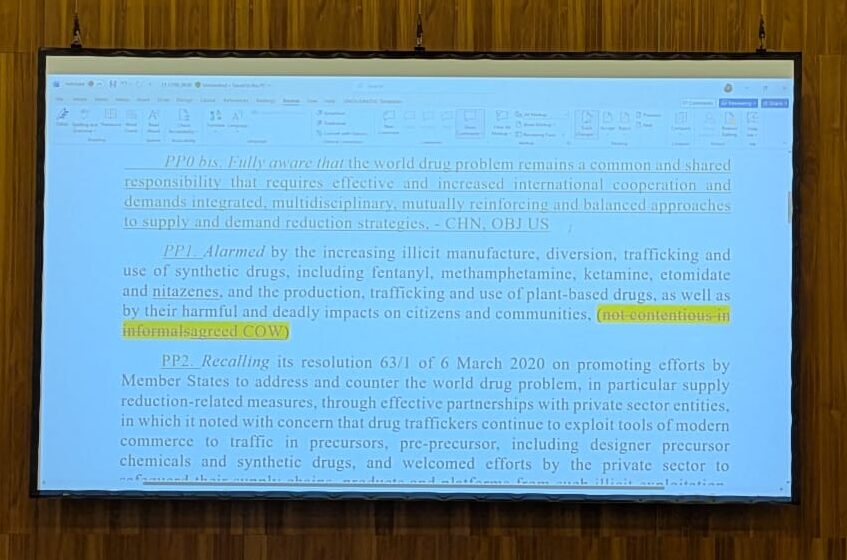
Chair: Substitute ‘chemicals’ with ‘drug precursors’.
European Union: We support this.
United States: This formulation we’re having difficulty with during informals. We want to continue consulting. Drug precursors is too narrow a term here because it does not capture all chemicals in the illicit manufacture of drugs. There are different definitions domestically on what ‘drug precursors’ are. So we will bring back a proposal after consultations.
India: We would like a more specific qualifier than ‘chemicals’. ‘Drug precursors’ is a good alternative.
OP6
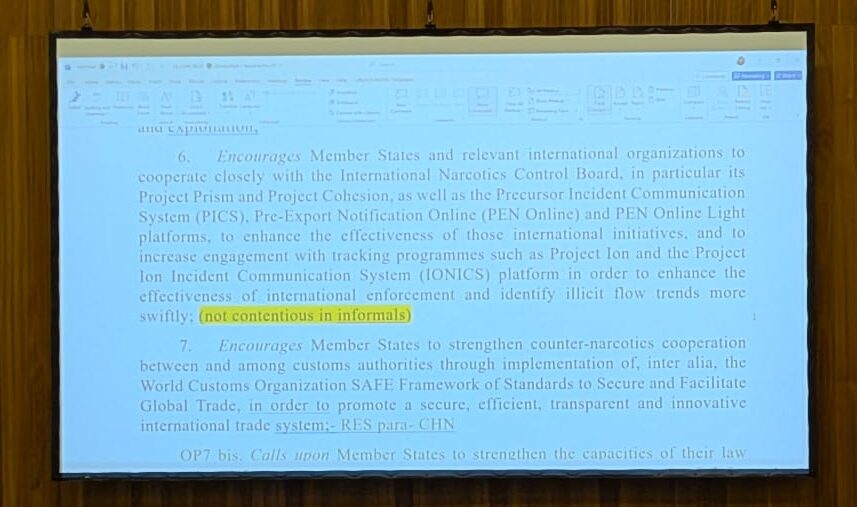
Chair: Agreed in Cow? Agreed.
OP10
Egypt: We have a reservation on ‘in particular those who have not made…’
Chair: We have a horizontal issue with this phrase. Good for delegations to look at this carefully. Where it applies, where it’s not, etc.
Chair: Should we go through the text in the 15 minutes we have with this resolution draft?
PP3
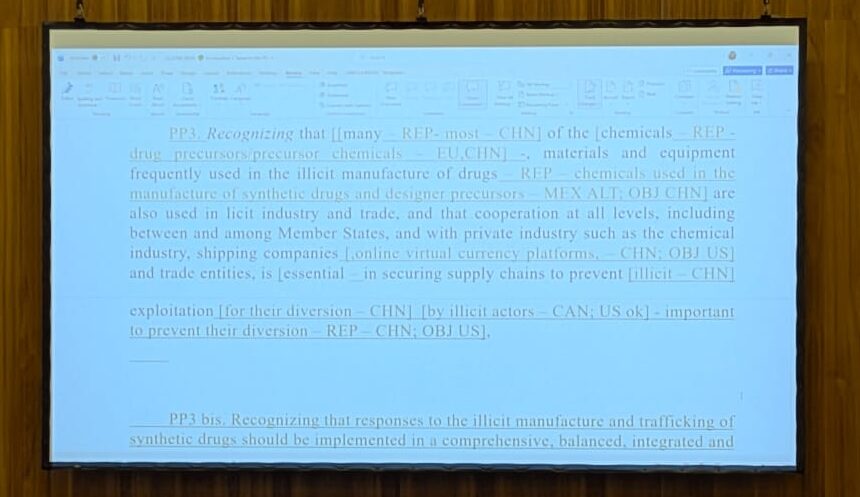
Chair: Why ‘most’ and not ‘many’?
China: There’s millions of chemicals. When we discuss the conventions, hundreds. So, we think we should say ‘most’.
: We would, in hearing China’s explanation, opt for ‘many’ not most.
India: Are we talking about chemicals or precursors? ‘Most’ would be problematic because it would suggest that most of the chemicals are involved. ‘Most’ is closest to all than ‘many.
China: To echo the Indian delegate, the ‘most’ here is about materials, chemicals and equipment. (…)
Chair: We ask you to work through this to find a useful way forward. I see there’s an addition of ‘online virtual currency platforms’ — any positions on this beyond the ones mentioned in brackets with a position on this? We leave it to the mentioned parties to discuss, then. I imagine this is about bitcoin and related. There’s also the question of ‘prevent illicit exploitation’ and ‘for their diversion’. Any suggestions to opt for one of the constructions?
China: Our first suggestion was ‘to prevent their diversion’ and end it there. The sponsors said it was important to talk about exploitation in the resolution. So we wanted to add ‘illicit’ as a qualifier. We are in CND, not WTO or another scenario — so our purpose is to avoid diversion for illicit purposes.
United States: I don’t think that’s an accurate retelling of the US position. We don’t understand the concept of ‘illicit exploitation’. I can’t agree on something we cannot understand. The Canadian addition is clear re: illicit actors. But ‘illicit exploitation’ isn’t clear. We can compromise by agreeing on the Canadian addition.
Chair: We encourage China to consider the Canadian solution overnight.
India: On the ‘online virtual currency platforms’ addition. Why are we singling out a specific platform? We would rather say ‘financial platforms’.
Chair: Think it over for tomorrow. We have 20-30 minutes for our last resolution.
L.4. Appendix to Complement the United Nations Guiding Principles on Alternative Development
Thailand: We propose the CoW considers paragraphs agreed in informals: PP1, PP3, PP4, PP7.
PP1
Chair: Agreed in CoW? Agreed.
PP3
Chair: Agreed in CoW? Agreed.
PP4
Chair: Agreed in CoW? Agreed.
PP7
Chair: Agreed in CoW? Agreed.
PP2
Chair: Could we have explanations about not including the UDHR to this paragraph?
United States: We would end it in ‘the Charter of the United Nations’. The rest are red lines for us.
Chair: I now understand why the language is bracketed but I am interested in the arguments.
Colombia: We would like the retention of this language. It has been agreed for a long time and we support its retention.
Peru: We had an extensive debate on the mentions of these instruments. Unfortunately, no consensus yet. Most delegations were in favour of keeping the language but there are still a few who are reflecting.
Germany: Echoing other sponsors. We would like to retain this paragraph due to its mentions to key documents that are at the foundation of the success of alternative development in practice.
South Africa: We add our voice in support of the Chair’s proposal and other delegations re: retention of this language.
Thailand: This paragraph reflects discussions in informals. It was broadly supported. We encourage all delegations to retain the paragraph, so that it’s a balanced text.
Chair: No agreement. Some hold the mentions very dearly and some others think these mentions have no place in this paragraph so we hope you can find a way forward.
Chair: PP6 and OP2 contain alternative formulations that speak to nuances for delegations to consider.
OP2
Chair: Could delegations keep ‘Invites’ instead of ‘Encourages’ if it brings consensus or reaching closer? Would it be acceptable?
Peru: Of course, as sponsors, we are working hard to update and complement the guiding principles to make them better, stronger, more useful — for member states and institutions working on alternative development. At this stage, my delegation would keep ‘encourages’ because it’s closer to the spirit of the complementing guiding principles. We could, in the process of negotiations, exercise flexibility. But we are on Monday.
India: I wanted to ask you about the word ‘complemented’ — is it possible you want to say ‘use the complement to the Guiding Principles…’?
Chair: Is there more elegant phrasing that the sponsors could suggest?
Spain: Retaining the first part of the paragraph is important to us. We want to not just invite member states but encourage them to do so. This was very much discussed in the expert meeting in Lima about this matter. On the second edit, proposed by India, this was discussed during informals — the best way to reflect it was the text on the screen before. We would rather not open this formulation for consideration again.
Germany: It was a suggestion from the floor to use ‘the complemented Guiding Principles…’. The argument the sponsors followed is that, once complemented, the document will be ‘as complemented’. So these won’t be two different documents but one holistic document. On the second proposal, a little more than ‘invite’ would be welcome.
India: I won’t insist on the change but I think the word is not used as it is expected to work. But if everyone else agrees, I’m OK.
Thailand: ‘Encourages’ is still allowing for voluntary adoption. This is a common verb in resolutions. It’s the promotion of the voluntary use of guidance documents.
Chair: We have five minutes. Could delegations look at OP3?
OP3
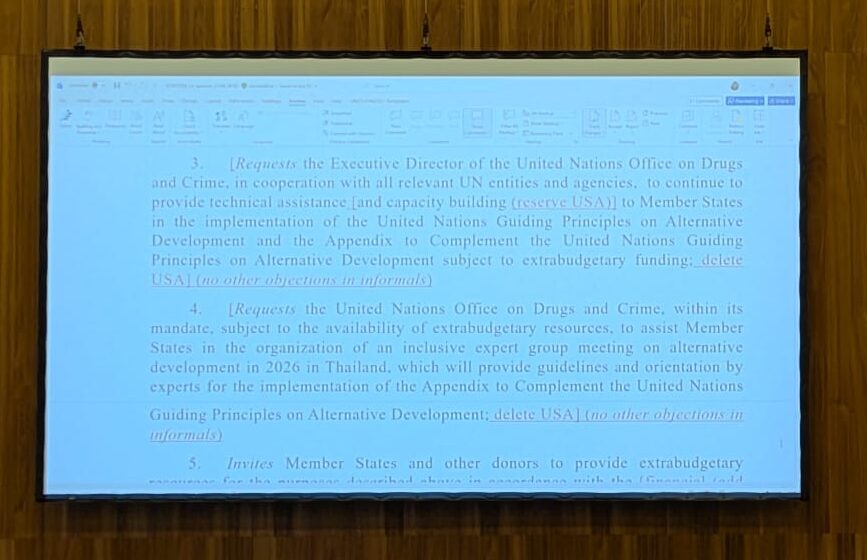
Chair: Is ‘capacity building’ a bridge too far?
United States: You can remove the brackets from the first three lines. We call for the deletion of the entire paragraph.
Chair: I hope the sponsors know why you insist on the deletion of the entire paragraph.
United States: I can clarify but this has been discussed at length in informals.
Chair: I hope it is clear to delegations in the CoW that you don’t like it and insist on its deletion? Is it agreeable to other delegations, this deletion?
Colombia: The discussion would benefit from using the same wording on OP2. When we talk about ‘complemented Guiding Principles…’. With the same formulation, it will clear things up moving forward.
Peru: Of course, my delegation would like to retain this paragraph. The issue of technical assistance and capacity building is of utmost importance for the sponsors and countries who benefit from alternative development efforts. To give a tangible example of its importance: tomorrow, we will have, the delegation of Peru, the launch of an alternative development coffee that results from the technical assistance and capacity building provided by states who worked with us. This is in the rotunda. It demonstrates the importance beyond policy discussion. You will hear from the ambassador of a women cooperative who has benefited from these programmes. It’s not the words of the delegates but of beneficiaries.
Chair: Grateful, but it is clear disagreement continues.
China: We agree that technical assistance and capacity building are critical for alternative development programmes.
Spain: This paragraph is very important for us. We would not be implementing the Guiding Principles without UNODC and relevant agencies — so this is a core paragraph of the resolution, which cannot be suppressed from the text. The complemented Guiding Principles include the Guiding Principles and the Annex. To sum up, it’s ‘the complemenetd Guiding Principles’.
South Africa: We echo the remarks on the importance of technical assistance and capacity building.
Germany: Really important paragraph for us. It translates the Guiding Principles into something that is actionable on the ground. Otherwise this is just hot air if there’s no thrust to implement. Sponsors will discuss Colombia’s proposal.
Chair: All resolutions feature some progress. We have endorsed some paragraphs in all resolutions. It’s clear now you have to focus on the aspects where there is no agreement. And at times there are deeply opposing perspectives. This must be taken into consideration.
European Union: We have been convinced about alternative development for along time. We cosponsored the resolution last year to complement the Guiding Principles. We are cosponsoring this resolution as a token of appreciation and support.
Chair: We stop now. I invite sponsors to discuss how to move negotiations forward. We resume CoW in the afternoon session as, during the morning, the Plenary will vote.