L.6. Promoting integrated and coherent systems of scientific evidence-based drug-related public health responses
L.6 has been sent to the Plenary
L.2. Measures to implement article 13 of the United Nations Convention against Illicit Traffic in Narcotic Drugs and Psychotropic Substances of 1988 to prevent the diversion of equipment and related materials used for illicit drug manufacture
OP1ter
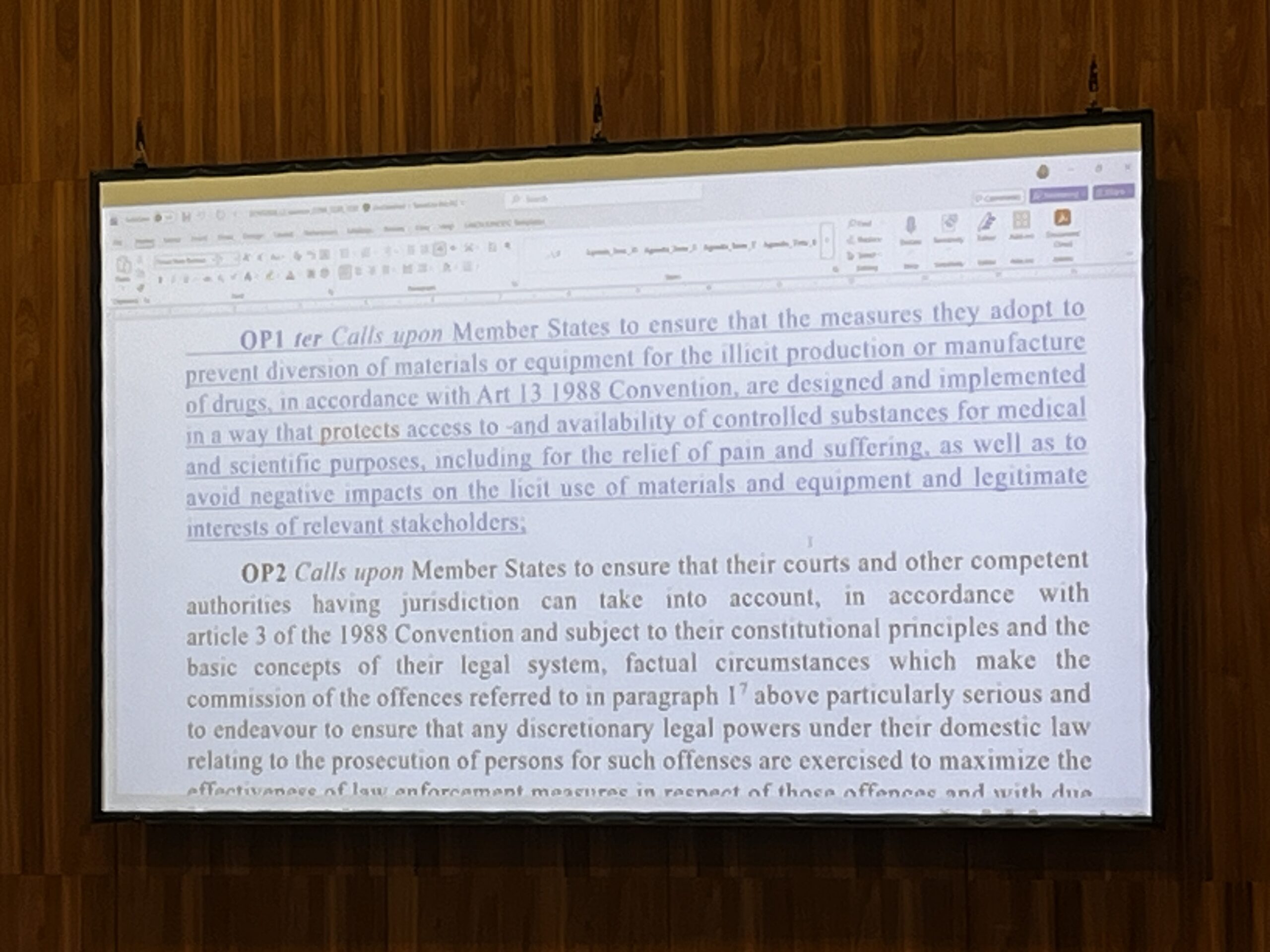 Mexico: I appreciate the involvement of delegations. The version we are putting forward is the result of lengthy and delicate conversations to balance something we are not willing to compromise further. This is the version that will be brought for consideration to the plenary.
Chair: Is this acceptable to the room?
South Africa: This is not acceptable to us yet. We understand the concerns from the cosponsors. But for South Africa looking at issues of high cost are critical. We did not see any major objection to the previous text.
Chair: The only reason for us to come back to this text was to see if this could carry agreement. As far as I am concerned, this can go to plenary and you can act according to your beliefs tomorrow. We have exhausted all avenues to see if this could be fixed.
Mexico: Thank you for the summary of the situation. I would entertain any possibility of this issue if all delegations agreed. But additional comments would take us nowhere, so we will bring this to plenary for consideration, bearing in mind the sensibilities of different countries. Affordability is also an issue for Mexico.
Chair: At this point, the time for this discussion is up at this point. Let’s first look at other outstanding issues, and see how that looks, if that is agreeable to South Africa.
South Africa: I am in your hands, I don’t intend to block this issue, but of course this issue is absolutely critical to South Africa. I wanted to try again to make suggestions. It is not just South Africa mentioning the issue of high cost.
Chair: I never said you were the only one. There were multiple delegations making similar points this morning, but it led nowhere, not in the direction of consensus. At this point, procedurally, we are passed this point. However, who knows, there may be an epiphany in this room and we may be able to fix it. But I want to make sure that you know what will be coming to the plenary tomorrow. Thank you for your understanding.
OP3bis
Mexico: This will be the version going forward for the consideration of the plenary.
Chair: Acceptable to the room? Seems to be the case.
OP7
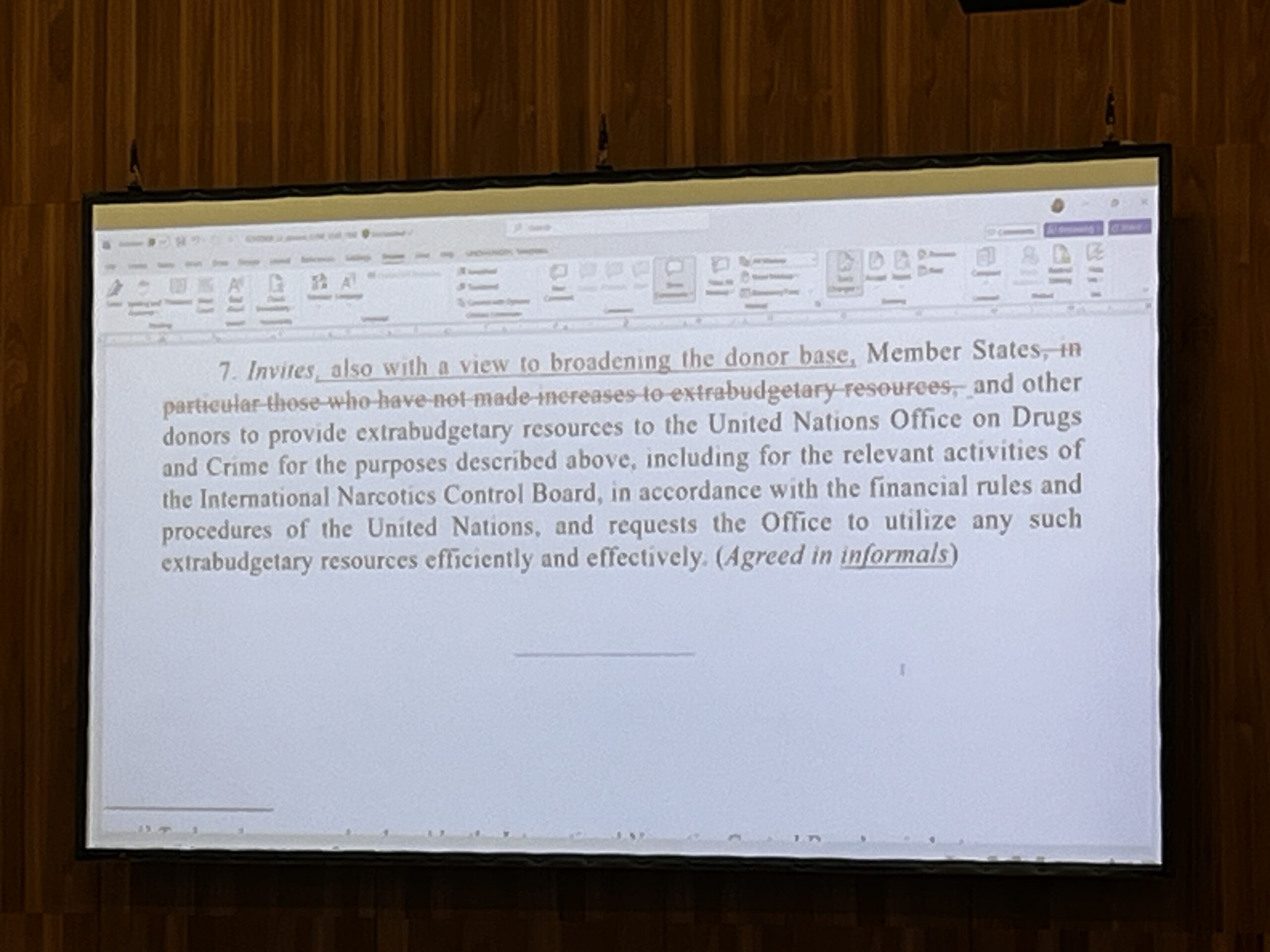
Mexico: Crosscutting discussion. We have reached a point where there is nothing else to do. Dialogue with sponsors is never closed. But we would go forward with your suggestion, but change the order ‘Invites member states, also with a view to broadening the donor base,…’ We hold the presidency of FINGOV. On his behalf, FINGOV is open to address all issues to address budgetary issues.
Chair: This is a familiar text because it’s been here for two days. The discussions in FINGOV are taking care of the concerns that we express. Would this formulation carry the room’s consensus?
United States: We would not be able to agree to the text on screen. We insist on our insertion as opposed to this.
Chair: We note there is no consensus and say this is the text before the Plenary tomorrow. Having said this, from a procedural point of view, which is what we do here. Wer’re not reopened the negotiation. We have brought this text as far as possible toward consensus. Two outstanding issues unfortunately but of a nature that somehow cannot be….the hurdles there cannot be overcome. Perhaps, miracles, epiphanies take place overnight and tomorrow morning from the floor it can be amended to carry consensus…but at this point, this is going to the floor of the Plenary.
Mexico: Thank you. I want to first of all, express my personal appreciation to Diego Simancas who has steered this resolution presented by Mexico. He has been able to listen to manu of the concerns while at the same time keep with the spirit of the resolution. I want to thank all the delegations for contributing to this resolution and keeping on focus and target, and ensure that issues are better defined. I thank you chair for your leadership and allowing us to reach a stage in which we have an extensive consensus on the proposal presented by Mexico. I hope that by tomorrow we can reach an approval of the resolution.
Chair. I also extend my thanks to Mexico. With that, we conclude our consideration in the CoW of L2. The resolution as it stands now will go for consideration to the Plenary tomorrow morning.
L.3. Enhancing supply chain integrity to prevent exploitation of licit supply chains and shipping modalities for the illicit manufacture and traffic of synthetic drugs
Chair: We will now move to L3, we will bring this as close to consensus as possible and see what we can bring to the Plenary. We will work on this until 5:30 and then move to L5. I will now turn to the USA and ask which paragraph we can look at.
OP5
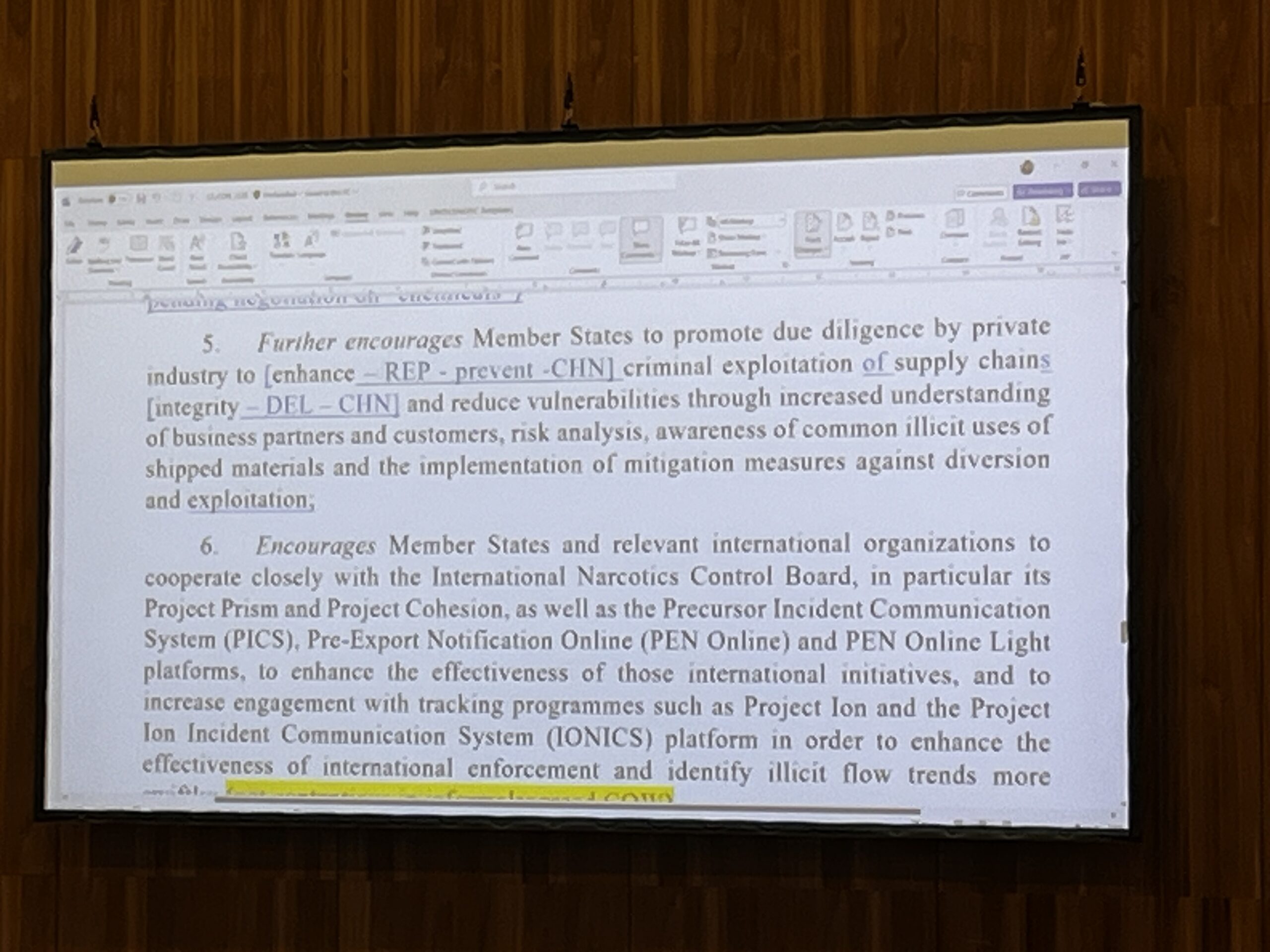 USA: We will accept the edits in this paragraph and hope we can agree to the text in this room.
Chair: This seems to be agreeable to the room.
OP7
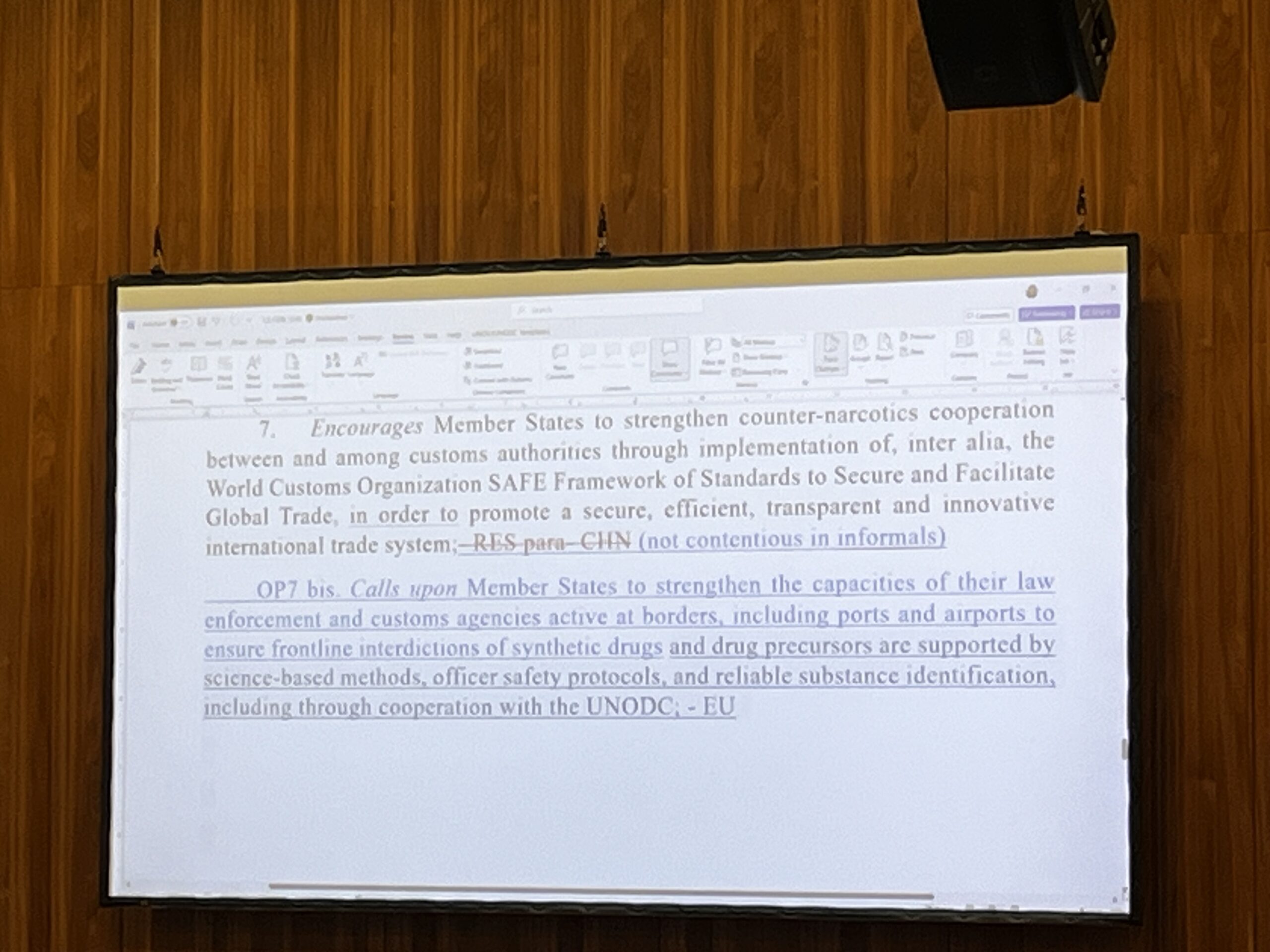
USA: We had one delegation asking to make minor changes to this, we will do this now, by replacing “inter alia” with “measures, such as”, and delete the end of the paragraph from “in order”. We will bring this forward to the room.
Chair: This is agreeable to the room.
USA: We want to have a wider discussion on language “chemicals” versus “substances”. We will go to OP1 to insert language that was agreed to. We will like to popular that to OP1, OP4, OP8.
OP1
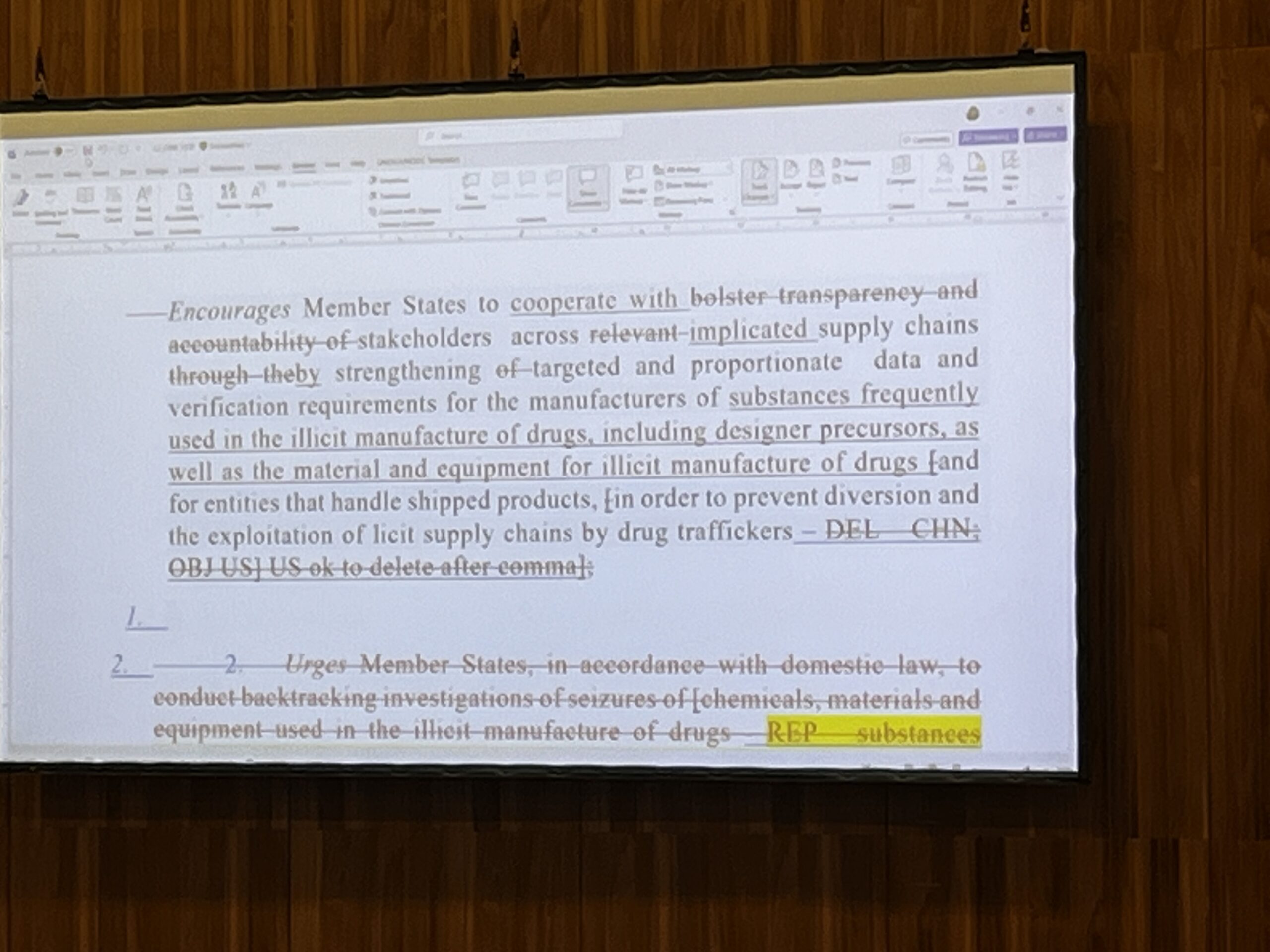
USA: This is the new language: “substances frequently used in the illicit manufacture of drugs, including designer precursors, as well as materials and equipment for the illicit manufacture of drugs”. We are focusing on the “substances” language here. But we also have some additional comments in the text.
Chair: Let’s look at the language introduced first here. I understand that this will be copied and pasted in other parts of the resolution. The way this is phrased, can I see consensus in the room?
Iran: We would like to use “criminal exploitation” as this is how it is formulated in other parts of the resolution.
USA: Starting at the top, we had previously “bolster transparency and accountability” instead of “cooperate with”, and we would like to accept language proposed by Iran. At the end, we would like to remove “in order to prevent diversion and the exploitation of licit supply chains by drug traffickers”
China: The original paragraph looks more elegant. “Bolster transparency and accountability” is not included in the conventions. At the end of the para, the deleted segment is included in the conventions, so we would prefer to revert to the original language.
USA: The original language was “bolster transparency” and we would like to retain that. I am hoping we can find compromise in the rest of the para.
China: I want to reiterate here that “bolster transparency” was not included in the conventions. We invite the USA to reconsider.
Chair: I suggest we take this phrase “substances” and paste it in OP4.
OP4
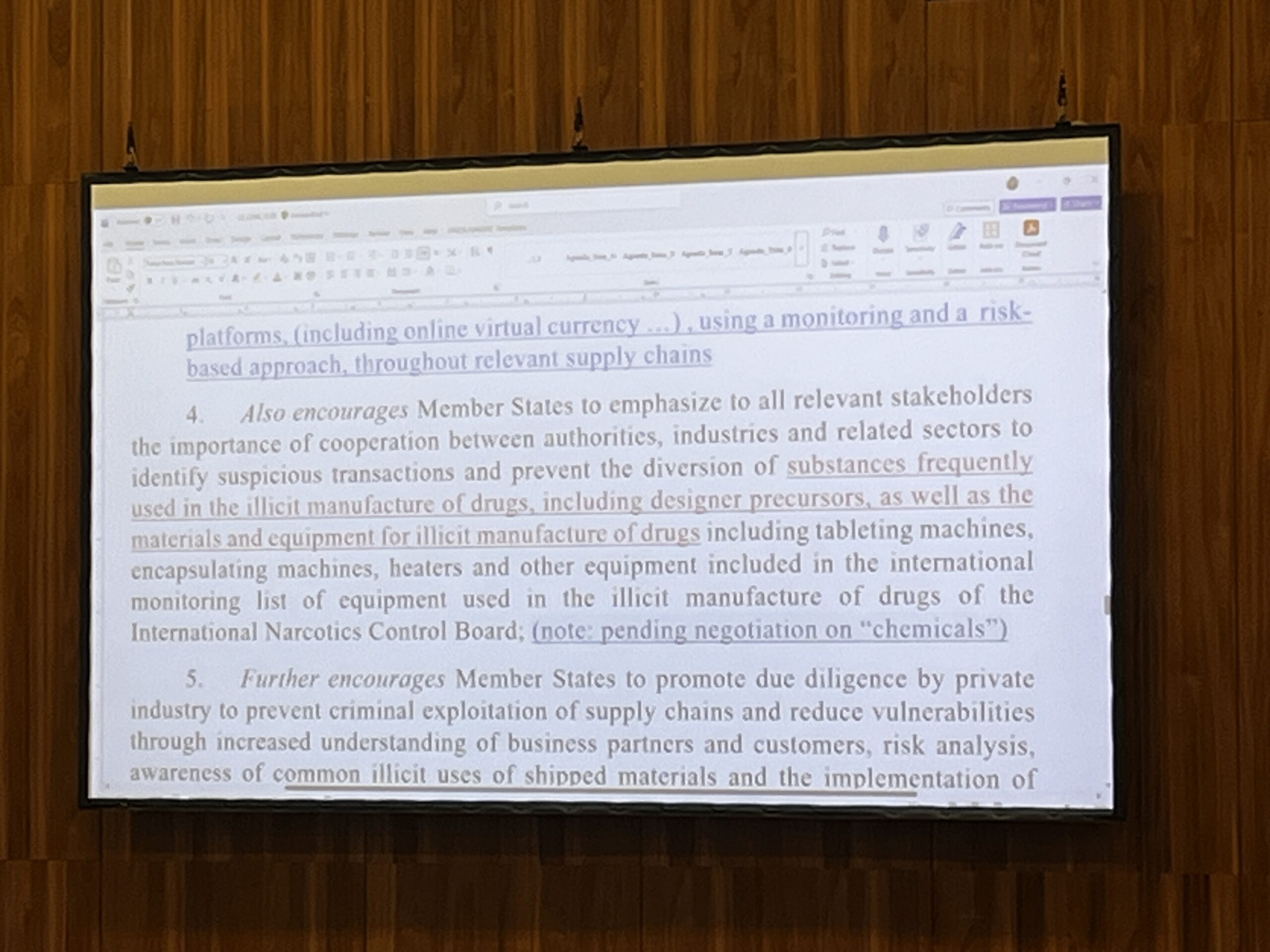
Chair: Let’s briefly stop. The negotiations on chemicals is done. This para OP4 – this is so decided.
OP8
Chair: Is this acceptable to the room?
China: We had some discussion in the morning and some delegates are not in the room now, who might have an opinion on this.
Chair: I appreciate the concern you show for delegations that are not here. I am glad to know that you can live with it.
USA: We would like some of the proposed insertions removed such as “not in real time” as other delegations raised this too.
Chair: any other issues?
China: How about if we remove “exportation of and”?
India: We propose that last few works “in order to expedite trade and secure supply chains” to be deleted. We are not ok with this.
Chair: It is getting shorter. Can we agree to this para?
USA: we are fine with the edit from India but need to check on the deletion proposed by China, we are not ok with that.
China: we can compromise by adding “suspicious” before “exportation”
USA: we prefer not to have the term “suspicious” because it pertains to substances that are already referred to in OP8 so we would like to remove “suspicious”
China: Here because you mention that you want to cooperate and use risk management, but don’t want to talk about suspicious exportation, how about we use the term “selected”?
USA: We are not in favour of that insertion either. We are happy to go to PP3, PP4.
Chair: PP3, PP4.
USA: This was negotiated in the room yesterday
Chair: the negotiation yesterday was whether to include”frequently” in PP3 as it might not seem necessary or do i understand “frequently” is ok here?
China: we can be flexible if we use the phrases that have been decided and to keep consistency
Chair: which text does the US want to put before us?
USA: we would like to delete “designer precursors” and the second “frequently” that was mentioned in PP3.
China: we can say “for” instead of “frequently used in the”
EU: We discussed yesterday that because we are talking about licit industry, we propose keeping “designer precursors” in the first sentence of PP3.
Chair: The text as it stands now, does it carry consensus in this room?
China: Actually, “designer precursors” are only a small part of “chemicals”, so we want to remove “can to some extent be”.
Chair: this text does not seem to be agreed yet, should we go to another para?
USA: We are willing to go forward with this para as it is now.
OP7bis
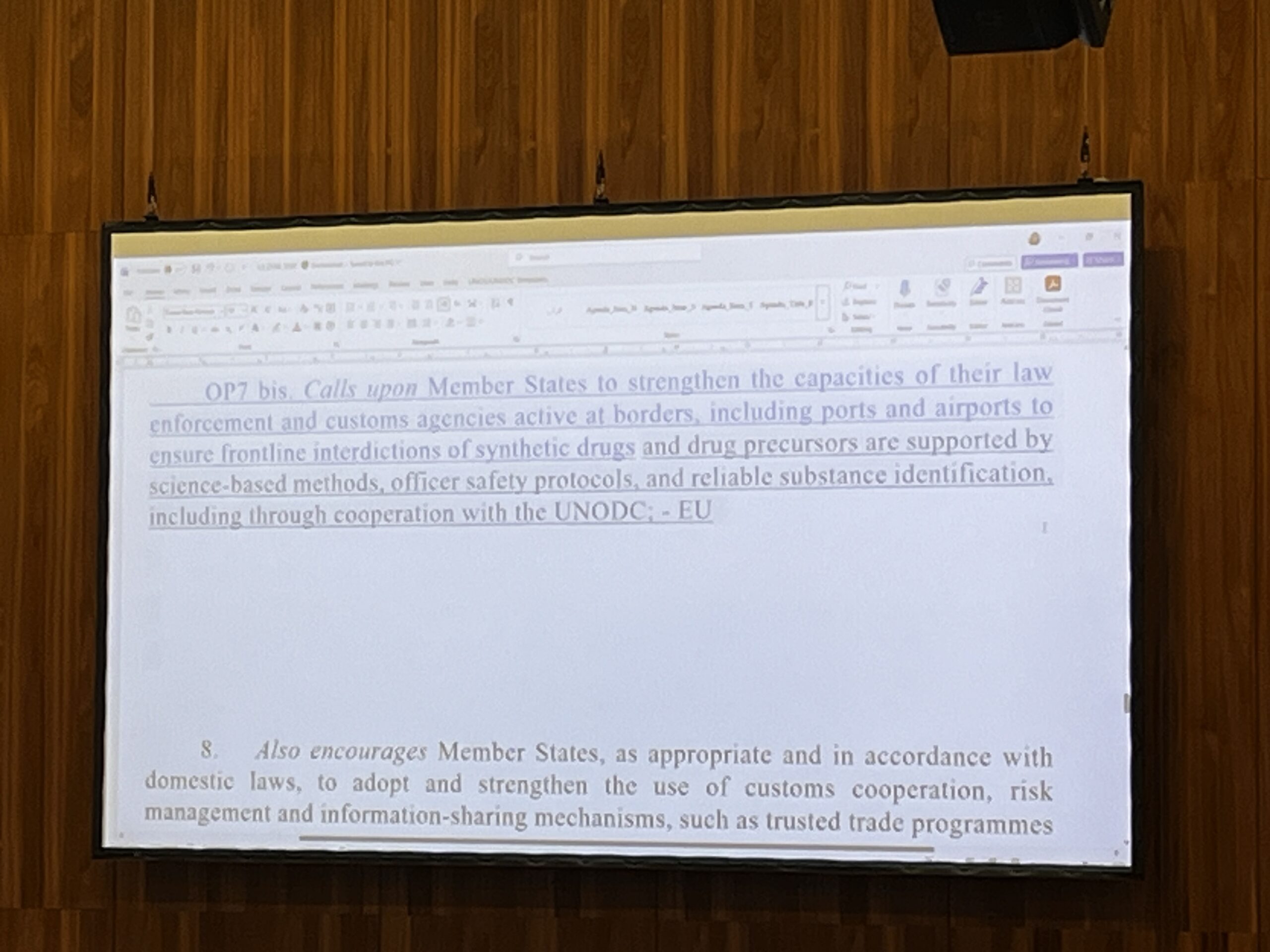 USA: We didn’t have any objections in informals.
Chair: text agreed.
OP9
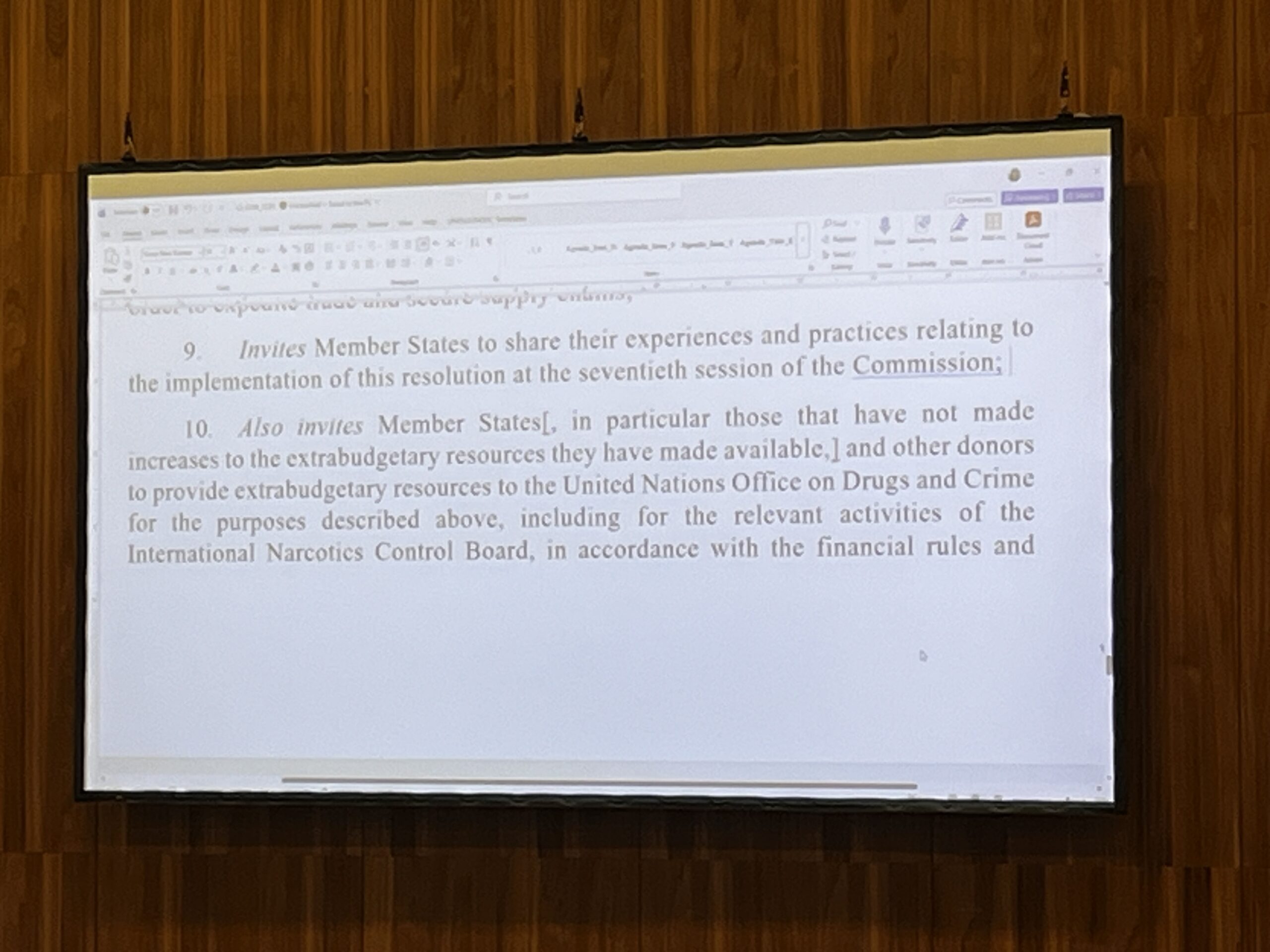 Iran: In PP3, I think we made a mistake. The EU proposed something as a package, but then our colleague from China deleted some of this. We need to go back to that.
Chair: OP9 first, and that’s agreed.
PP3
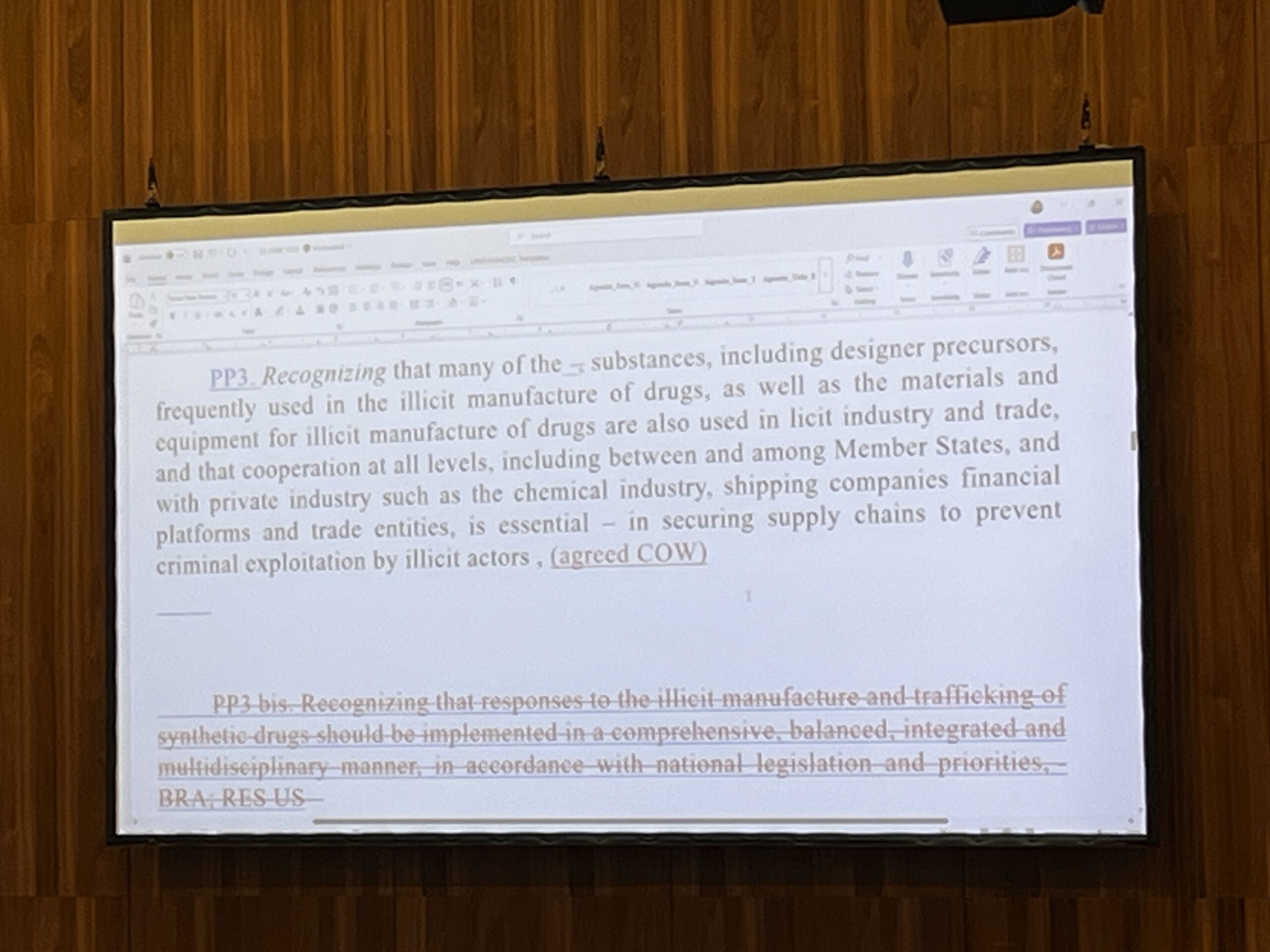 Iran: EU proposed two different proposals, and then we deleted one of them. This deletion does not make sense. If we remove “to some extent”, we then need to delete “including designer precursors”.
EU: We can go along with that.
Chair: I recognise that things go fast and are complicated. The EU is ok with this.
USA: We are not trying to slow down progress, but we have one amendment: after “shipping companies”, please add a comma.
Chair: Is this now agreeable? Good. USA, what is the next para?
OP10
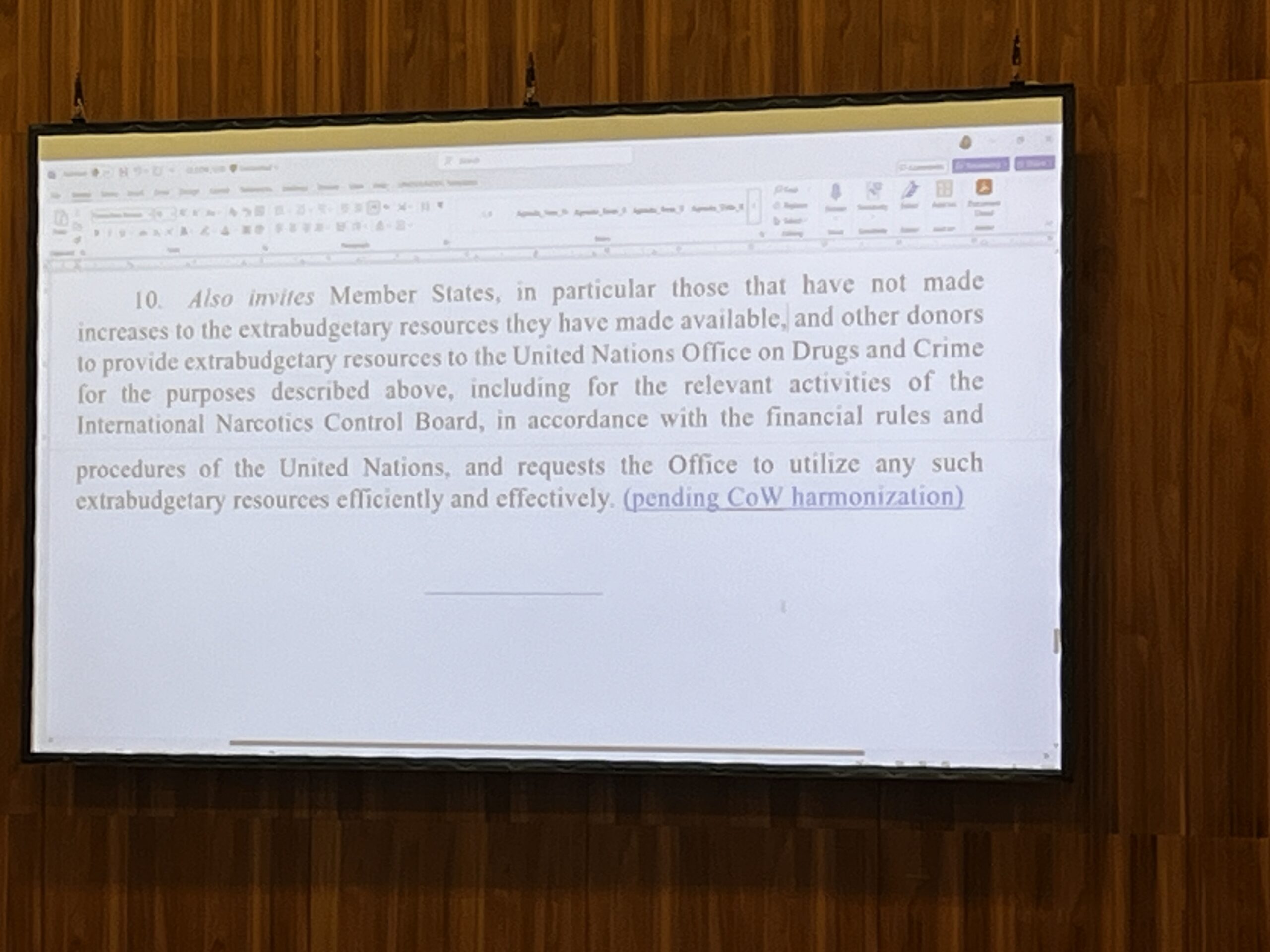 USA: this resolution only asks Member States to take action. We will reserve this para with possible deletion in the plenary.
Chair: so you have no objection, but a reservation and we won’t know until the plenary if that holds. So we cannot adopt this now, pending agreement in the plenary.
France: We would like to see “in particular those that have not made increases to the extrabudgetary resources” put in brackets.
USA: the brackets are fine.
Chair: good to know that there is a good chance that this will go.
PP5
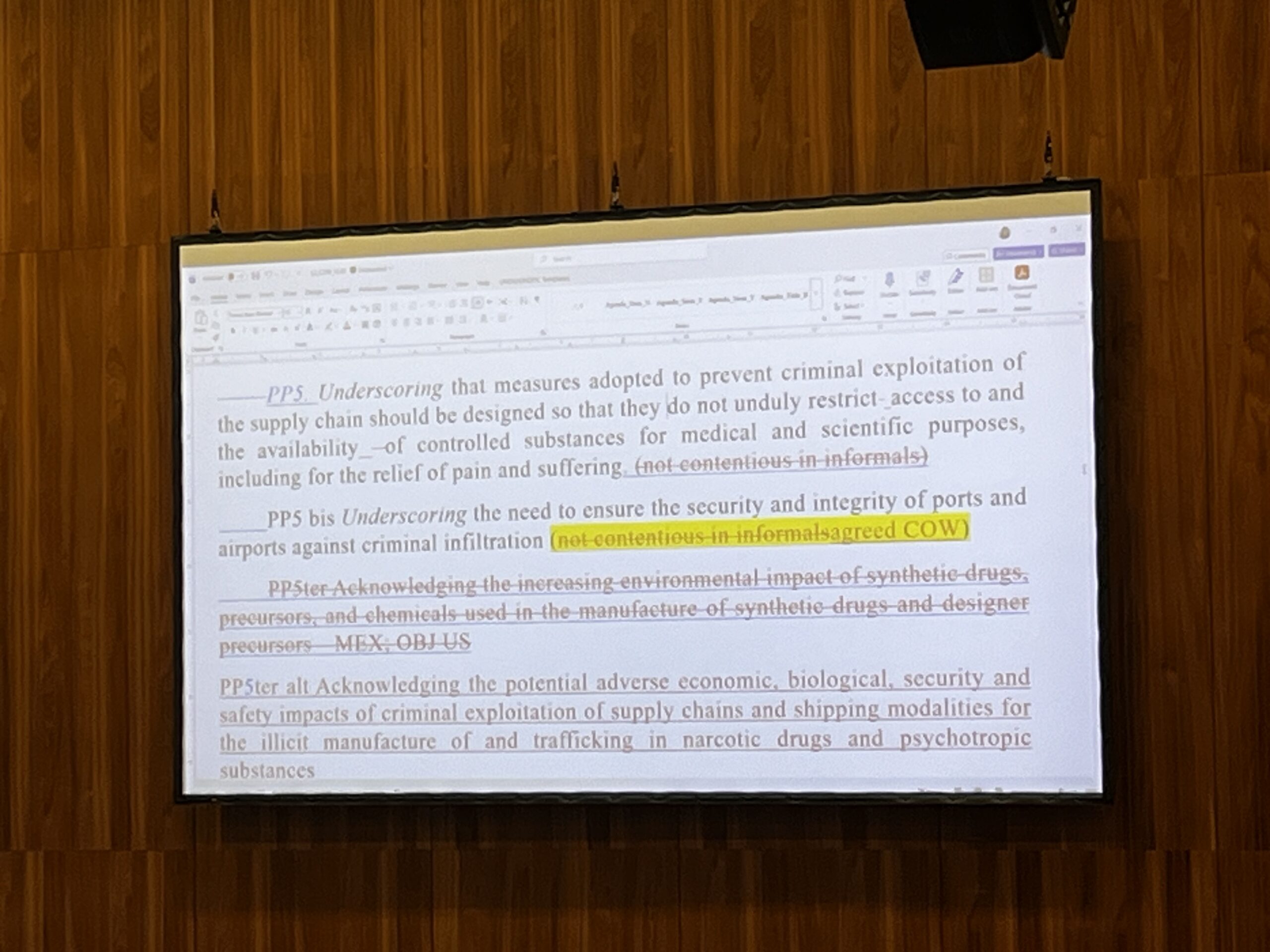 USA: we would like to go back to PP5, and would not like to take on the proposed insertions in the CoW.
South Africa: Thank you to the US. It really is a pity. I don’t think it is a misplaced ask for my delegation to insert “affordability” given there is not a lot of developmental issues here. On the comment made by the distinguished colleague from the US yesterday that affordability is misplaced here. High costs are a barrier to access to controlled medicines. If there is no affordability, then access to medicines including for the relief of pain and suffering and criminals can take advantage of that. Not having reference to developmental issues or affordability here, is an indictment for developing countries especially for Africa.
Chair: Thank you for pointing out the need.
Belgium: This para looks good for us except what we discussed. Can we be inspired by what we discussed earlier in L2? “Should be designed in a way that protects access to and the availability”
China: We would like to add “should be designed and implemented in a way that protects” in PP5 and then “to avoid negative impact on licit use and legitimate interests of relevant stakeholders”
USA: we are comfortable with the formulation by Belgium. The addition at the end of the para is unacceptable. We have had a lot of discussion on this issue and the whole resolution. We first added this para on access to deal with the issue at hand, but as we put up new language for which we do not know the purpose of, we are not in a position to take it on.
Chair: Thank you the USA for explaining.
China: This is not a new language, it was suggested many days ago for PP4. Yesterday to show our flexibility, we discussed PP5 together as suggested by Belgium. And nobody said no. Belgium said it was more likely to have these considered together. It is agreed language.
Chair: Are there any paras you think we could usefully consider at the CoW to get closer to consensus? If not, we are about to shift gears if you will, and look at this text in a different way. Before going there, I recognise Egypt.
Egypt: We would like to propose, instead of “legitimate interests of relevant stakeholders” put “legitimate trade”. Any measure taken by national authorities should not hinder legitimate trade when dealing with the supply chain.
USA: We are ready to go with the second option.
Chair: For the sake of good housekeeping, can we go ahead with this new proposal?
China: We can compromise with this second suggestion.
Chair: This is welcome but not enough to satisfy the whole room. This is a difficult moment conceptually. We have been working night and day to see if we can bring this text close to consensus. We have to conclude it’s not going to work all the way. I was given the task by the Bureau to have a text we have all seen and we know will be with us tomorrow for action at the Plenary. This is not a consensus text. So we’ll now have a Rev2 the sponsors can introduce and that will be put before the Plenary. As we have done with L2, we have gone through the paras in the way the sponsor wants to present it tomorrow. It’s a bit difficult here as there are many outstanding paras. Let me confer with the Secretariat what the best way forward is there. Before going there, I recognise Egypt and China.
Egypt: I wonder if there is an objection to PP5 as amended now
Chair: yes the US objected to the last insertion.
USA: We gladly accept the insertion by Belgium and the edit by China but not the addition proposed for the end of the para.
China: This is important for licit industry, you don’t care about their legitimate interests. We would like you to consider this and the compromise offered by Egypt.
Chair: Thank you but it is not enough for agreement. Allow me some minutes to confer with the Secretariat and some of the parties.
Chair: There are a number of paragraphs that have not been agreed so I will ask the sponsors of the resolution which paras they wish to put forward to the plenary. If you really object, you say “i object” then we move on to the next para. It is unfortunate, i really liked the game that we were playing but so be it. So we will now indicate the paras that the sponsor loves and the ones that you detest. So PP0bis has been deleted, PP1bis has not been agreed so what should happen?
USA: PP1bis should read “Recognizing ….”
Chair: Is this agreeable to the room? That seems to be the case. Agreed. PP2 was agreed in the CoW. PP3 (with PP3bis deleted) and PP4 was agreed in the CoW. PP5 – do the sponsors agree for this to be presented?
PP5ter
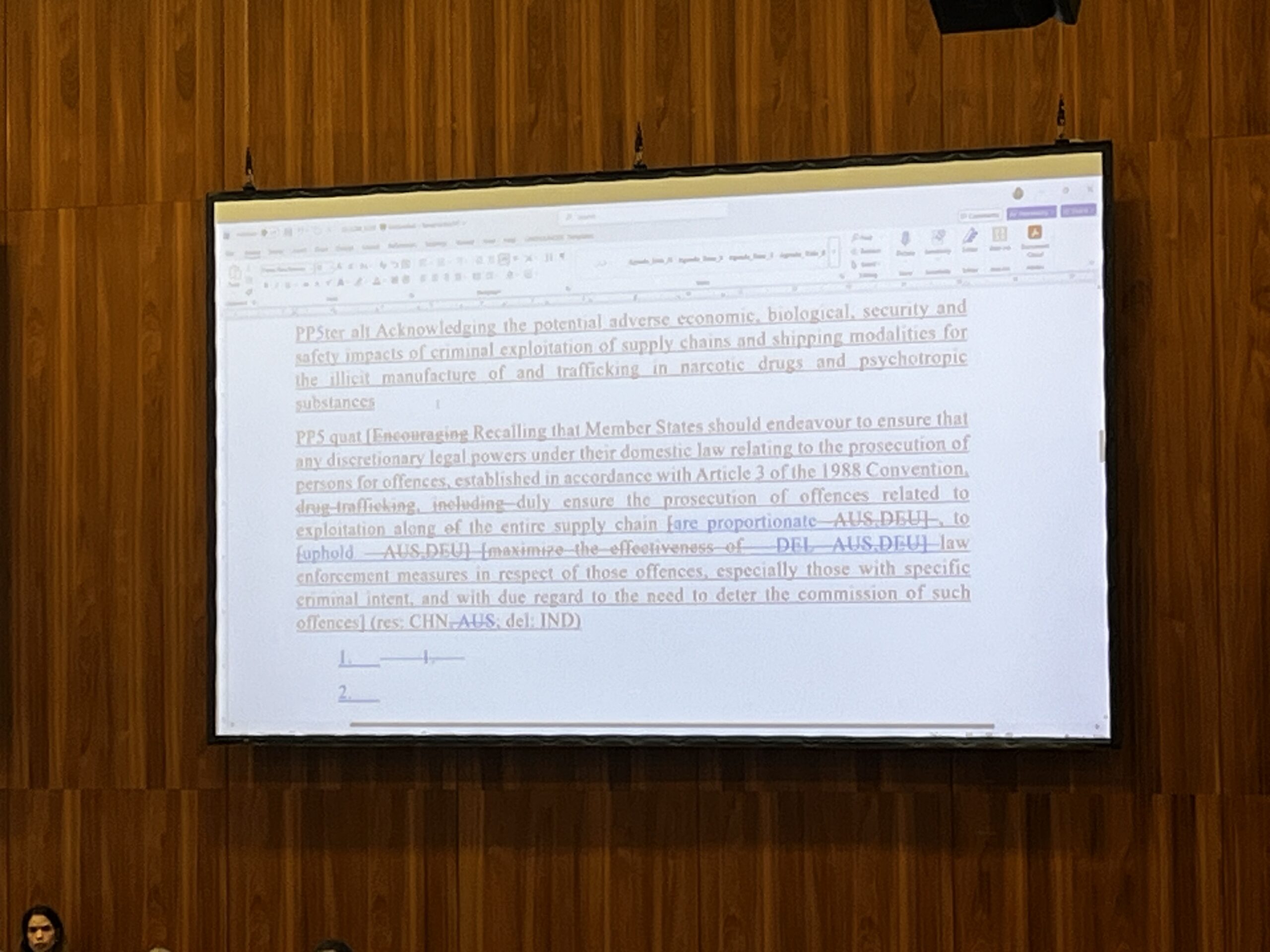 USA: yes
Chair: do others agree? I will allow you some time to read it.
China: we invite our sponsor to consider the difference between licit use and illicit use. You cannot just overlook legitimate use.
Chair: China, the rules of this game is that you now agree or object. So you do not agree.
Egypt: We object to PP5ter
Chair: I ask the sponsors how you would like the language reflected on the screen?
USA: we wish for it to be reflected as it is.
Mexico: As the original proponent of PP5ter we are fine with it going tomorrow.
PP5quat
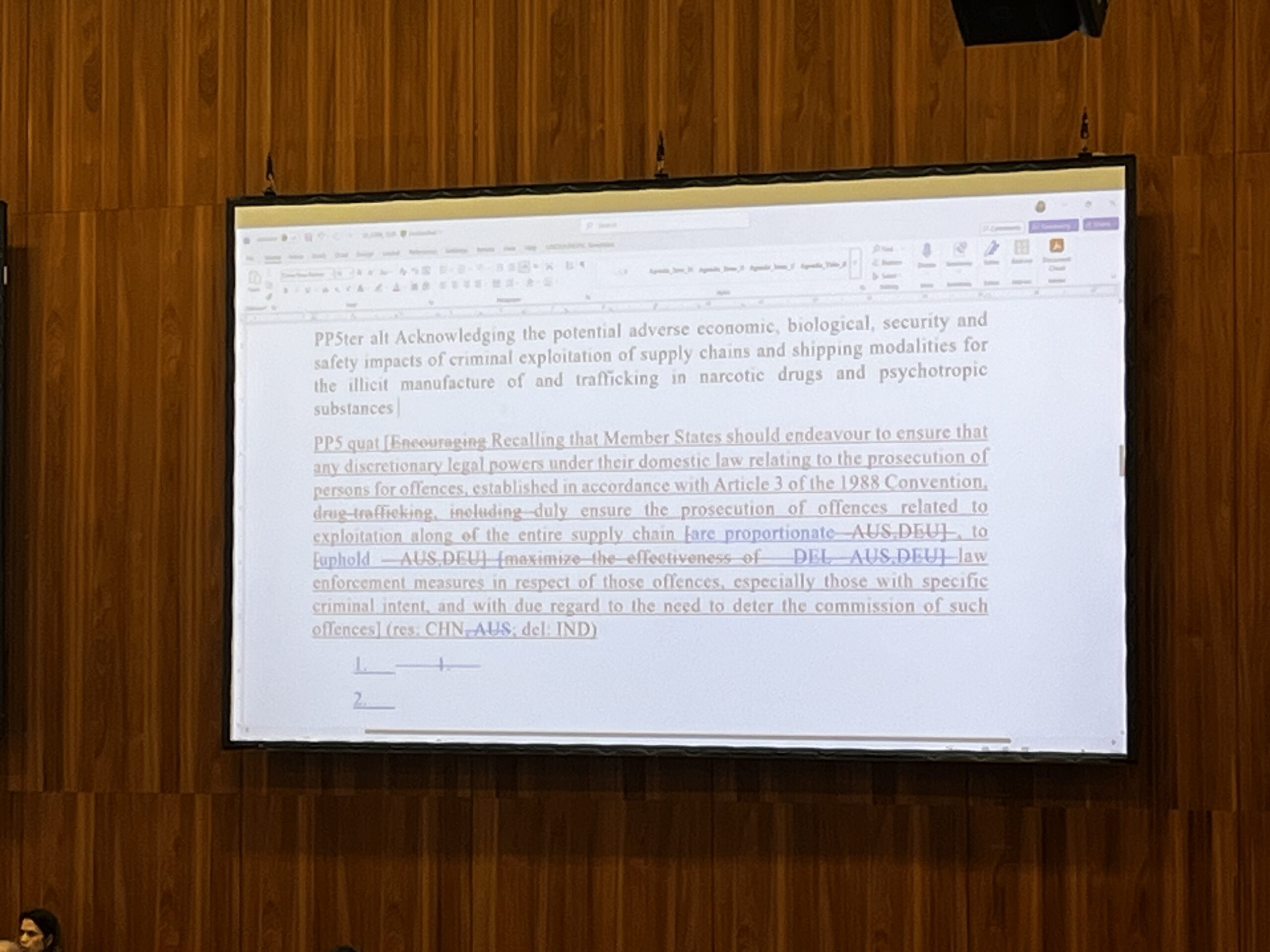 USA: PP5 quat should read “Recalling that Member States should endeavour to ensure that any domestic laws that offences established in accordance with the 1988 convention are exercised to facilitate the prosecution of offences related to exploitation along the entire supply chain.”
Egypt: the discretionary measures that we are talking about is related to offences established in accordance with article 3. Now we are expanding the discretionary measures. We object to it.
Chair: I thank Egypt for their clear statement. This is clear that it’s not agreeable. Sponsors, how do you want OP1 reflected?
OP1
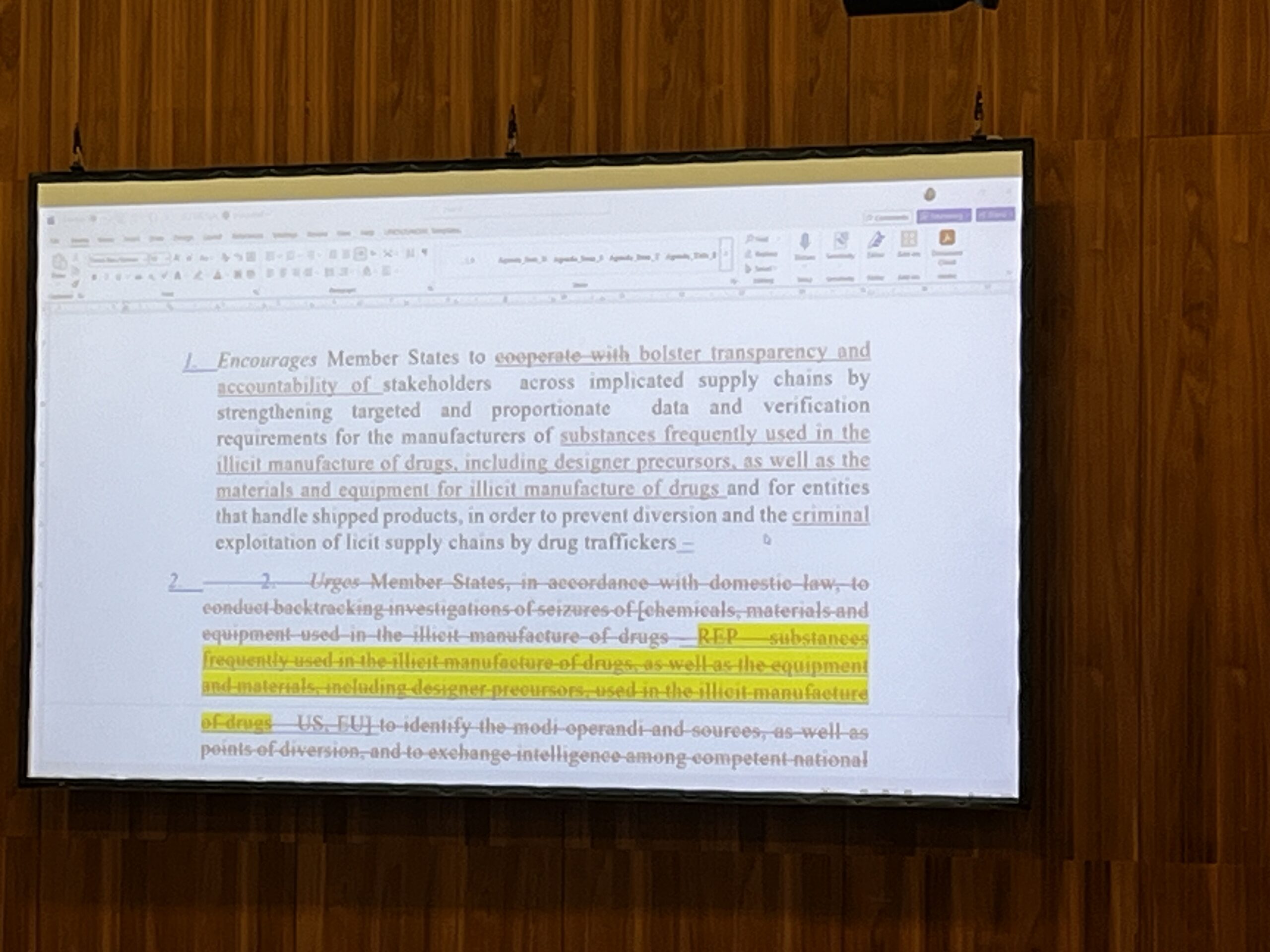 USA: Just give us a second to go through the OP. This is reflected accurately until “in order to prevent diversion”, this should be deleted.
China: I want one explanation. At the end of the para, China never said we wanted this section deleted. I maybe misunderstood that from the sponsor.
Chair: So this is not approved by the CoW.
OP2alt
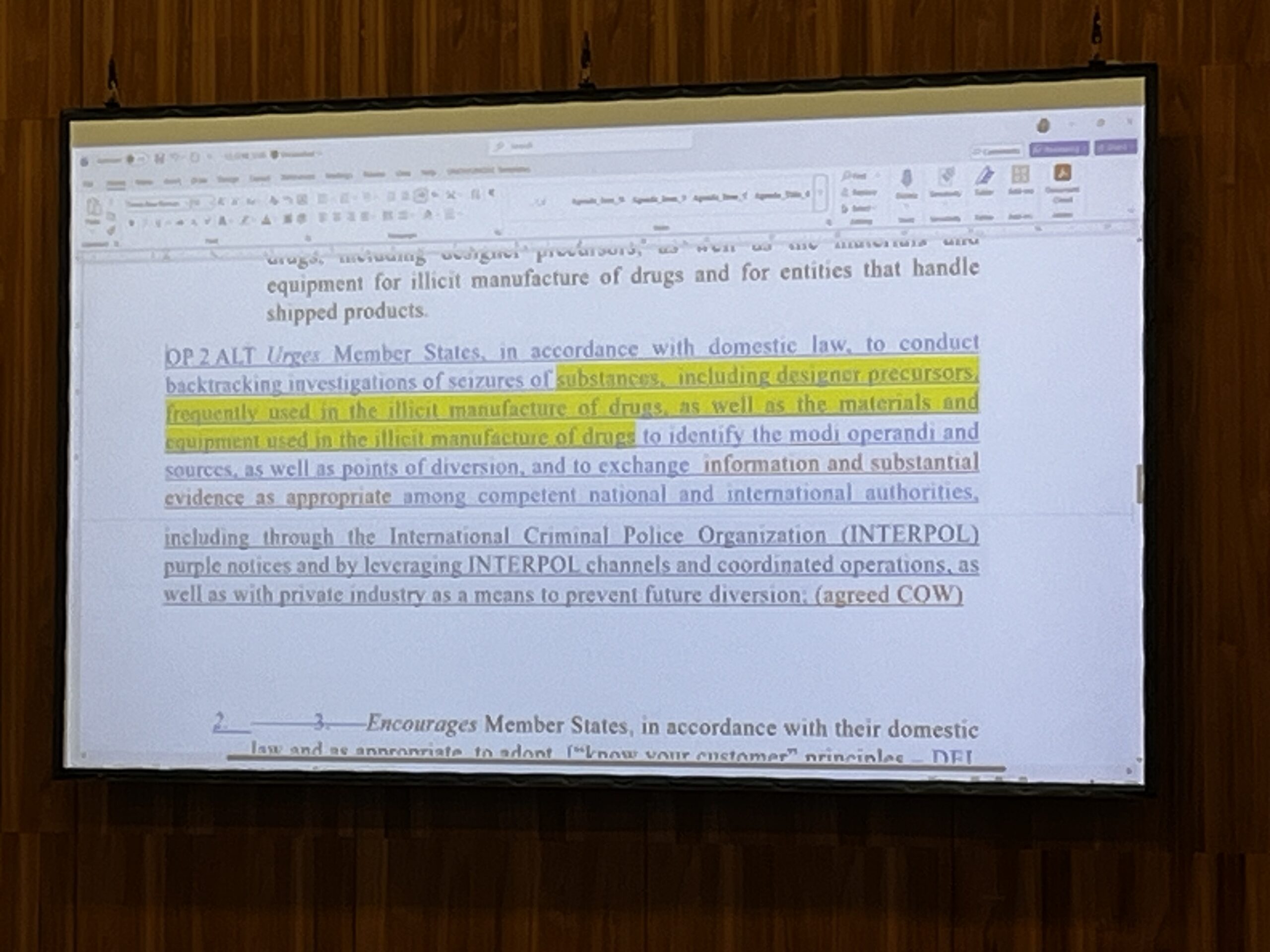 Chair: This is agreed in CoW, we are cleaning it up.
OP3
Chair: This one is deleted.
OP3alt
 USA: [Reads the latest version of the para]
EU: We had agreed earlier that “chemicals” was going to be replaced, so that needs to be changed.
India: This para as it currently stands introduces very onerous actions on a wide range of substances. Currently as it stands we do not agree with it.
Chair: I now turn to the USA to see if they want to adjust the para.
USA: Thanks to colleagues from the EU for catching that. We do want to use the formulation we so carefully crafted in place of “chemicals, materials and equipment”. This is how the para will be presented in Plenary.
India: This partially addresses my concerns, but again, the actions requested here are evry extensive and well beyond the mandate of the CND.
Chair: Not agreed, so we move on.
OP8
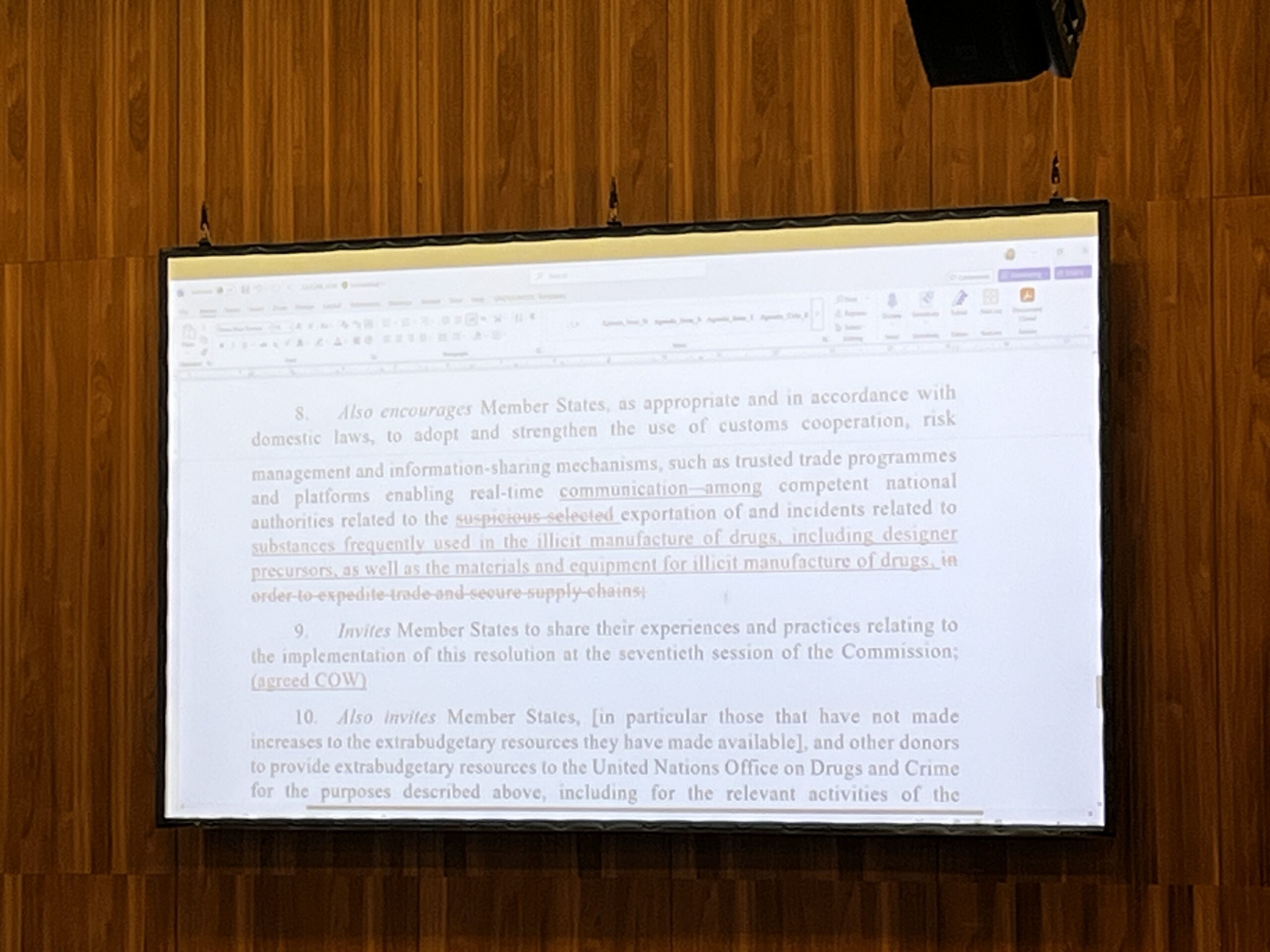 USA: We did agree to delete the last paet after “manufacture of drugs”.
Chair: Given the discussions we’ve had and time we have had to reflect on this text, is this agreeable to the group?
China: Not.
OP10
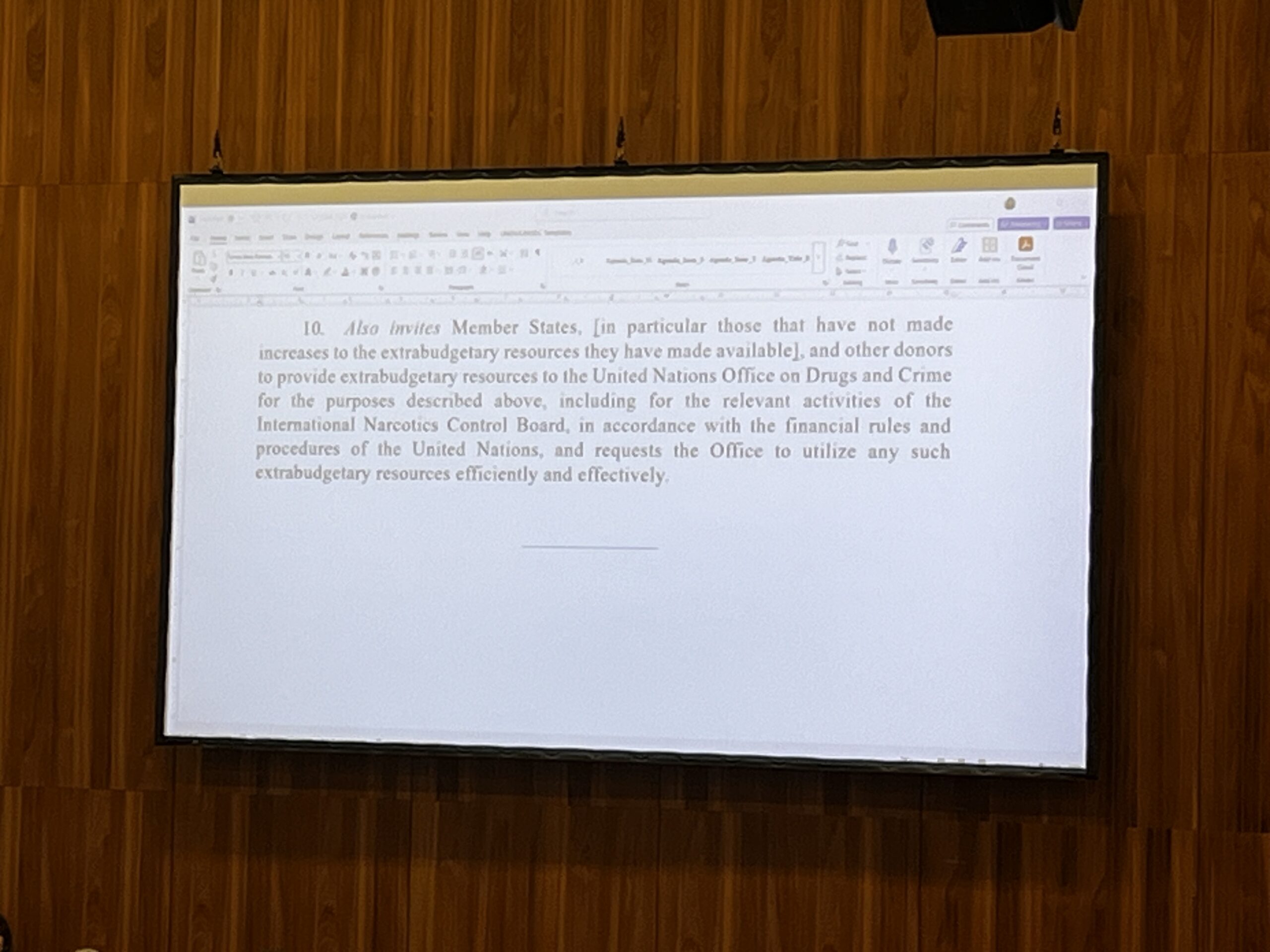 Chair: We heard what you said about it, but it’s not good enough. What do you want to put in front of the Plenary tomorrow?
USA: We are at the point where we will lift our objection and present this as is.
Egypt: No.
Title
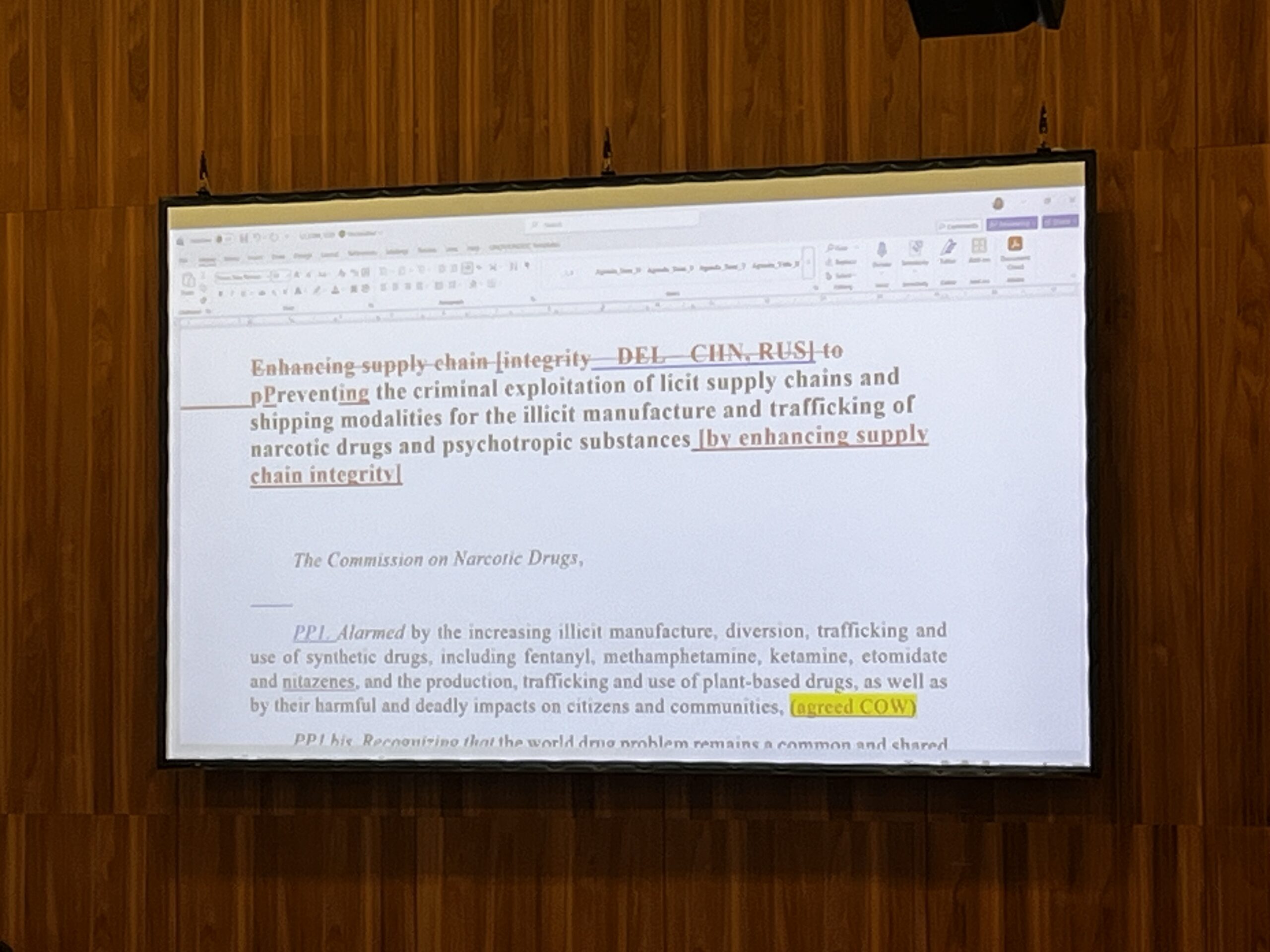 Chair: We now go to the title. How do you want to call your baby?
USA: We recognise the UNODC tweets referring to the resolution as the one on supply chain integrity. Therefore the formulation should be: Enhancing supply chain integrity to prevent the criminal exploitation of licit supply chains and shipping modalities for the illicit manufacture and trafficking of narcotic drugs and psychotropic substances.
China: We are happy to accept the previous amended one and do not accept this one.
Chair: We have agreed a lot but hope that we have not sweated in vain. We will transfer this text to the Plenary and note that it is not agreed text and it will be decided in the Plenary on the next steps, which is not my responsibility. I give you 5 mins and we come back to L5 and we will go over the text that will be presented to the plenary tomorrow.
L.5. Strengthening early warning mechanisms consisting of monitoring and assessment systems to enable effective responses to the emergence of new synthetic drugs, new psychoactive substances, precursors and precursor substitutes
Chair: We will now focus on a resolution on early warning mechanisms. They have been negotiating in the CoW and informals for a long time to bring this resolution almost to consensus. We’ll see if we can achieve this here, if not, we’ll bring to plenary for a sympathetic consideration. At this stage of our deliberations, this is the text that the sponsor will send to Plenary. Let’s see if we manage consensus on outstanding paras, if not, you can consider them for action tomorrow.
PP4
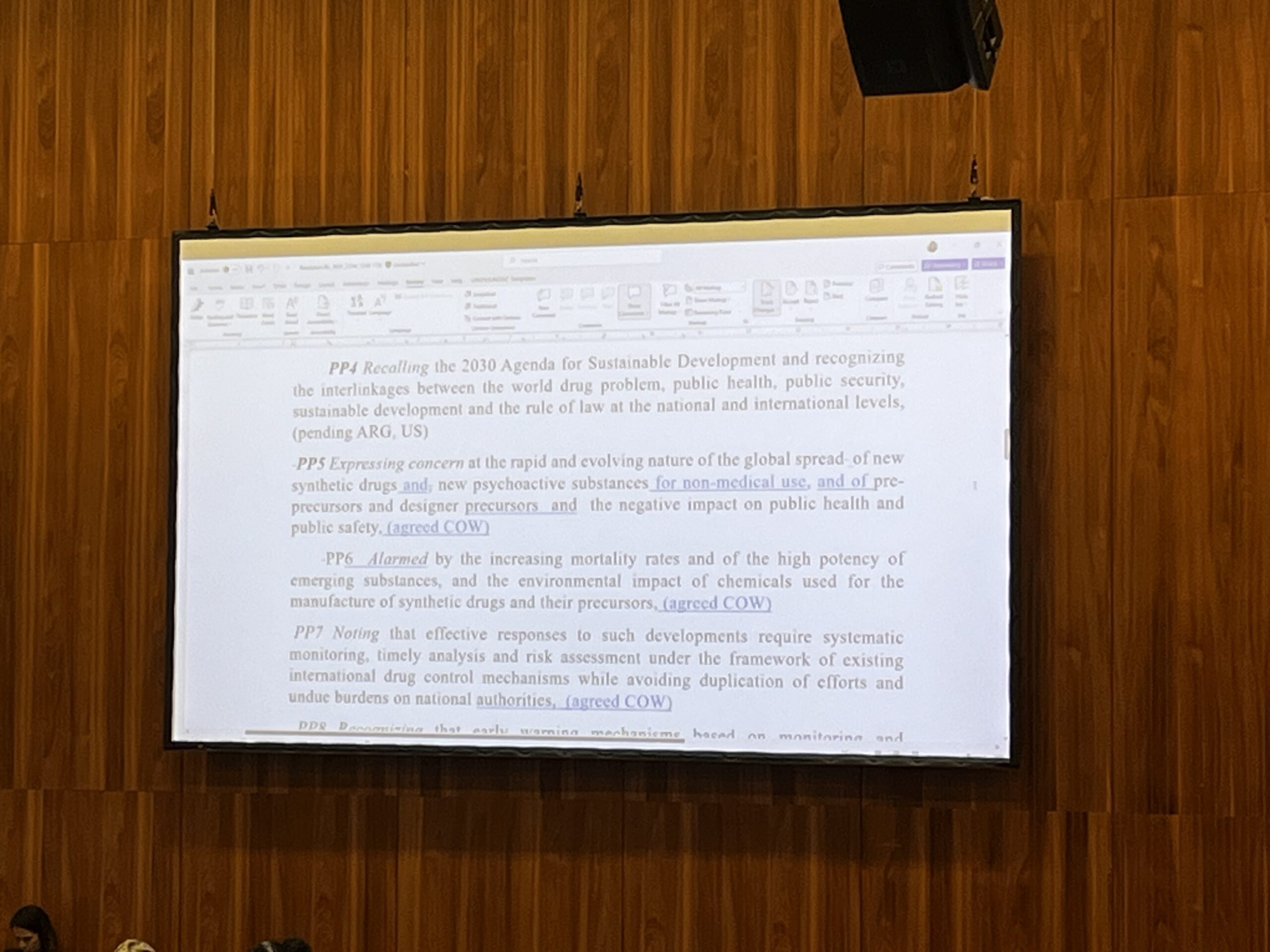 Chair: In an effort to seek consensus, this text was negotiated as now appears. Can this carry consensus?
USA: We’re not in a position to agree to this para. Are we in a state where we are in a position to propose textual amendments?
Chair: We have only 30 minutes to negotiate, so we ask only whether we can agree or not.
OP2
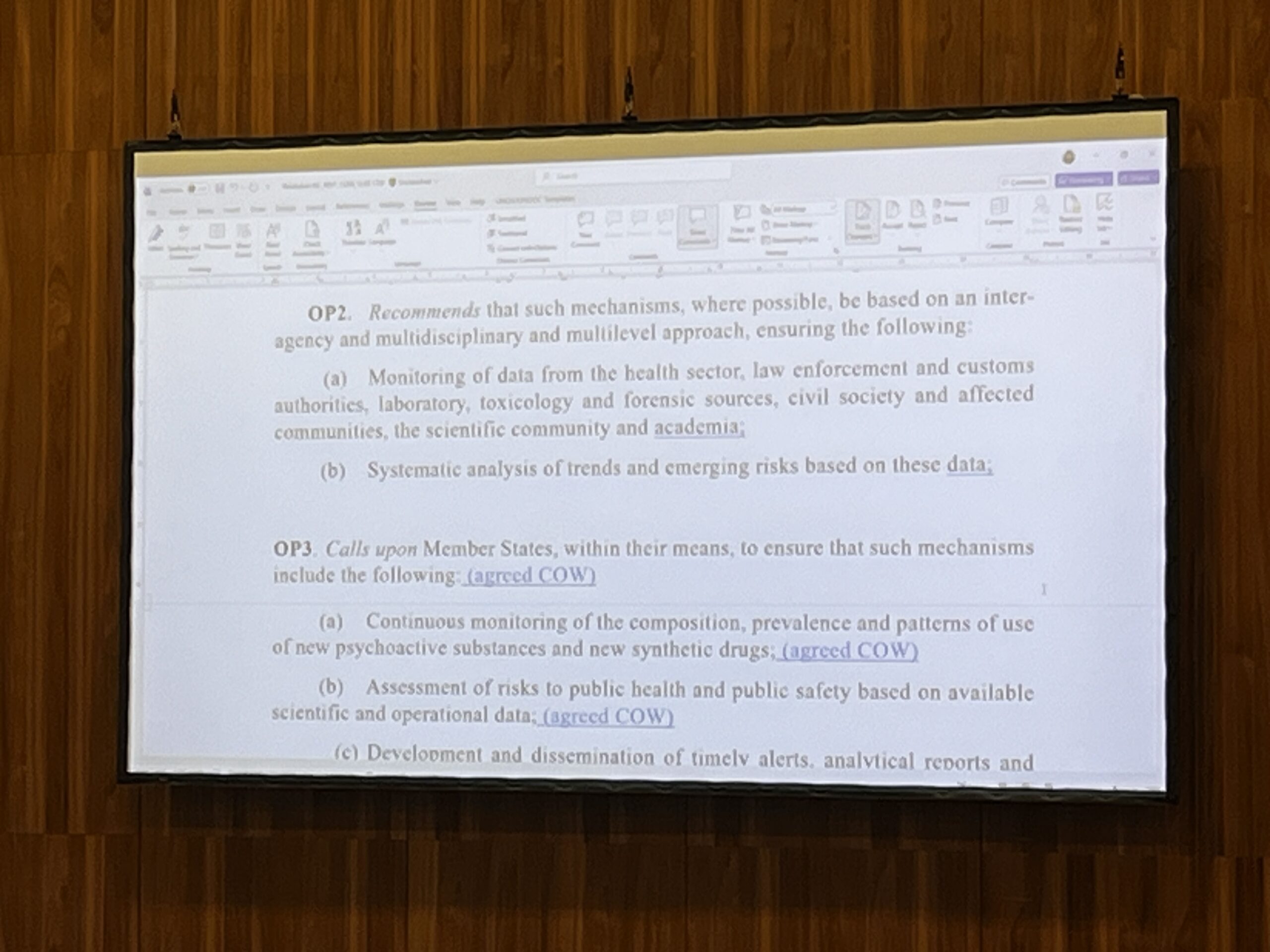 Chair: The sponsors are presenting the following text. Can this carry consent in the CoW? That seems to be the case.
OP5c
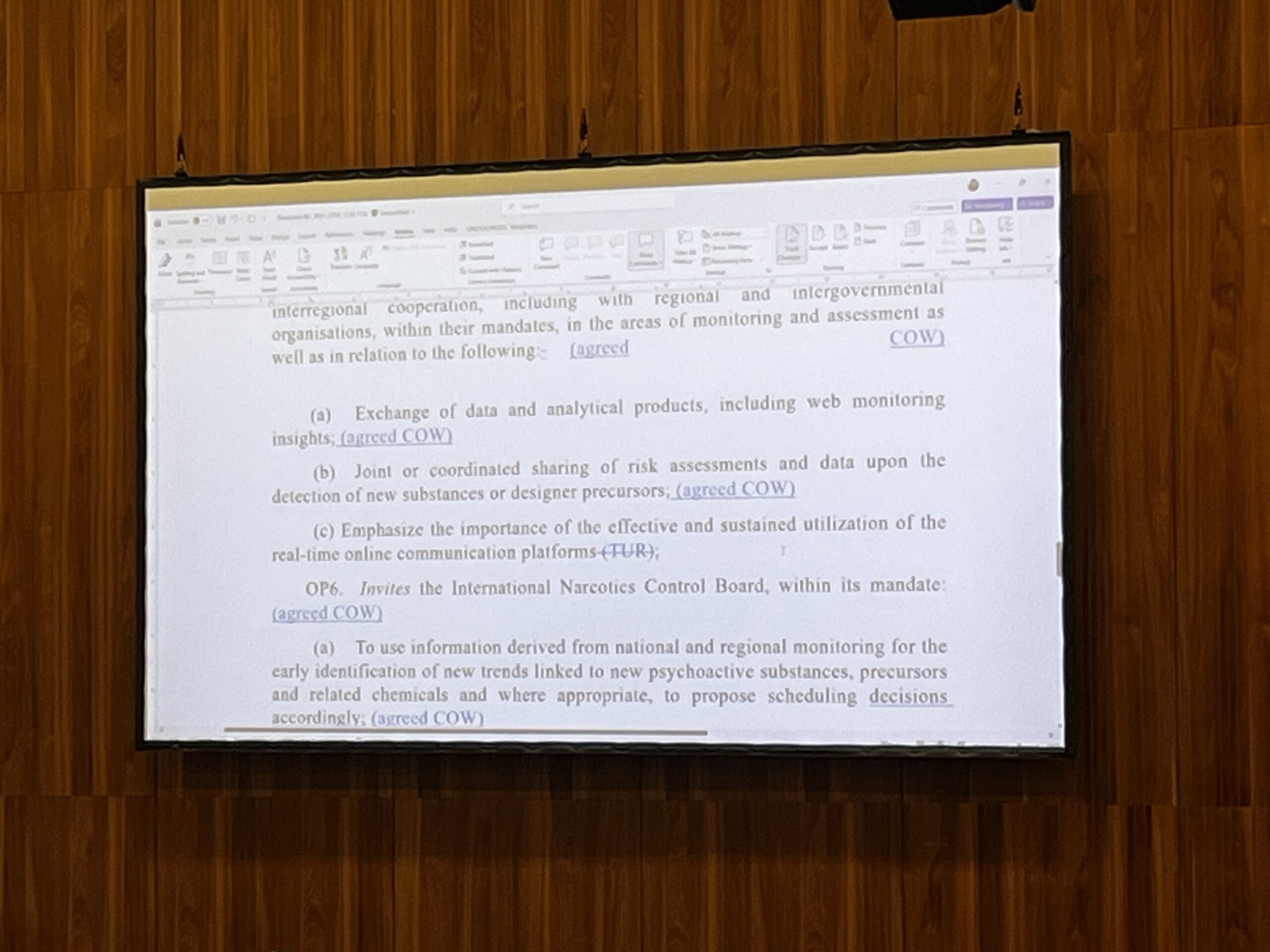 Chair: Can we have the consent of this room?
USA: A question as this was a new proposal. What are “real-time communications”? Conceptually we won’t stand in the way of this subpara, but this is a new proposal and I’m not sure I fully understand what it means.
Chair: It’s a fair question. We ask the sponsors.
Kyrgyzstan: The proposal was from Turkiye during informals. We are not sure whether to include this para. We talked about this with Turkiye and maybe I am confused and I explained to Turkiye that maybe there is not time to do this.
Chair: I can ask Turkiye what this is about or ask the sponsors to take it back. Maybe the representative for Turkiye has an explanation that can put people’s concerns to rest.
Turkiye: We believe this para can be good but to save time, maybe for consensus, if there is objection, we can take it off. If there is strong opposition, we can take it off.
Chair: what do the sponsors want?
Kyrgyzstan: We can delete it since there are questions about it where people do not understand.
OP7
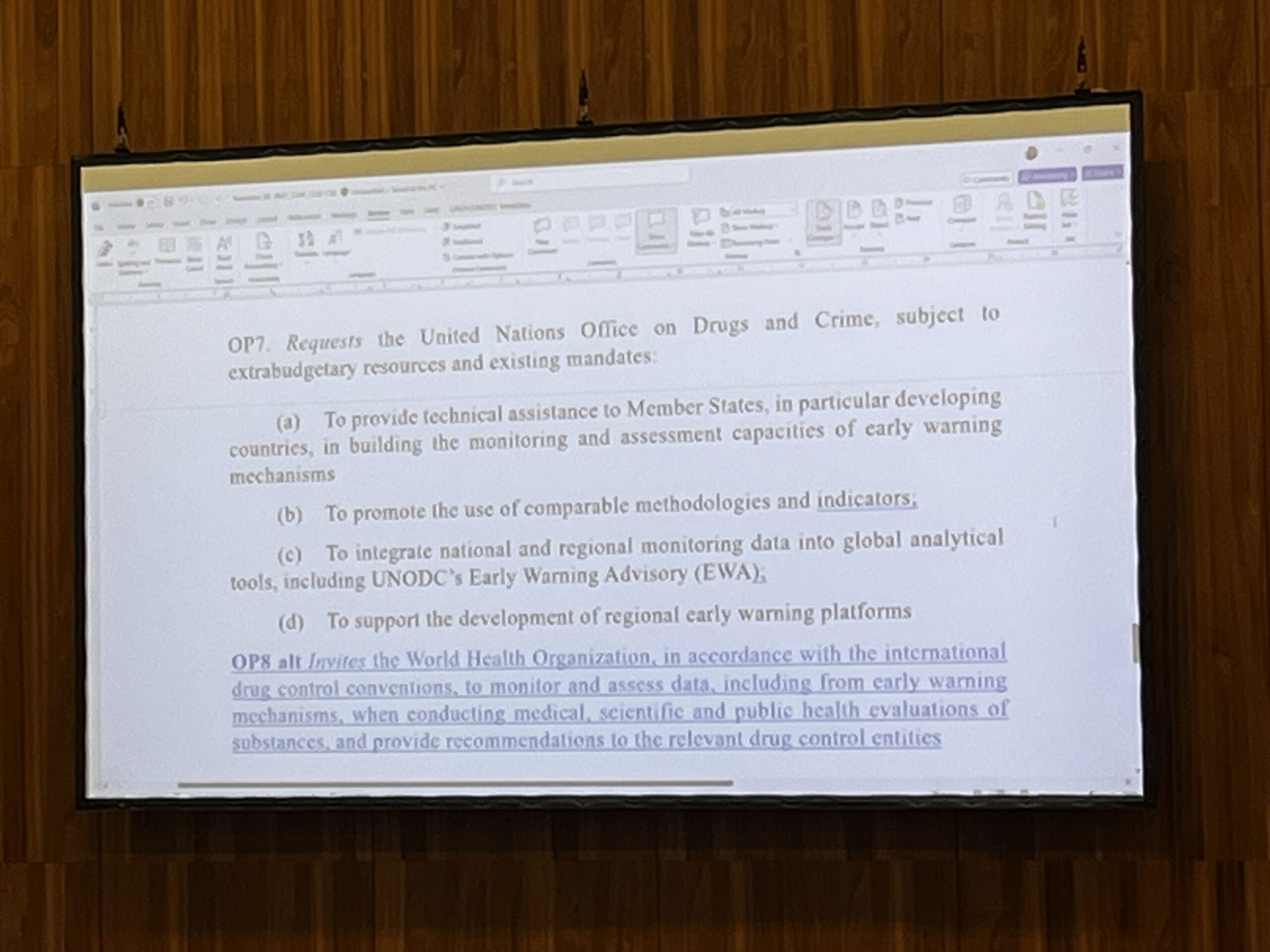 Kyrgyzstan:The US asked to replace “to develop” to “to support”
USA: I cannot accept this as it stands except for para a. I can accept the other paras. I think there was a misunderstanding, i had objected to one word but the entire sentence was deleted.
Chair: First I conclude that OP7 is not agreeable. I understand what you say but the sponsors were confused as to what it meant and was prepared to take it away. I prefer to leave it at that.
Turkiye: Thank you to the delegate of the US. If I insist we will lose time so i don’t want to do it. We can move on.
Chair: For now we have agreed OP6 but have not agreed on OP7.
OP8
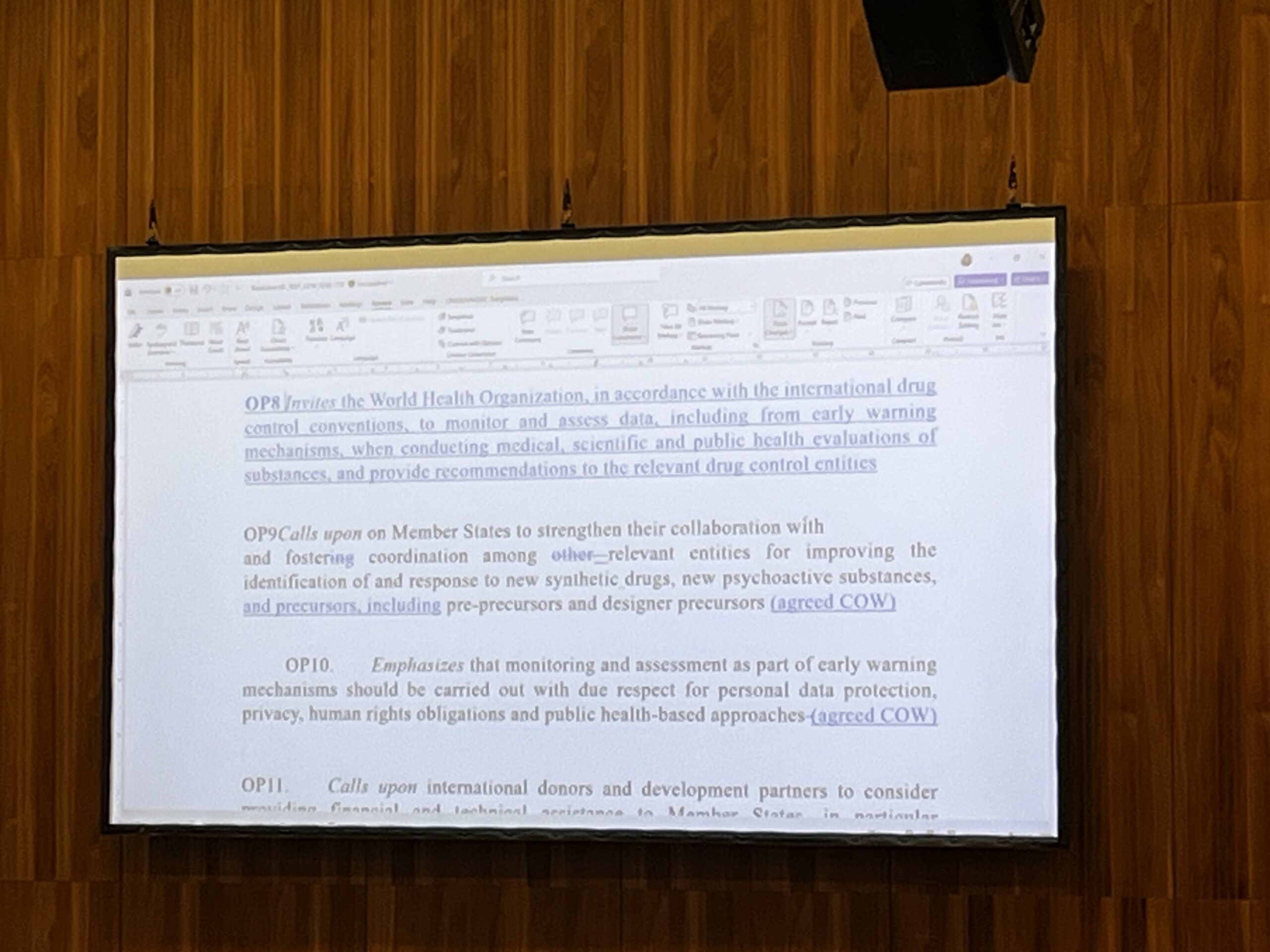 USA: We cannot accept that.
OP11
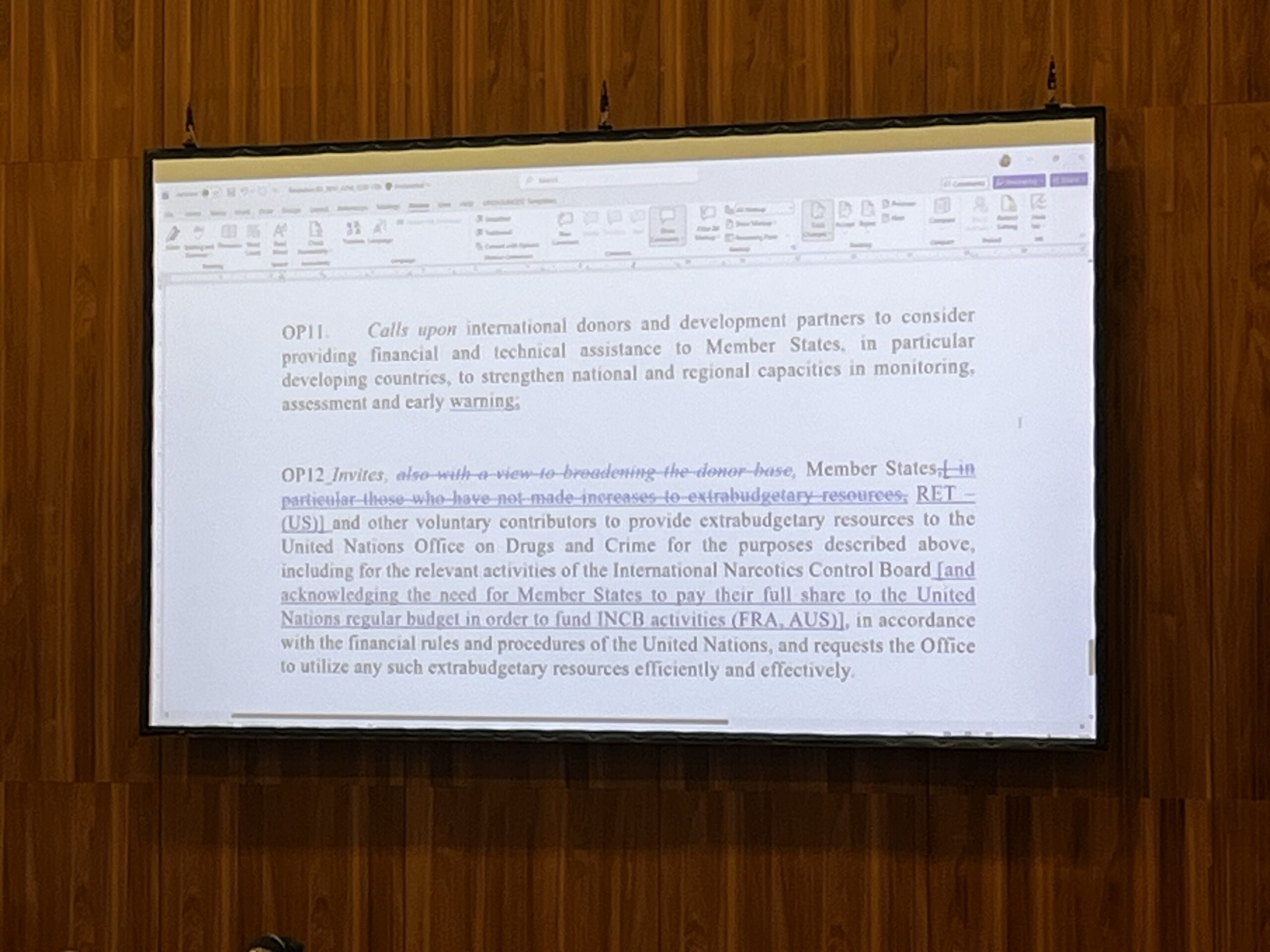 USA: I cannot accept this.
OP12
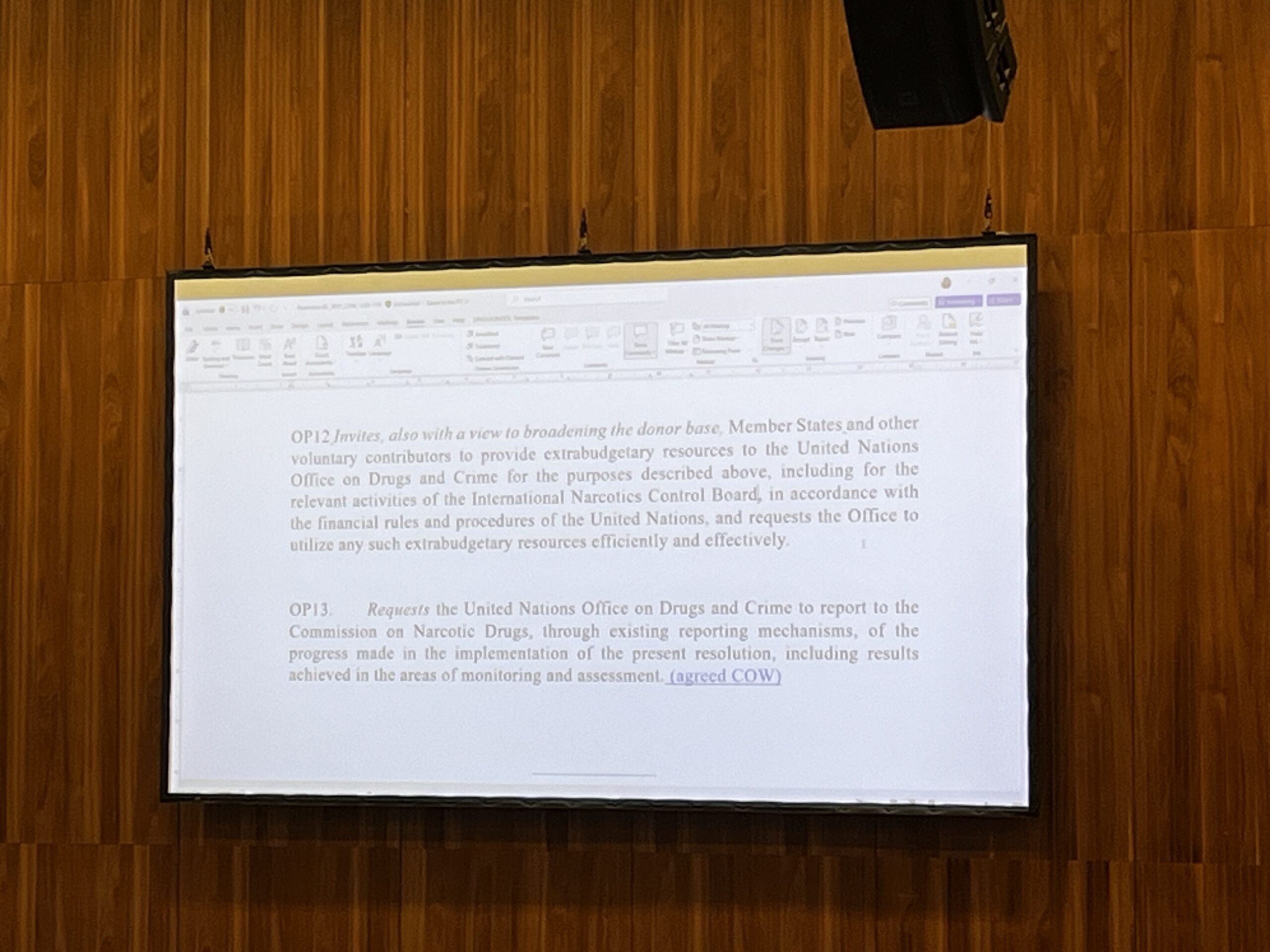 Chair: Turning to Kyrgyzstan to explain how you want this to be reflected tomorrow.
Kyrgyzstan: [reads the para]
Chair: This is agreed by the CoW. Many thanks to Kyrgyzstan for having provided us with a clear text. We have come to the end of consideration of L5. I note we had a considerable amount of paras agreed by the CoW. We did a good job, not good enough to achieve consensus. We will go to the Plenary with all this tomorrow. But thanks to Kyrgyzstan for bringing this forward and wish you success tomorrow in Plenary.
Mexico: We express our deepest appreciation to Kyrgyzstan for how they conducted the negotiations.
Chair: It’s not even 6pm and we have concluded the work of the CoW. I will now turn to the Secretariat to explain what is happening now, and how to get a hold of the texts sent to Plenary, and what will happen tomorrow.
CND Secretariat: We will uphold the revised versions that the sponsors have agreed to send to Plenary. Thank you.
Chair: Are there any questions on the procedure?
Mexico: What is the timing expectation tomorrow?
Chair: We will first look at the agenda for next year. Then I suspect that we’ll move to consideration of the resolutions. We ask delegations to be ready.
Turkiye: We can have a completely different text then?
Chair: No, you have all seen what will be presented to the PLenary, there will be no further change. Thank you, it’s been a great week,m you’ve been a great bunch, I thank you.
Armenia: Thank you, I wanted to wholeheartedly and sincerely thank you for your very hard efforts and for bringing as much consensus as was possible. It was really appreciated and we enjoyed your facilitation and peaceful approach. I ask for a big round of applause for you.
Chair: My pleasure! This meeting stands adjourned.