Annotated provisional agenda [ENG]
Chair (CND): We have a full afternoon and will start with agenda item five on implementation of the international drug control treaties. UNODC will report on its evidence-based work, including activities under resolution 66/3 and the Early Warning Advisory on new psychoactive substances. WHO will then provide an oral update on the outcome of the 48th meeting of the Expert Committee on Drug Dependence. After that, we will have an update on the implementation of resolution 68/6 on strengthening the international drug control system and the establishment of the INCB expert panel. Delegations may speak afterward and should indicate which issue they are addressing and keep remarks under three minutes. I invite Mr. Justice Tettey, Chief of the Drugs Laboratory and Scientific Services Branch of UNODC, to take the floor.
Justice Tettey (UNODC): The scheduling of substances under the three international drug control conventions remains a critical pillar of the global rule-based system of control, ensuring access for medical and scientific use while preventing misuse. In just over a decade, the number of new psychoactive substances has surged from 254 in 2013 to over 1,400 today. During this period, this Commission has acted on WHO recommendations to control 89 of the most harmful and persistent NPS. It has also placed 28 chemical precursors of amphetamine-type stimulants and fentanyl analogues under the 1988 Convention. The World Drug Report confirms that scheduling decisions guided by WHO recommendations have helped slow the alarming rise in NPS. Traditional drugs such as cocaine and amphetamine-type stimulants continue to pose major threats to health and welfare. The 2025 World Drug Report indicates that global cocaine production reached a new high of 3,708 tons in 2023, accompanied by increases in seizures, use, and cocaine-related deaths. The synthetic drug market continues to expand with no signs of slowing. New synthetic opioids continue to emerge, with 168 monitored by UNODC’s forensic early warning system. Ninety-eight fentanyl analogues have emerged, and nitazenes continue to increase, with 34 now reported. Ten such substances have been scheduled within five years, and WHO will recommend scheduling two more this week. Non-medical use of the anesthetic etomidate is increasing and has been detected in illicit liquids and vapes. Benzodiazepines remain persistent in cases of harm, including clinical admissions and impaired driving. Significant challenges persist in clandestine drug manufacture. The rise of designer precursors and the scaling of precursor chemicals complicate implementation of the conventions and law-enforcement responses. UNODC’s synthetic drug strategy offers a balanced, science-driven framework built on international cooperation, early warning systems, health responses, and enhanced counter-narcotics capacity. We will continue to provide accurate scientific information, strengthen national forensic capacity, enhance early warning systems, and provide tailored technical assistance to support implementation of CND scheduling decisions.
Mr. Mubakitsi (WHO): I will present the recommendations of the 48th ECDD, which met from 20–22 October 2025. WHO receives its mandate for pre-review and critical review from the 1961 Single Convention on Narcotic Drugs, as amended in 1972, and the 1971 Convention on Psychotropic Substances. These instruments task WHO with reviewing and assessing psychoactive substances and recommending whether they should be internationally controlled. WHO fulfills this mandate through the independent Expert Committee on Drug Dependence, which follows review guidance adopted by the World Health Assembly and the Executive Board. The committee’s advice concerns scientific, medical, and public-health findings and must comply with the criteria established by the conventions. Under the 1961 Convention, a substance may be scheduled if it is liable to similar abuse and produces similar ill effects as substances in Schedules I or II, or is convertible into a substance already in those schedules. Under the 1971 Convention, the criteria include the capacity to produce dependence or CNS stimulation/depression resulting in harmful effects, similarity of abuse potential, and sufficient evidence that the substance is or is likely to be abused so as to constitute a public-health and social problem.The substances reviewed at the 48th meeting were: the coca leaf, MDMB-FUBINACA (indazole-based synthetic cannabinoid), N-pyrrolidino isotonitazene (isotonitazepyne) and N-desethyl etonitazene.
The two synthetic opioids are nitazene-class synthetic opioids detected in illicit substances and counterfeit medicines. They are clandestinely manufactured, pose public-health risks, and have no recognized therapeutic use. They had never been reviewed and are not under international control. The committee found that they are synthetic depressants liable to abuse and produce effects similar to controlled opioids. N-ethyl etonitazene could theoretically be converted into a controlled substance. Use can cause substantial harm. The recommendation is to add both to Schedule I of the 1961 Convention. Coca leaf is defined in the 1961 Convention as the leaf of the coca bush except where all cocaine alkaloids have been removed. A party to the Convention explicitly requested review. Historically, coca leaf chewing was discussed in 1952 and 1954 by WHO experts, who considered it a form of addiction. The leaf was placed in Schedule I of the 1961 Convention. A pre-review in 1992 considered the scheduling appropriate because cocaine is readily extractable. Coca leaf remains in Schedule I, defined as wholly liable to abuse and constituting an especially serious risk to public health with very limited therapeutic usefulness. The committee reviewed convertibility and found that extracting cocaine from coca leaf is straightforward, requires no special expertise, is highly profitable, and therefore meets the criteria for convertibility. Traditional coca use by chewing or in tea does not appear to pose serious public-health risks, though long-term safety is not well documented. Coca leaf holds significant cultural and therapeutic importance for Indigenous peoples, and some national frameworks provide exemptions. Emerging research suggests possible therapeutic applications, but current evidence is insufficient. The recommendation is to retain coca leaf in Schedule I of the 1961 Convention.The synthetic cannabinoid MDMB-Fubinaca is a receptor agonist found sprayed onto herbal products. WHO received information that it is clandestinely manufactured, poses public-health risks, and has no therapeutic use. It has never been reviewed and is not under international control. Its effects are similar to other Schedule II synthetic cannabinoids under the 1971 Convention. It has been associated with severe adverse events, including death. The committee recommends adding MDMB-Fubinaca to Schedule II of the 1971 Convention. Background procedures and full meeting outcomes will be published in early 2026 and made available on the WHO website.
Chair: Recognizing that delegations may wish to respond to the WHO presentation, we will move to the item on implementation of resolution 68/6 on strengthening the international drug control system. The Commission had to establish a multidisciplinary panel of 19 independent experts. The extended Bureau undertook extensive work with the Secretariat across four meetings in May, June, September, and November. We addressed funding, process, and timelines and made considerable progress. On 13 May, the Bureau emphasized that adequate extra-budgetary resources were essential and requested an issues paper and resource estimate. At the 26 June meeting, we determined that written funding pledges were necessary before launching the nomination process. Given the internal consultations required within governments, we set 31 August as a reasonable deadline.b We said that 31 August was a reasonable timeline. On 4 September, we reviewed initial pledges, which were a little short, but decided to proceed based on what we assessed as the minimum requirement for at least two in-person meetings for the Panel, estimated to cost 440,000 US dollars. We planned a phased nomination process.
Tthe Panel has two pathways: five nominees by the UN Secretary-General, one by WHO, and four by the INCB, along with two experts from each regional group. The Secretary-General, WHO, and INCB submitted nominations by 15 October, which we shared with all permanent missions, along with short bios. Regional groups were requested to nominate two experts by 15 November. Currently, nominations have been received from three regional groups, while two are pending. We will return to that issue, but first it is useful to hear from the Secretariat about the current status of funding, nominations, and other details.
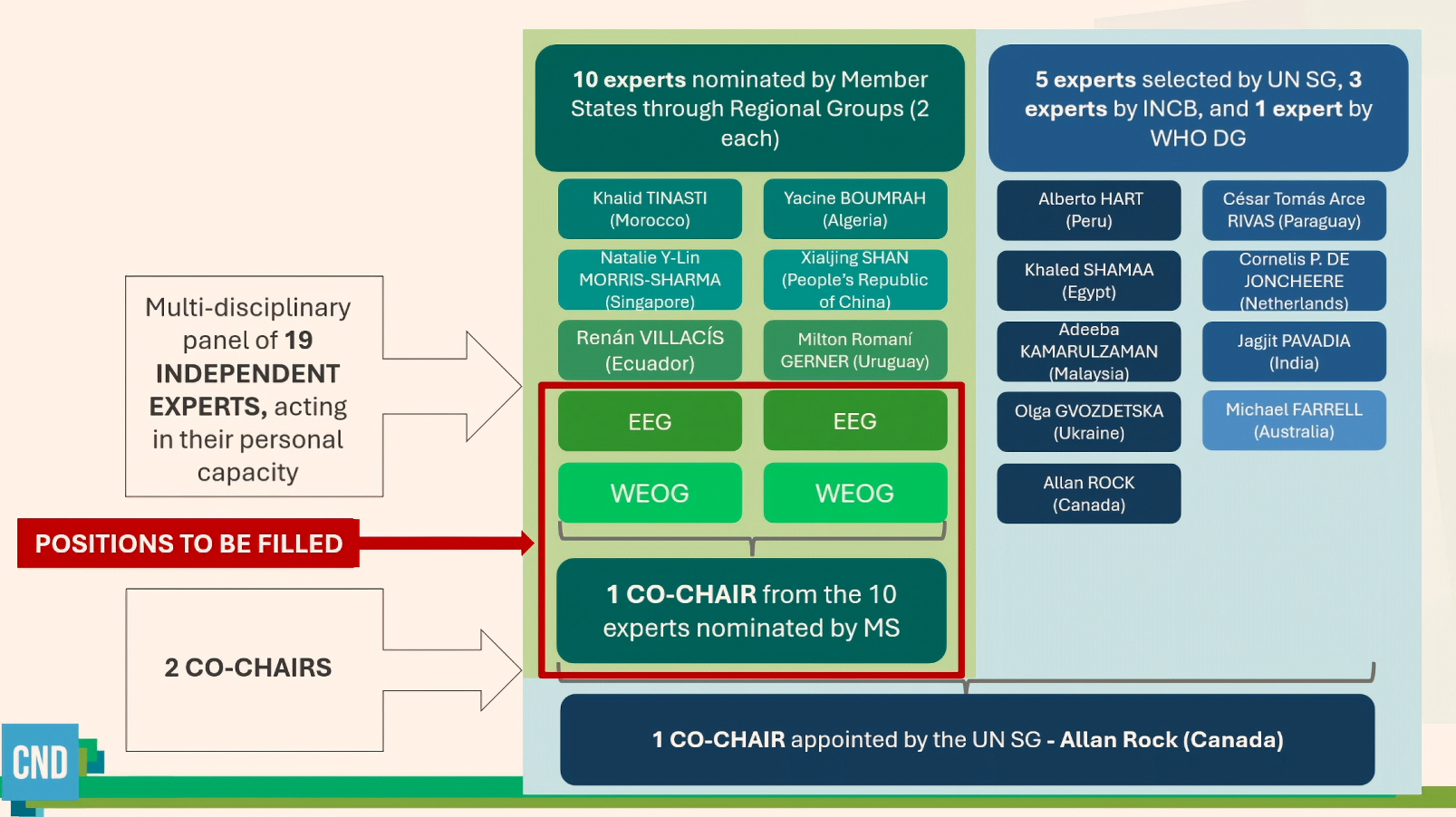
Secretariat: I will share further details. The extended Bureau met on 13 May, and we prepared papers summarizing the resolution, key questions regarding implementation, and a resource estimate. The estimate was approximately 900000 US dollars to hold three in-person meetings, cover staff support, and prepare reports in six languages, as well as interpretation for the in-person meetings. At the 26 June extended Bureau meeting, member states were invited to pledge contributions by 31 August. Confirmed pledges were received from Colombia, Portugal, and the Netherlands. At the 4 September Bureau meeting, the threshold of approximately 440000 US dollars was confirmed as the minimum to hold two in-person meetings. A second call for pledges was issued. By 15 November, additional confirmed pledges were received from Austria, Uruguay, Canada, and Switzerland, bringing the total to approximately 458000 US dollars. On 17 November, we reported that the threshold of 440000 US dollars had been met. This funding allows for two in-person meetings in English of up to three days for 19 experts, including economy class travel and DSA, as well as virtual exchanges. Partial staff support and report preparation in English are also covered. After this meeting, Belgium contributed approximately 29000 US dollars, bringing the total to 487000 US dollars. Some pledges are still pending transfer.
Regarding nominations, the Panel consists of 19 independent experts with balanced geographic representation, expertise in relevant fields, and diverse policy approaches. Experts are selected as follows: 10 nominated by member states through the five regional groups (two per group), five by the UN Secretary-General, three by INCB, and one by the WHO Director-General. Nominations received from the Secretary-General, WHO, and INCB include Mrs. Oga Falls, Professor [Malaysia], Mr. Alan Rock (Canada), Ambassador Talib Sharma (Egypt), and Mr. Alberto Hart (Peru). From member states, the African Group nominated Mr. Yasin Boomer (Algeria) and Dr. Khalid Tinasti (Morocco); the Asia Pacific Group nominated Mrs. Natalie Maurice Sharma (Singapore) and Mrs. Zhao Jian (China); and the Latin American region nominated a candidate from Ecuador.
Chair: This process is complex, balancing geography and policy. While some funding has been received, there remain reservations about conducting all meetings in English due to limited funds. The Panel is expected to begin formal work in March following the regular CND session. We need to decide on the regional group nominations. I propose the Commission endorse these 15 of 19 nominations (shown on screen). The two remaining regional groups should continue consultations and inform us if consensus cannot be reached, so elections can occur in March. One co-chair will also need to be selected from the 10 nominees from regional groups. Do we have the endorsement of the Commission for these nominations?
It is so decided. The two remaining regional groups should continue consultations to reach consensus or notify us if elections are necessary.
This concludes comments on this agenda item. I now open the floor for interventions.
Belgium: Belgium aligns itself with the statement delivered by the EU, but I would like to highlight the following points in my own capacity, particularly regarding the subject just discussed. The global drug crisis threatens health, security, and stability worldwide, and confronting this challenge is among the most urgent priorities of our time. It calls for a robust and coordinated international response grounded in respect for international law and human rights, strengthened through interagency cooperation.This Commission holds central responsibility in this effort. The multidisciplinary expert panel established by CND resolution 68 last March offers a unique opportunity to assess the shortcomings of our current approach and develop concrete, innovative solutions guided by evidence-based, balanced, and inclusive drug policy. Belgium is ready to support the panel’s work constructively. As you saw on the charts, Belgium has provided around €25,00 in financial support and has nominated our compatriot, Mr. Alex Egos Deal, Executive Director of the European Union Drugs Agency, to serve as an expert on the panel. We are aware of competing candidacies within various regional groups, underscoring the importance of the panel’s mandate. We hope for a swift agreement on the candidates, either within the regional groups or through the establishment of CND procedures, to ensure the panel delivers tangible outcomes that can drive transformative change.
Dominican Republic: We echo earlier congratulatory remarks to the Chair and wish to reaffirm our commitment to the full and effective implementation of the international drug control treaties: the 1961 Single Convention on Narcotic Drugs, the 1971 Convention on Psychotropic Substances, and the 1988 Convention against Illicit Traffic in Narcotic Drugs and Psychotropic Substances. These treaties form the keystone of the multilateral drug control system. Our government has prioritized combating drug trafficking and protecting our youth. From August 2020 to July 2025, the National Counter-Drugs Directorate implemented comprehensive reforms, strengthening our capacity to meet obligations under these treaties and counter emerging threats. Compliance with the 1961 and 1971 Conventions is maintained through licensing, registration, inspection, and control over hospitals, pharmaceutical companies, private clinics, and health professionals, while guaranteeing access to substances for legitimate purposes. We recognize the threat posed by synthetic drugs and new psychoactive substances and have adopted a multidisciplinary approach, including establishing a Department on Synthetic Drugs, issuing Presidential Decree 585/24, and reforming Bill 58 on precursors and emerging technologies. The Dominican Republic engages closely with INCB, Interpol, NLA, EU, and US Marshals in information exchange and operations.b Prevention and education remain essential. Over 40,000 individuals, particularly youth, have received training and information, reinforcing protective factors in schools. We reaffirm our commitment to international cooperation and the multilateral community to protect societies, especially youth, from drug trafficking and organized crime.
Indonesia: Indonesia aligns with the statements made by G77 and China. We reaffirm our commitment to full and effective implementation of the international drug control conventions. Regarding the substances reviewed by the Expert Committee on Drug Dependence in October: Indonesia welcomes the recommendations concerning coca leaf. NBMB is already controlled under Indonesia’s national regulations. Indonesia has not yet recorded confirmed domestic cases involving new psychoactive substances (NPS), but international forensic reports indicate these substances pose a serious threat. Indonesia underscores three priorities: Strengthening international toxicology data, regulatory findings, and information exchange to prevent infiltration of potent substances. Enhancing capacity in forensic laboratories, including access to reference standards for nitazenes and other opioids, ensuring accurate detection and rapid public health responses. Encouraging continued discussion and flexible legal and regulatory approaches, including class-based scheduling to address structurally modified synthetic opioids.b Indonesia reaffirms its commitment to working with UNODC, WHO, INCB, and member states to strengthen early warning systems, cross-border cooperation, and collective action against emerging synthetic drugs.
Venezuela: Venezuela thanks the permanent representatives of India and Mexico for their reports. We support statements delivered by the G77, China, and others, and wish to share the following in our national capacity: Venezuela remains committed to addressing the world drug problem in accordance with international law, the UN Charter, and the Universal Declaration of Human Rights, respecting sovereignty, territorial integrity, and the principle of non-intervention. However, recent actions by the United States in the Caribbean and Pacific, including the deployment of over 14 war vessels and 15,000 troops, have created a grave precedent, threatening regional peace, security, and stability. These actions have included more than 20 lethal strikes against vessels, causing extrajudicial killings of over 80 people.We stress that drug control measures must comply with international law, due process, and human rights. We call on the international community to uphold the UN Charter and reject unilateral use or threats of force.
China: China supports and actively implements the three international drug control treaties. Measures include monitoring and regulation of 524 narcotic and psychotropic substances, class scheduling fentanyl-related substances, synthetic cannabinoids, and mutagenic substances, and controlling 47 precursor chemicals. China appreciates CND, UNODC, INCB, and WHO efforts to strengthen monitoring, assessment, and scheduling of substances, emphasizing that decisions should be prudent, cautious, science-based, objective, fair, and impartial.
Turkey: … UNODC should continue to guide international drug policy. Turkey supports capacity building and international cooperation. Between 2018 and 2025, 45 international operations were conducted by the Turkish National Police Counter Narcotics Department, training law enforcement officers from 55 countries through the Counter Narcotics Academy. Turkey also addresses the nexus of drug trafficking, human trafficking, and terrorism, citing the PKK’s involvement in synthetic drugs and money laundering. Turkey emphasizes the importance of monitoring the impact of conflicts on drug production and trafficking routes, particularly in Syria, Ukraine, and Afghanistan. Finally, Turkey expresses concern for the Palestinian people, supporting UN Security Council Resolution 2803 and the implementation of a two-state solution, urging countries to abide by obligations arising from drug control conventions.
Japan: The threat of organized crime must never undermine global security. The drug problem presents pressing challenges for both public health and public safety. Regarding the four substances reviewed by WHO, three—MDMB-Fubinaca and synthetic cannabinoids—pose evolving dangers. They can cause agitation, sedation, memory loss, and, tragically, hospitalizations. Japan moved 50 years ago to designate these substances as controlled and continues to refine monitoring so similar compounds can be controlled promptly. Two other substances under review have no definitive toxicological record yet, but their mechanisms suggest effects stronger than fentanyl. Japan treats this possibility with utmost seriousness. One substance is already designated domestically; the other remains under monitoring. We maintain heightened surveillance and are prepared to act immediately as risks become clear. This demonstrates our commitment to tailoring substance-specific responses in light of evolving synthetic drug production. We value evidence-based information gathered and shared by UNODC and INCB, which strengthens the world’s ability to respond promptly and reinforces global capacity. Japan supports UNODC programs, forensic science initiatives in Southeast Asia, drug abuse prevention, treatment, and responses to drug-related crime, including smuggling. Comprehensive control of new psychoactive substances allows regulation even before they appear. Japan will continue to work closely with UNODC to implement international drug control conventions and advance global safety from drug-related harm and illicit networks.
Colombia: Regarding the recommendations published by the Expert Committee on Drug Dependence concerning the coca leaf review, Colombia values the committee’s work and recognizes the cultural and therapeutic significance of coca for indigenous peoples and other communities. This is progress. However, we are concerned about the treatment of coca under the international system. It is neither fair nor consistent with criteria applied to other substances. The committee continues to use technically inaccurate terms like “convertibility” without clearly referencing the extraction process, leading to treaty-based implications that must be addressed. Scientific conclusions from the 1950s indicate coca use poses limited risk to public health. There are no documented fatalities, and adverse impacts are minor. The current evidence does not justify treating coca as a harmful substance comparable to others in Schedule I. Cultural acknowledgement alone is insufficient when scientific evidence is disregarded. Colombia remains ready to work with member states, WHO, and CND to establish a more balanced system that respects cultural diversity and is based on up-to-date evidence. Regarding the implementation of Resolution 68/6, Colombia notes significant setbacks and procedural decisions that have created unforeseen barriers, affecting predictability and the Commission’s credibility. We are concerned about the postponement until March 2026 of elections for regional group nominees and the second co-chair. This delays the panel’s ability to meet deadlines and goals. Colombia emphasizes that the financial contributions received reflect member states’ shared interest in operationalizing the panel. As a major contributing country, Colombia calls on the panel and extended Bureau to adopt measures ensuring the panel can begin work before March 2027. Prompt action will enhance credibility and reflect member states’ commitment. Finally, we echo the Chair’s call for further financial contributions to facilitate the panel’s operationalization.
Australia:The situation remains complex and multifaceted. Recent discussions at the CND and intersessionals show a concerning surge in drug production, particularly synthetic drugs. These trends underscore the urgent need for coordinated international responses, enhanced monitoring, and targeted, evidence-based interventions to address the drivers of increased drug production and its social, health, and security impacts. From a public health perspective, the proliferation of potent synthetic drugs and their infiltration into the global drug market pose serious risks, including overdose for people who use drugs. These risks persist and evolve due to the adaptive nature of drug trafficking and supply syndicates. Evidence-based harm reduction interventions must be incorporated into frontline responses alongside supply and demand reduction. Responses aimed at preventing and reducing drug-related harms are more effective when they strengthen protective factors, address social determinants, reduce stigma and discrimination, and improve health literacy. All drug control policies should respect universal human rights, be gender-responsive, and address the specific needs of communities and populations in vulnerable situations. Australia continues to call for the abolition of the death penalty in all circumstances, particularly for drug-related offenses, which do not meet the threshold of “most serious crimes” under international law. Australia welcomes the adoption of Resolution 68/6, establishing an independent expert panel to provide recommendations to enhance implementation of the international drug control conventions and international drug policy commitments. Australia remains committed to working constructively with the Commission, including through member state consultations with the expert panel, as we work toward 2029 and our shared commitments.
Russia: The Russian Federation fully supports the INCB and its work assisting states in discharging their obligations under the three UN anti-drug conventions. We hope the INCB will continue pursuing a principled and unbiased line regarding the inadmissibility of legalization of narcotic drugs for recreational purposes. We also hope it will not allow its work to be influenced by an unjustified imbalance in favor of human rights —which lie outside its mandate — and would lead to waste of limited resources. The liquidity crisis cannot be an excuse to underfund this key UN body. Complete discharge of INCB functions is vital for countering the global drug threat and ensuring effectiveness of the current drug control system, especially amid increasing violations of international obligations and the spread of synthetic drug precursors, including those not yet under international control. The second issue concerns inequitable distribution of narcotic medicines. Russia contributes to increasing availability of controlled substances for medical purposes. The Russian Federation is a key donor to INCB Learning, which conducts training worldwide to increase availability and improve government reporting on convention implementation. In January in Nairobi, with Russia’s participation, a training was held for regulatory bodies from ten African countries. In August, a similar event was held for eleven francophone African countries. The last part pertains to the expert group under Resolution 68/6. During discussions of the non-consensus resolution in March, all participants agreed that success depends on depoliticized discussions, geographic representation, and balance between drug control approaches. Based on this understanding, Russia proposed a renowned specialist in prevention, treatment, and rehabilitation of drug-dependent people. The Russian Federation objected to the candidacy put forward by Latvia. Her experience is only tangentially related to the drug problem; she works mainly in human rights and has displayed clear anti-Russian bias. We doubt that she could work for the benefit of all member states. Therefore, we see no option but to submit to the Commission the makeup of the Eastern European Group’s candidates. We express solidarity with Venezuela. We recall that the 1988 Convention states that removal of drugs from illicit trafficking is the responsibility of all countries. Article 2 affirms sovereign equality and territorial inviolability. Article 17(5) states that when inspecting vessels of foreign states, parties must avoid endangering crew, and avoid causing damage to commercial, security, or other interests of the flag state or any other interested state.
Portugal: aligns with the EU statement delivered this morning, but offers remarks in a national capacity regarding Agenda Item 5 and the panel of experts. Portugal supports the work of the CND, the INCB, and WHO. Grounding actions in science, health, and human rights is essential for shaping a drug policy framework that serves communities. Portugal supports Resolution 68/6 establishing the multidisciplinary panel of 19 independent experts proposed by Colombia. We have submitted a nomination from our regional group, the President of the Institute for Addictive Behaviors and Dependencies in Portugal. We have also contributed financially. We believe the panel should be established swiftly to provide clear recommendations to strengthen implementation of the international drug control treaties and support the comprehensive review ahead.
Switzerland: Underscoring the importance of a full and rapid implementation of Resolution 68/6, the Independent Expert Panel must be able to start its work without delay to submit its recommendations to the CND in 2027, in keeping with its mandate. All necessary conditions have already been met: member states have provided required financing, and the UN Secretary-General, the INCB, and the WHO Director-General have nominated their experts in line with their mandates. By adopting Resolution 68/6, the CND recognized the need for clear and operational recommendations to ensure the international drug control system can react to current realities and meet future challenges. Human rights–based and public health–based approaches must remain central in national and international drug policies. Switzerland underscores the right to health and the need to reduce risk as key pillars of responsible drug policy. Public health and harm reduction approaches must be supplemented through firm but proportionate legal responses, and drug-related offenses must always be addressed with full respect for the right to life. The 2024 UNODC World Drug Report indicates that human rights remain at the heart of drug policy, and the INCB highlights the need to promote rehabilitation, prevention, and alternatives to incarceration. Switzerland stands ready to support effective international drug policy respectful of human rights, based on scientific evidence, and to support efforts to strengthen law enforcement within the global drugs control system.
USA (addresses agenda items 5(a), 5(b), and 5(e), and exercises its right of reply to respond to Venezuela): The United States appreciates hearing the results of the WHO Expert Committee on Drug Dependence, particularly its review of the coca leaf. Thorough scientific data is essential for enabling effective international cooperation against drug trafficking and associated health harms. The United States acknowledges concerns that international control of the coca leaf may hinder traditional or industrial uses. In the US view, the practices identified as traditional are largely medical or industrial and are legitimate under the Single Convention. Schedule I status of the coca leaf should not prevent countries from enacting domestic regulatory systems that allow these practices while maintaining necessary controls to prevent diversion. On agenda item 5(b), one of the most pressing challenges remains the rapid spread of synthetic drugs and precursor chemicals used for illicit manufacture. Criminal and terrorist organizations exploit the absence of controls by creating endless new substances, often more potent and lethal than natural drugs. Proactive and efficient scheduling must be the CND’s top priority, along with tools such as rapid temporary national scheduling. Regarding the expert panel, we think it should focus on the specific and limited tasks approved by the CND: preparing clear, specific, actionable recommendations to enhance implementation of the obligations under the three UN drug control conventions and other relevant instruments, and to support the 2029 review. The panel must not be drawn into consideration of alternatives to the existing framework. The resolution establishing the panel omitted critical context for understanding the CND’s mandate, which is grounded in the treaties. CND members should avoid interpretations that selectively emphasize one element over another. The United States nominated Professor Pat Prugh, whose extensive experience negotiating and implementing drug control treaties makes her uniquely qualified for the panel, as many of you are familiar with her and her dedicated work.
The United States responds to Venezuela’s statement regarding strikes in the Caribbean. The Maduro regime’s failure to combat drug trafficking underpins US actions to protect American citizens [reference toTrump’s commitment to defend America]. Any discussion of this matter is beyond the scope of this forum.
Algeria: We fully support the mandate of the Commission and the valuable work of the International Narcotics Control Board. At the national level, Algeria has taken concrete measures in full respect of its international obligations. Our domestic legislation now includes classification of narcotic drugs and psychotropic substances, serving as the basis for criminalizing illicit trafficking and countering new forms of drug abuse, such as the diversion of medication for addictive purposes among youth, particularly substances like Pregabalin and Tramadol. These measures are implemented without prejudice to the right of patients to access controlled substances for legitimate medical needs and in accordnce with international treaties that allow states to protect public health, national security, and welfare. On treatment and rehabilitation, Algerian health authorities actively encourage individuals struggling with addiction to pursue detoxification programs. Those who fully commit to treatment are exempted from criminal prosecution. Algeria currently operates 15 medium-sized treatment centers and five large facilities. We have joined the “Pledge for Action” initiative, under which Algeria is committed to building four new, modern, fully equipped treatment centers.
We are introducing a new approach to early addiction by screening children in schools to identify drug use and implement preventive measures. The National Office for Prevention of Drugs and Addiction has developed a comprehensive strategy coordinated across multiple sectors, structured around four pillars: demand reduction, supply reduction, treatment and rehabilitation, and strengthening regional and international cooperation. Algeria expresses deep concern regarding the legalization of recreational cannabis. Scientific evidence has demonstrated its addictive potential, and permitting recreational use poses serious risks to public health, social welfare, and national security. We call upon all UN member states and stakeholders to strengthen collaboration in order to achieve the objectives of the international drug control conventions. Thank you.
Argentina: We thank the representative of the World Health Organization for the report containing the results of the 48th meeting of the Expert Committee. Argentina is pleased to note the recommendation regarding the coca leaf. A recommendation to remove the coca leaf from the schedule would have created a negative precedent, which could have led to the descheduling of other substances whose harmfulness and adverse impact on health, as well as their role in organized crime, are broadly recognized. Regarding the multidisciplinary panel, Argentina recalls that we voted against this and cannot support its establishment. Thank you.
Iran: We underscore that the three international drug control conventions constitute the cornerstone of the international drug control system. We reiterate that the CND is the principal policymaking body of the United Nations on drug control, and that the INCB serves as the treaty-mandated monitoring body.
Iran has adopted a balanced approach encompassing prevention, treatment, harm reduction, rehabilitation, social support, vocational training for persons with substance-use disorders, and strong efforts to combat illicit trafficking. In the first half of 2025, Iran seized more than 1,605 tons of various drugs along its shared border with Afghanistan, during which two members of our enforcement and intelligence forces lost their lives. We dismantled 1,201 criminal networks. The decline in drug production and the rise in prices have increased the demand for new psychoactive substances. Approximately 10 NPS have been detected in Iran, including substances of chemical, herbal, medicinal, and animal origin. The growing diversity of NPS, combined with limited awareness among law enforcement and monitoring bodies, underscores the urgent need for experience sharing and coordinated action across countries. Effective legislative frameworks, national control measures, relevant examinations, and information-sharing with other states are essential. We encourage the development and use of early warning systems at national and international levels, particularly the UNODC Early Warning Advisory. Iran benefits from a solid legal and institutional framework, including the national Anti-Narcotics Act of 1988 and the Drug Control Headquarters, which includes 24 ministries and national institutions under the chairmanship of the President. Our agencies remain committed to monitoring the diversion of precursor chemicals and the abuse of new substances by illicit networks. We are deeply concerned about the trend toward legalization of cannabis for so-called recreational purposes. We fully support the INCB’s assessments that permitting non-medical, non-scientific use contravenes the 1961 Single Convention. This trend poses significant challenges to the international community and to the implementation of the conventions.
Ecuador: As stated this morning, Ecuador deems it fundamental to preserve consistency among the work and achievements of the CND. Based on this, we restate our support for the full and timely implementation of Resolution 68/6 and the establishment of the multidisciplinary expert panel. Fulfilling the decisions adopted by the CND strengthens its role and institutional relevance. As a co-sponsor of the resolution, we recognize the contributions made by member states that enabled the establishment of the panel, the planning of two in-person meetings, and the nomination of experts by regional groups, including one from Ecuador. We trust the panel will begin work without further delay, given the time constraints it faces, and that its recommendations will help strengthen implementation of commitments under the international drug control system. Thank you.
Singapore: My comments address the establishment of the expert panel mandated by Resolution 68/6. For the process and outcome to be credible, the composition of the panel must be balanced to allow rigorous discussion reflecting the full range of perspectives in drug policy.
The process has been complex, largely due to high costs. We note a considerable funding shortfall; just over half of the required funding has been pledged or collected. We hope this will not constrain the panel’s work or the quality of its output. The Commission endorsed nominees from the UN system, the INCB, the WHO, and the regional groups, including Singapore’s nominee, an experienced international lawyer. The Commission will select its co-chair next March. We recall the parameters set by the resolution: relevant expertise, geographical equity, and diverse policy approaches. These must guide the selection of the Commission’s co-chair nominee to ensure balanced leadership. We remind the panel of its responsibility to develop clear, specific, and actionable recommendations within the mandate of the resolution, supporting effective implementation of the three conventions and contributing to the 2029 high-level review. Thank you.
Peru: We thank the WHO expert for the report. Scientific evidence is vital for decisions regarding the coca leaf. The review considered convertibility, health hazards, and traditional and therapeutic uses, and these enjoy an exemption allowing traditional uses in countries such as ours and other indigenous countries.
Removing the coca leaf from Schedule I would have increased diversion to cocaine production, strengthening trafficking, organized crime, and related crimes, with serious impacts on health and security. Regarding Resolution 68/2, we thank the Bureau and its Chair for making progress on what was a very difficult resolution to adopt. We are pleased that the 15 experts nominated by the Secretary-General, the INCB, the WHO, and the regional groups have been endorsed. To proceed, the remaining regional groups must finalize their nominations so the panel can begin its work. A few hours ago, GRULAC reached consensus on our two nominations. We appeal to others to do the same so the panel may begin. Thank you.
Nigeria: We are concerned about the threat posed by unscheduled and evolving psychoactive substances such as Tramadol. The rapid emergence of new formulations challenges national systems, particularly in low- and middle-income countries. Nigeria has faced massive inflows of potent Tramadol formulations that bypass legitimate supply chains. Seizures reach hundreds of millions of tablets annually, with doses far exceeding therapeutic levels. Our agencies report that these originate from extra-regional illicit manufacturing sources, demonstrating the transnational nature of the problem. Unregulated substances are associated with increased public health harms, drug-impaired criminality, and in some cases their opportunistic use by terrorist groups and non-state actors. This underscores the need for stronger upstream monitoring and early detection. Nigeria stresses enhancing the international early warning system, strengthening laboratories, expanding reporting networks, and improving scientific data flows to support WHO prioritization. Nigeria remains committed to ensuring availability of controlled medicines for medical and scientific purposes while preventing unregulated substances from destabilizing communities. We welcome the establishment of the multidisciplinary expert panel under Resolution 68/6 as a step toward improving treaty implementation by 2029.
Lithuania: My delegation did not intend to take the floor, but since we were mentioned explicitly, I will make a right of reply on the expert panel, speaking on behalf of our candidate to the Eastern European Group, Dr. Elīna Šteinerte. She is an experienced international human rights lawyer and academic focusing on prevention of torture and arbitrary deprivation of liberty. Her professionalism has been recognized by the UN; she served nine years as an independent expert under two UN mandates. Dr. Šteinerte served on the UN Working Group on Arbitrary Detention, becoming Vice-Chair and later the first Eastern European Chief Rapporteur in over three decades. In 2019–2021 the Working Group was tasked with a study on arbitrary detention relating to drug policies. This study examined the impact of drug policies on the right to liberty and the prohibition of arbitrary detention. It demonstrated that prevailing approaches have led to serious violations of these rights. As Chief Rapporteur, Dr. Šteinerte presented the study to the Human Rights Council and subsequently to the CND in December 2021. She later served on the Subcommittee on Prevention of Torture. The expert panel’s mandate to deliver clear, specific, and actionable recommendations to enhance implementation of the three drug conventions is a historic opportunity. This can only be achieved with firm respect for human rights and fundamental freedoms. Latvia believes Dr. Šteinerte’s strong track record at the interface of drug policy and human rights makes her a uniquely qualified candidate. Thank you.
France: Thank you, Chair. I will be brief. France associates itself with the EU statement. Combating transnational drug trafficking is a major priority for France. We enforce cooperation bilaterally with main production, transit, and sale countries, and internationally within this Commission. We thank the WHO Expert Committee on Drug Dependence for its recommendations on the four substances. We salute WHO’s professionalism. We note that important control measures for the coca leaf are in place and justified. We are committed to the work of the expert panel and are very interested in its outcomes. Thank you.
Bolivia: The coca leaf, in its natural state, has been part of Indigenous cultures for millennia. It remains central to traditional health systems, rituals, social relations, and the daily lives of Indigenous peoples and rural communities. Recognizing this reality is not political—it is respect for anthropological evidence, science, and the rights of Indigenous peoples. The international community undeniably faces major challenges related to illicit cocaine trafficking. We must combat this crime through cooperation and shared responsibility, while at the same time ensuring that legitimate substance control does not extinguish ancestral practices that cause no harm and are protected under instruments such as the UN Declaration on the Rights of Indigenous Peoples. The Expert Committee on Drug Dependence recently recommended retaining the coca leaf in Schedule I of the 1961 Convention, despite also acknowledging that traditional uses of coca do not pose a specific public health threat and have significant cultural and therapeutic importance. Evidence from the people and Government of Bolivia documents regulated traditional practices and the absence of overdose cases. Instead of recognizing this, the report repeats the idea that coca must be treated as a threat, disregarding its proven benefits and properties. The committee should recognize the coca leaf’s therapeutic potential rather than discarding it. Retaining its current classification lacks a robust evidence base. There is no scientific evidence demonstrating harm from the coca leaf itself, yet it remains scheduled. This approach does not prevent illegal diversion. The committee admits the leaf poses no adverse threat but still maintains its classification solely due to the possibility of converting it into cocaine—holding the plant responsible for activities carried out in clandestine laboratories, divorced from the socioeconomic, political, and historical factors that drive trafficking. This is unscientific and perpetuates stigma. A critical review of the coca leaf is a historic opportunity to distinguish between the natural leaf and chemically processed illicit products, and to update international policies in line with contemporary science. It is a chance to promote a balanced, evidence-based, human-rights-based, and sustainability-based approach. Bolivia reiterates the need for a thorough review of technical assessments regarding the coca leaf, taking into account recent research in nutrition, pharmacology, and ethnobotany so the committee can fully appreciate the complexity of the issue and adopt a fair, science-based decision.
Chile: We commend the Chair and the Ambassador of Mexico for their leadership, and we thank the WHO for presenting the latest review of the 48th meeting of the Expert Committee on Drug Dependence. We will comment on the report in detail later, but we note and appreciate the diligence and scientific work underpinning the communication.
Italy: Italy welcomes the ongoing discussion on the international control system governing the coca leaf. We appreciate the WHO’s work through the Expert Committee on Drug Dependence and the depth of the scientific analysis conducted. The report offers a comprehensive assessment of the coca leaf—its chemical characteristics, pharmacological properties, toxicological profile, traditional use patterns, and public health implications. We welcome the scientific approach, transparency, and methodological robustness adopted by the WHO. We reaffirm our support for science-oriented interpretation of the drug control conventions, while noting that any change to the control system must also consider potential security implications, in line with principles of shared responsibility. Italy will continue to follow this process closely, engaging constructively with all Member States and in full coordination with the European Union.
OHCHR (Office of the High Commissioner for Human Rights): As the international community undertakes an unprecedented critical review of the coca leaf—a plant of deep cultural, spiritual, and medicinal importance for Indigenous peoples of the Andean–Amazonian region—OHCHR recalls that this process must be grounded in human rights. For decades, the coca leaf has been stigmatized because of its association with cocaine, leading to policies that have harmed Indigenous peoples, restricted sacred traditions and ancestral practices, and violated rights to identity, traditional medicine, and self-determination as affirmed in the UN Declaration on the Rights of Indigenous Peoples. This review is an opportunity to address discrimination and repair historical harms. To succeed, the process must move beyond narrow scientific or prohibitive approaches and recognize the coca leaf as living cultural heritage and a matter of Indigenous rights. Any decision must align with UNDRIP, ILO Convention 169, and human rights standards, including ensuring free, prior, and informed consent of Indigenous peoples at every stage. Meaningful and inclusive Indigenous participation—especially of women and elders—is essential. The review should also reflect guidance from UN human rights mechanisms, which consistently affirm Indigenous peoples’ rights to traditional medicines, health practices, culture, and natural resources. OHCHR urges the CND to center Indigenous rights in the review and decision-making. This is not only a matter of justice but of cultural survival, historical reparation, and the full realization of Indigenous peoples’ rights.
IDPC: Thank you very much Mr. Chair for giving me the floor. I am making this statement on behalf of the International Drug Policy Consortium and 56 other civil society, community and Indigenous organisations, regarding the outcome of the critical review of the coca leaf by the World Health Organization’s ECDD. We express our profound disappointment at the decision by the ECDD to keep the coca leaf within schedule I of the 1961 Single Convention on Narcotic Drugs. The coca leaf is a plant that has been cultivated and used by Indigenous Peoples in the Andean-Amazonian region for ancestral, religious, cultural, nutritional and medicinal purposes for millennia. The inclusion of the plant in Schedule I of the Single Convention was a historical error, based on deeply flawed, racist studies and arguments. Dismantling the colonial legacy of the UN drug control regime, and aligning international drug policy with human rights – including the rights of Indigenous Peoples – was a key reason for Bolivia’s request to initiate this critical review in the first place. And yet, the ECDD recommendation to keep the coca leaf in Schedule I of the Convention fails to redress the historical wrong committed in 1961. It overlooks the millennia of Indigenous knowledge of the coca leaf – and sidelines the rights of Indigenous Peoples to self-determination, to the use of their natural resources, and to the preservation of their culture, traditional medicines and health practices. It also fails to adequately reflect new evidence of the therapeutic, nutritional and industrial uses of the coca leaf which are now widespread in the Americas and other parts of the world. Furthermore, the critical review process has given little to no attention to the additional human rights impacts of retaining the coca leaf in the 1961 Single Convention. Today, thousands of families depend on coca cultivation to survive. Militarisation and forced eradication campaigns, especially in fragile ecosystems and Indigenous lands, have caused devastating harms for affected communities’ right to safe water, to food security, to health, and to a healthy environment, as well as the right to life – as coca farmers and human rights defenders in cultivation areas have faced violence and death as a result of punitive policies. This critical review process once again showcases the inability of the international drug control system to question the failings of the punitive paradigm, to better align with human rights principles – which should be at the core of the UN system as a whole – and to move towards meaningful reforms. In the midst of geopolitical turmoil, a funding crisis, and UN system reform, this was an ideal opportunity for the UN drug control system to show that it can adapt, repair past mistakes, and confront and dismantle colonial legacies. The ECDD has failed to do this, and is simply propping up an outdated regime that has so clearly failed to achieve any of its stated objectives. Thank you very much for your attention.
Chair: That concludes the list of speakers. I see a claim to the right of reply from the floor.
Venezuela: Regarding the first point (that no threat to the United States will be tolerated), we reiterate that the drugs affecting your population do not come from Venezuela. The world drug problem, regardless of its sources, will not be resolved through bombings. No World Drug Report, nor any UNODC report, identifies Venezuela as responsible for the drug problems in the United States. The absurd argument that Venezuela is responsible for fentanyl in the U.S. collapses under scientific scrutiny and the information provided by your own institutions. On the second point, the alleged lack of action by President Nicolás Maduro: the drug problems in the United States are ultimately due to the inaction of the U.S. government itself. To address your drug crisis, you must start in Miami, New York, and San Francisco, not in the waters of the Caribbean. You will be held accountable for every extrajudicial assassination carried out in Caribbean waters, for every person killed without due process, under international human rights mechanisms. You should also examine your own legal system before pointing fingers outward. Regarding the third point (that this discussion goes beyond the bounds of this forum), this is precisely why we raise it. If we cannot speak here about threats to the system we collectively established through the three drug control conventions, their principles, and their implementation, then where are we expected to speak of them? If the United States has decided not to talk but instead to proceed with bombings, then it is all the more necessary to raise this issue here in Vienna, within the very system that since 1961 has affirmed that the world drug problem must be addressed through cooperation, peace, and respect for human rights. This militarized approach is not part of that mandate. Thank you.
Chair: With no further requests from the floor, we move on to the next agenda item. As you recall, the 2019 Ministerial Declaration decided that in 2024, the Commission would conduct a midterm review in preparation for the 2029 review of progress made in implementing all international drug policy commitments. At the opening of the high-level segment, Member States adopted by consensus the High-Level Declaration of the Commission on Narcotic Drugs 2024 Midterm Review, following up on the 2019 declaration. In May 2024, the Commission, at its 67th session, adopted by silence procedure a work plan for the thematic discussions leading up to the 2029 review. I wish to thank all of you for your active participation. The second round of thematic discussions was held from 29 September to 1 October 2025. Before opening the floor, I would like to give the Secretariat an opportunity for a short presentation.
Secretariat: I will keep this brief. Since the regular session, we have held another round of thematic discussions based on the work plan developed after the Ministerial Segment in 2024. All non-negotiated discussions and interventions are available in a follow-up portal on the CND website. It is a collection of expertise and experience shared by Member States and other stakeholders during these meetings.This year’s thematic discussions focused on health issues, held over three days. Two topics were discussed on the first and second days, and the availability of internationally controlled substances for medical and scientific purposes was discussed on the third day. There was also space for topics raised by Member States. All information is in the Secretariat’s summary. We still have a few rounds to finalize the work plan and address all challenges. By the 2029 review, these discussions will have provided Member States and stakeholders the opportunity to share experiences and good practices, resulting in concrete progress in implementing policy commitments and increasing capacity. During the last extended Bureau meeting in November, members were reminded that these thematic discussions rely fully on extrabudgetary resources, and we hope for continued support from Member States to ensure they can continue.
Angola aligns with the statements of the G77 and China. No state has been spared the problems caused by drugs, which affect health, families, communities, safety, security, and sustainable development. Tackling these challenges is essential to fulfilling global commitments in the drug treaties and Agenda 2030, which requires coordinated action among governments and civil society. Angola reaffirms its commitment to implementing the three international drug control treaties and strengthening public policies on prevention, treatment, rehabilitation, and social reintegration, respecting human dignity, public health, and community safety. Illicit drugs pose a multi-dimensional challenge, threatening social stability, public safety, and sustainable development. Angola has implemented structural actions through its national drug control plan and strategy, including community-based awareness programs, educational campaigns, training for clinical psychologists, outpatient treatment protocols, and preventive interventions for adolescents and secondary school students. Law enforcement has conducted numerous actions: between January and September 2025, there were 153 drug-related cases, resulting in 172 arrests (168 for cannabis sativa, 2 for heroin). In the legal system, 213 court proceedings are ongoing. These actions highlight the need for prevention, expanded treatment access, and improved national data compilation and exchange. Angola thanks UNODC for technical assistance, training, and promotion of good practices. We apply a multi-sectoral, humanized approach, coordinating our National Counter-Drugs Institute with the Ministries of Interior, Education, Justice, and Youth & Sports, as well as with civil society. We are committed to extending technical training nationwide, consolidating outpatient treatment protocols, strengthening preventive actions for youth, and sharing best practices and scientific data with regional and international partners.n Angola reiterates its commitment to scientifically informed, sustainable public policies that prioritize prevention, humanized treatment, and social integration. Thank you, Mr. Chair.
Canada faces a rapidly evolving drug landscape, with synthetic drugs and an unpredictable illegal supply. This global challenge is addressed through the Canadian Drugs and Substances Strategy and the Canadian Border Plan, balancing public health, safety, and human rights. Canada applies a gender-based plus analysis to better understand at-risk populations, such as working-age men and Indigenous peoples. Globally, women face barriers and stigma in accessing treatment, and sexual and gender-based violence affects treatment engagement. Canada operates robust surveillance systems, including early warning and wastewater monitoring programs, and is committed to sharing data internationally. On Resolution 68/6, the establishment of the multidisciplinary expert panel remains critical to strengthening the international drug control system and ensuring effective convention implementation. Canada looks forward to the rapid finalization of the panel composition and engagement with its work. In closing, Canada remains committed to cooperation and coordination with partners to advance the 2019 Ministerial Declaration and the safety of communities.
Venezuela reaffirms the 2019 Ministerial Declaration’s principle of common and shared responsibility and recognizes the CND as the principal regulatory body for narcotics and psychotropic substances. We also recognize the leadership of the INCB. Venezuela rejects the instrumentalization of the world drug problem as a pretext for aggression or violation of state sovereignty. International cooperation must consider inequalities faced by developing countries, including those affected by unilateral coercive measures. Venezuela’s counter-drug policy is comprehensive and humanist, coordinating prevention, prohibition, and citizen safety. In 2024, 40 tons of drugs were seized, with over 10000 arrests and the destruction of four cocaine laboratories. In 2025, more than 65 tons were seized, over 9000 individuals detained, two cocaine labs destroyed, and 15 clandestine airstrips neutralized. We highlight international cooperation, including joint operations with Colombia, Brazil, Mexico, Nicaragua, and European countries. Venezuela stresses the importance of multilateralism and technical assistance to uphold the law and counter drug trafficking effectively. Finally, Venezuela reaffirms its commitment to the international drug control treaties, promoting multilateralism and regional peace, guided by recognition and solidarity.
Jordan addresses synthetic drugs, contributing to regional and international security. Its strategic location imposes responsibilities to counter production, trafficking, and distribution networks. Jordan uses targeted operational campaigns, joint regional operations, and intelligence sharing to disrupt trafficking and extradite offenders. Cooperation with Interpol and other countries limits the entry of precursor chemicals. Addiction treatment is provided free of charge, and Jordan supports Syria in counter-drug efforts, including laboratory capacity building and early recovery projects. Countering drugs is a shared global responsibility, requiring strengthened international cooperation and investment.
Indonesia prioritizes prevention and eradication of drug-related issues, with robust law enforcement, intelligence, and evidence-based approaches. In 2025, Indonesia addressed 28000 narcotics cases, 51000 suspects, and 197 tons of drugs seized, including smuggling via cargo, hand carry, and online distribution. Indonesia emphasizes international cooperation, scaling up evidence-based treatment and rehabilitation, integrating mental health services, strengthening HIV/hepatitis responses among people who use drugs, addressing NPS with real-time analysis, and expanding regional and international cooperation. Programs include drug-free village initiatives, grassroots prevention, and family-based interventions, demonstrating Indonesia’s people-centered, evidence-based approach.
Colombia: In keeping with the 2024 2028 thematic reviews, in order to take stock of compliance with the 2019 ministerial declaration, Colombia wishes to underscore that the discussions that have taken debates have highlighted the need to further strengthen evidence based policies, in particular when it comes to prevention, harm reduction and access to health. In order to take stock of compliance with the 2019 Ministerial Declaration, Colombia wishes to underscore that the discussions that have taken place have highlighted the need to further strengthen evidence-based policies, in particular when it comes to prevention, harm reduction, and access to health services, as underscored repeatedly by the special proceedings of the Human Rights Council. Criminalization and stigmatization related to drug use creates barriers which prevent people from accessing scientific evidence, health services, and early orders induction, as we have seen in the discussions that took place as part of the Thematic Debate. These are far from being an optional measure, but rather are an indispensable tool, one which works in order to protect lives, dignity, and public health, and should therefore systematically be made explicitly part of this Commission’s work. Turning to new psychoactive substances and the dynamic changes in the illicit market, we underscore the need to strengthen early warning systems as well as political services and consolidated comprehensive responses, including community-based participation and the input of the scientific community. We restate that international cooperation is a key pillar to uphold the Ministerial Declaration of 2019 and all other commitments made as part of the international drug control system when it comes to common challenges, which requires common efforts to be made, mobilization of resources to build institutional capacity, as well as active participation of the communities that are effective. This is the way to move forward without harking back to stigmatized stigmatization. We recall that to tackle the complexity of the drugs problem, the common shared principle continues to be the guiding light for our actions, as well as understood the respect for international law, for the Universal Declaration of Human Rights, as well as for the territorial sovereignty and integrity of states, for the principle of non-interference in domestic affairs, as well as for the fundamental freedoms and inherent dignities of all persons and the principles of equal rights and mutual respect among states. These are the fundaments of international understanding in order to tackle the drugs problem. As such, we note with concern the recent statements that have been made following the Special Representative under the Human Rights Council and the High Commissioner of the United Nations for Human Rights warning of the impact of military attacks in the Caribbean and Pacific vessels, presumably engaging in drugs activities. These are lethal operations that are not to be justified under international law, human rights, or keeping with the charge of the United Nations and the International Covenant on Civil and Political Rights. Like Colombia, we once again firmly reject and condemn such military attacks. Combating drug trafficking does not stay to act outside the bounds of international law. Organized crime is a matter of law enforcement. It is not a war scene.
Panama: My delegation fully aligns itself with the statement delivered on behalf of the G77 and wishes in its national capacity to make the following comments. Panama is grateful for this opportunity to take the floor on this agenda item on follow-up to the commitments under the 2019 Ministerial Declaration, an instrument that continues to guide us in our collective actions and countering the world drug problem. As such, we wish to underscore the central relevance of the principle of common responsibility, which is the bedrock of international cooperation when it comes to drugs. This principle underscores that the world drug problem knows no borders and therefore requires coordinated, coherent, and sustained responses, implying that all our states hold differentiated but complementary obligations in keeping with our national realities and capacities. We acknowledge that in order to build upon achievements and effectively tackle emerging threats, including that of synthetic drugs, the diversion of precursors, and illicit financial networks, it is essential to draw on technical assistance, capacity building, and appropriate resources. We equally underscore the value of multilingualism in our international cooperation. At the same time, sustained investment in training, technology, and development is key in order to build the effectiveness of our response, both nationally as well as internationally, and in order to support coordinated efforts within the CND. On this latter point, we highlight the need for the approach to be balanced, comprising prevention, suppression, rehabilitation, and public health interventions. Drug use has a significant impact on physical and mental health and leads to an increase in illness, overdose, and stigmatization. As such, it is essential to strengthen evidence-based prevention, guarantee access, and promote harm reduction strategies through programs for social reintegration. Particular attention should be paid to young people, women, and vulnerable groups. The responses in the sphere of health and safety must be human, scientific, and respectful of human rights. Panama restates its commitment to the CND and to all member states in order to continue progressing together for the full implementation of the 2019 objectives and deeply values the support provided by the UNODC Regional Office with whom we engage in constant and close cooperation for the implementation of key initiatives, both nationally and regionally.
USA: Saving American lives by combating flows of illicit drugs, particularly synthetic drugs and the precursor chemicals, remains a top priority for the United States. To that end, the United States continues to disrupt and dismantle the operations of transnational criminal organizations by targeting these groups, illicit finances, networks, and safe havens, including through the use of financial sanctions. The US Department of State manages two programs: the Narcotics Rewards Program and the Transnational Organized Crime Rewards Program that offer up to $25 million for information leading to the arrest and/or conviction of members of significant transnational criminal organizations. Both of these programs have prioritized new rewards targets in 2025. Since February, the Secretary has approved reward offers for the leaders of six different foreign organizations, designated cartels. The reward offer for a specially designated cartel leader is up to $50 million for information leading to his arrest or other actions. This reward offer is the highest offer in the history of the State Department’s reward programs. These programs enhance the ability of the United States to bring major fugitives who operate outside the United States to justice. They also help to identify and locate unknown assailants, malicious cyber actors, and solve unknown major crimes by incentivizing reporting of information to law enforcement authorities. Separately, the United States continues to prioritize disrupting and dismantling the operations of organizations that directly affect Americans, targeting these groups, illicit finances, networks, and safe havens, including through the use of financial sanctions. In the last two months, the United States has sanctioned 43 individuals and companies engaged in illicit fentanyl production and supplying precursor chemicals to the Sinaloa Cartel, a terrorist organization responsible for a significant portion of deadly drugs trafficked into the United States. We have sanctioned two individuals supplying hundreds of thousands of counterfeit prescription pills filled with fentanyl and other illicit drugs to victims across the United States. The United States has sanctioned three individuals and companies involved in the manufacture, sale, and shipment of synthetic opioids to Americans. In June, the US Department of State announced a new authority to impose visa restrictions on those affiliated with sanctioned drug traffickers, including their family members and close personal and business associates. We are working to implement this new authority and will continue to use all necessary tools to deter and disrupt the flows of fentanyl and other illicit drugs into the United States and protect US citizens. Turning to the CND and its core mandates, the United States values the CND for its facilitation of international scheduling under the drug control treaties. However, in recent years, the CND has tied divisive social issues that fall far beyond the scope of its core mandates. The core mandates of the CND are clear: to supervise the application of the three international drug control conventions, provide control policy guidance, and govern drug-related activity. Regarding kinetic operations, President Trump has made clear that his job is to protect the United States from threats, and that is what he is doing in the kinetic operations, utilizing all available tools to stop narco-terrorists poisoning American communities and plaguing our hemisphere with death and destruction.
Algeria reaffirms its firm commitment to the three international conventions related to narcotic drugs and psychotropic substances, to the provisions of the 2019 Ministerial Declaration, and to harmonizing its national legislation and policies with these instruments, thus enshrining a comprehensive and effective national response to the global drug problem. This strategy relies on strengthening coordination between different sectors and national bodies, the effective involvement of civil society, and the promotion of judicial and police cooperation at the bilateral, regional, and international levels. [A legal framework] has been accompanied by the training of specialized human resources, supported by advanced scientific and technical assistance from forensic laboratories, canine training and education centers, rapid detection methods, and forensic analysis tools. This has increased the efficiency of investigations into drug-related crimes. Results include: seizure of over 37 tons of Indian hemp and derivatives, 1 ton of cocaine, 256000+ synthetic drug tablets, and 27 million psychotropic tablets. In most cases, parallel financial investigations trace criminal proceeds for freezing, seizure, and confiscation. Algeria also strengthens its involvement in regional and international mechanisms, including Interpol and the African Union. Special mechanisms address new psychoactive substances, such as pregabalin and tramadol. Algeria joined the Global Alliance and the Arab Initiative to combat synthetic drugs, developing law enforcement capabilities with international experts. Algeria reiterates its commitment to implementing the 2019 declaration in a comprehensive and balanced manner, promoting international, regional, and bilateral cooperation to counter illicit drug trafficking.
Argentina continues to broaden access to comprehensive care and treatment services, consolidating a coordinated system based on international quality standards. We have strengthened coordination between the public sector, private sector, and civil society, comprising a network of over 800 territorial units. Focus areas are (1) Continuity of care and ongoing training of technical staff (2) Emphasis on rural areas and high-vulnerability zones (3) Strengthening first-layer care and coordination with subsequent layers. The Argentine Drugs Observatory generates scientific evidence to guide public policies, analyzing epidemiological information through surveys, studies, and reports. Argentina has consolidated an early warning system addressing emerging substances and trends, focusing on public health and citizen safety. Since 2024, the system issued 13 early warnings and established a Regional Center of Information to combat synthetic drugs and NPS, focusing on early detection of criminal trends, regulatory frameworks, forensic methodologies, inter-institutional and international cooperation, and operational planning. Argentina’s early warning system is now a regional benchmark for addressing synthetic drugs and NPS.
Chair: Thank you to our speakers, interpreters and the Secretariat for their support today [remaining speakers, including Thailand, Morocco, Peru, Germany, Ecuador, and the Office of the High Commissioner for Human Rights, will present in the next session.] A briefing on the Generation Justice Initiative will be held tomorrow at 13:00 in Room CR2 during the lunch break, focusing on youth engagement and recommendations for the Abu Dhabi Declaration.
Meeting adjourned.