Unofficial transcript of the UN General Assembly Third Committee’s consideration of the 2026 omnibus resolution on international drug control (A/C.3/81/L.11/Rev.1), including voting on proposed amendments, adoption of the draft resolution and explanations of vote by Member States. The Third Committee considered two amendments to the draft resolution before voting on the resolution as a whole. The transcript below includes interventions and explanations of vote from the morning and afternoon meetings.
Morning session
Chair: I now invite the committee to resume our consideration of agenda item 111. International drug control in order to take action on draft resolution A/C.3/81/L.11/Rev.1 entitled Addressing and Countering the World Drug Problem through a comprehensive, integrated and balanced approach and the amendments thereto contained in documents A/C.3/81/L.73 and A/C.3/81/L.74. Uh, there are no budget implications, uh, for any of those documents. I now give the floor to the distinguished representative of Mexico to introduce the draft resolution. You have the floor.
Mexico: Muchas gracias. Thank you very much, Mr. Chairman. Mexico has the honor to present draft resolution entitled Addressing and Countering the World Drug Problem through a comprehensive integrated and balanced approach. Throughout the negotiations, our priority as facilitators was to lead a transparent, open and inclusive process that would make it possible to hear the priorities of all delegations through a frank dialogue. The consultations allowed us to ponder the different positions so as to preserve what we have achieved, and the delicate political balance that was achieved through consensus two years ago. In this way, we have also updated the content of the resolution in the light of the most recent technical updates and the resolutions adopted by the Commission on Narcotic Drugs during its recent sessions. Unfortunately, the Russian Federation presented two amendments to the draft resolution in spite of the fact that Mexico had the understanding to have achieved consensus. We believe that these two amendments are hostile, not just because they undermine the understanding that was agreed and the many concessions that were given to the Russian Federation during the negotiations, but also because they do not bear in mind the considerable efforts that were made by all delegations during the negotiations to try to strike a balance and achieve compromise. We trust that the version that we present here to address the issue takes on a broad, comprehensive approach and bears in mind public health, human rights and development, as well as preventing crime and ensuring public security. It preserves the achievements that have been made in the past, and it continues to put people at the heart of public drug policy It also reaffirms the importance of respecting and protecting human rights, strengthening access to prevention services, treatment, care for overdoses. And at the same time, it also recognizes the alternative development programs and the new independent panel of experts. It also strengthens the prevention of crime, the application of the law and international cooperation to address the illicit trafficking in drugs. It also responds to emerging threats. Which is done by strengthening early warning systems and protecting supply chains. It also recognizes the importance of safeguarding security and the integrity of law enforcement officials who are involved in these efforts. In this context, it preserves the spirit of consensus that has guided our work. This is particularly important. Mexico, therefore, invites all delegations to support the resolution and vote against the amendments. Thank you.
Chair: Thank you, Mexico. Co-Sponsors for this resolution are identified on iGov. Now let me invite the Secretary to seek additional co-sponsors from the floor. Thank you.
Secretary: Thank you, Mr. Chair. If any other countries wish to co-sponsor a draft resolution L.11/Rev.1, please signify by pressing the microphone button. I see South Africa, Chile and Paraguay. I see no further requests.
Chair: Thank you Secretary. I now give the floor to the representative of the Russian Federation to make a statement in connection with the amendments contained in documents L.73 and L.74. You have the floor.
Russian Federation: Thank you, Mr. Chairman. Russia is committed to our common objective that is eradicating the world drug problem. We’ve consistently supported the regular adoption of the relevant resolution. Having said that, we regret that the delicate balance in the text, which was adopted by consensus at the previous session two years ago, that this balance was, uh, undone in favor of medical and human rights aspects. Thus, Russia introduced the First Amendment so as to introduce greater balance into para 12 of the preamble. In it, the General Assembly takes note of the Human Rights Council resolution and relevant reports which promote a liberal anti-drug policy, including the establishment of some sort of special mandate on human rights and drugs as a reasonable compromise, factoring in the interests of various states. We proposed, including into the report, a paragraph about the impact of UCMs on the right to health. The document notes that UCMs and excessive implementation of sanctions regimes. Well, this has nefarious impacts on the enjoyment of the right to health for people in all countries under sanctions, including from a drug use perspective. Specifically, we underscore that under difficult economic conditions, children and adolescents become particularly particularly vulnerable to becoming addicted to drugs and involved in crime. Life expectancy of people in countries under sanctions falls by four months for every year of sanctions imposed. We also note that over the last 15 years, a quarter of countries have been subjected to such sanctions. Most of them are in Africa, according to the medical journal The Lancet, The Lancet. Between 1971 and 2021, such illegal sanctions were the main cause of death for almost 570,000 people per year. In light of the above, we believe it’s important to note this this negative impact in the report on the Second Amendment. Russia has consistently fought HIV Aids. The effectiveness of the measures were adopted is, uh, seen in the results. Over the last decade, the level of HIV infections in Russia has fallen to historic minimum. Russia stands ready to share its experience. The Russian delegation work constructively on the political declaration on HIV Aids. However, during the negotiations, instead of internationally agreed approaches, countries so imposed on them contradictory concepts such as harm reduction and new rights introduced for persons addicted to drugs. As a result, eight member states, including Russia, voted against 14 abstained and 22 did not take part in the vote. We stand convinced that the fight against HIV Aids should be an area where we support and pool the efforts of the international community, as opposed to imposing odious non-consensus approaches. In light of the above, we call on all states to support the Russian amendment.
Chair: Sponsoring, uh, the amendments contained in documents L.73 and L.74 are reflected on iGov. I pass the floor to the Secretary to invite additional co-sponsors.
Secretary: Thank you, Mr. Chair. If any other countries wish to co-sponsor the amendment contained in document L.73, please signify by pressing the microphone button. I see the Islamic Republic of Iran. I see no further requests. Turning to the amendment contained in document L.74. If any countries wish to co-sponsor the amendment contained in document L.74, please press the microphone button. I see no request. Thank you.
Chair: Thank you. Secretary. In accordance with rule 130 of the Rules of Procedure, uh, the Committee will first take a decision on the proposed amendments. Recorded votes have been requested on the amendments. Uh and, uh, I now invite any delegation which wishes to make a general statement or an explanation of vote before the vote in connection with either or both of the amendments to draft resolution L.11/Rev.1, as contained in documents L.73 and L.74. I have Ireland, you have the floor.
Ireland (on behalf of the European Union): Thank you very much, chair. I speak on behalf of the European Union and its member States and North Macedonia, Montenegro, Albania, Ukraine, the Republic of Moldova, Bosnia and Herzegovina Georgia and San Marino for the European Union. Addressing the world drug situation in a comprehensive and integrated manner is a priority. We attach great importance to all relevant aspects public health development, the social dimension, law enforcement, criminal justice and full respect of international human rights law and human rights based approach is key to all of these, as is international cooperation. Following a successful return to consensus on this resolution in 2024. This year, we had constructive negotiations under the able leadership of Mexico, and despite diverging views and priorities for UN member states regarding how best to address the world drug situation, only one red line was identified by any delegation throughout that negotiation process. In response to that red line, the European Union let go of a priority in the spirit of constructive and constructiveness and compromise We did not insist on the inclusion of a clear reference to measures aimed at preventing and minimizing the adverse public health and social consequences of nonmedical drug use. We therefore, dismayed to note that one delegation has identified this red line and has that had subsequently been accommodated and has now decided to. Table two amendments that reopen other parts of the agreed compromise to honor that compromise and to uphold the balance reflected in the text as submitted, the member states of the European Union will vote no on these amendments and urge all other delegations to do likewise. Thank you.
Chair: Thank you. Ireland. I have no other delegation seeking the floor. Accordingly, we will take action on the amendments one by one. Uh, let me first turn to the amendment contained in document L.73. Uh, and the committee will now commence the process of voting on L.73. I remind you of rule 128. Uh, delegations are requested to indicate their votes, and I pass the secretary
Secretary: The committee is now voting on the amendment to draft resolution L.11/Rev.1, entitled Addressing and Countering the World Drug Problem through a comprehensive integrated and balanced approach as contained in document L.73. The committees voting on the amendment contained in document L.73 will all delegations confirm that their votes are correctly reflected on the screen? The voting has been completed. Please lock the voting machine. The final result is in favour. 35 votes against 72 votes. Abstention 47 votes.
Chair: Therefore, the amendment to draft resolution L.11/Rev.1 as contained in document L.73 is rejected. We next turn to the amendment contained in document L.74. The Committee will commence the process of voting on that proposed amendment. I remind you of rule 128 please indicate your votes um are imminently.
Secretary: The Committee is now voting on the amendment to draft resolution L.11/Rev.1 as contained in document L.74. Will all delegations confirm that their votes are correctly reflected on the screen? The voting has been completed. Please lock the voting machine. The final vote is 11 votes in favour, 92 votes against, uh, 46 abstentions.
Chair: Accordingly, the amendment to the draft resolution L.11/Rev.1, as contained in document L.74 is rejected. Does any delegation wish to make an explanation of vote or a general statement following the vote on those amendments? I have, uh, no delegation seeking the floor since the amendments contained in documents L.73 and L.74 have been rejected, we will proceed to take a decision on draft resolution L.11/Rev.1 as a whole. As you’ll be aware, a recorded vote has been requested on that resolution. Does any delegation wish to make a general statement or explanation of vote before we proceed to the vote? I have the United States.
United States: Thank you, Mr. Chair. The United States firmly supports efforts to neutralize the world drug problem. We remain committed to dismantling narco terrorists and other transnational criminal organizations that manufacture, transport and distribute deadly illicit narcotics worldwide, and we support such efforts around the world. Our disengagement from this resolution’s negotiation and our lack of support of the final draft does not signal an argument over the merits of countering the global trade in illegal drugs. In fact, the United States has taken decisive action to reduce that trade, and we will continue to do so. The United States does not support this resolution because it politicizes the work of this body without seriously advancing the UN’s primary mandates of international peace and security, we reject the wasteful exercise of spending time and resources, revisiting this resolution every two years and continuing to add to its length. Furthermore, this effort duplicates work being adequately addressed by experts at the UN Office on Drugs and Crime in Vienna, a forum expressly designed to handle efforts addressed by this resolution and where international counternarcotics policy belongs. Today’s resolution offers a misguided approach to the illicit drug trade, placing the focus overwhelmingly on addressing the world drug problem through public health initiatives, rather than dismantling of terrorist and criminal organizations responsible for perpetuating it. The exact opposite of advancing international peace and security. As such, we have refrained from engagement both in negotiations as well as the consideration of the resolution for adoption, to avoid expending human and financial resources on this exercise. Third, committee resolutions should be short, actionable, and forward looking. Instead, many continue to include problematic language referencing the SDGs and gender that does nothing to advance the United Nations core mandate of maintaining international peace and security. Finally, we reiterate that General Assembly resolutions are non-binding instruments that do not create legal obligations for sovereign states or alter international law. Thank you, chair.
Chair: I thank the United States. Japan has also requested the floor. Japan
Japan: Thank you, Mr. Chair. Japan would like to express its sincere appreciation to Mexico for its leadership in facilitating this indispensable resolution. As the resolution mentions, the rapid emergence and illicit distribution of new non-scheduled substances and designer precursor chemicals, as well as the illicit manufacture of and trafficking in synthetic drugs and trafficking and diversion of precursor chemicals, pose a grave risk to our international community. Transnational criminal organizations enable illicit drug flows across borders, requiring robust international cooperation to effectively counter this threat including the sharing of experiences and best practices. Additionally, human rights based and scientific evidence based approaches are essential. While the world drug problem is primarily discussed in Vienna, raising global awareness also requires active engagement and discussion here in New York. Japan believes that this resolution is of great significance to this end. Furthermore, by focusing on a limited number of paragraphs this year, we were able to engage in intensive and in-depth discussion in which Japan participated constructively. Japan has been actively providing capacity building assistance in close cooperation with UN entities, including UNODC, and remains committed to doing so. For these reasons, Japan has joined as a co-sponsor of this resolution and will vote in favor. We encourage other member states to do the same. I thank you, Mr. Chair.
Chair: Thank you Japan. I have no other delegation seeking the floor. In which case, we’ll now commence the process of voting on draft resolution L.11/Rev.1. Uh, and I remind colleagues of rule 128 in relation to interruptions. Uh, delegations are kindly requested to indicate their votes.
Secretary: The committee is now voting on draft resolution A/C.3/81/L.11/Rev.1, entitled Addressing and Countering the World Drug Problem through a comprehensive, integrated and balanced approach with all delegations confirm that their votes are correctly reflected on the screen. The voting is completed.
Chair: Please lock the voting machine. The final vote is in favor 151 votes against one vote and abstentions 26 uh accordingly, draft resolution A/C.3/81/L.11/Rev.1 uh is adopted Uh, does any delegation wish to make an explanation of vote or general statement following the vote that’s just taken place? I have a number of delegations. I turn first to Argentina to be followed by China.
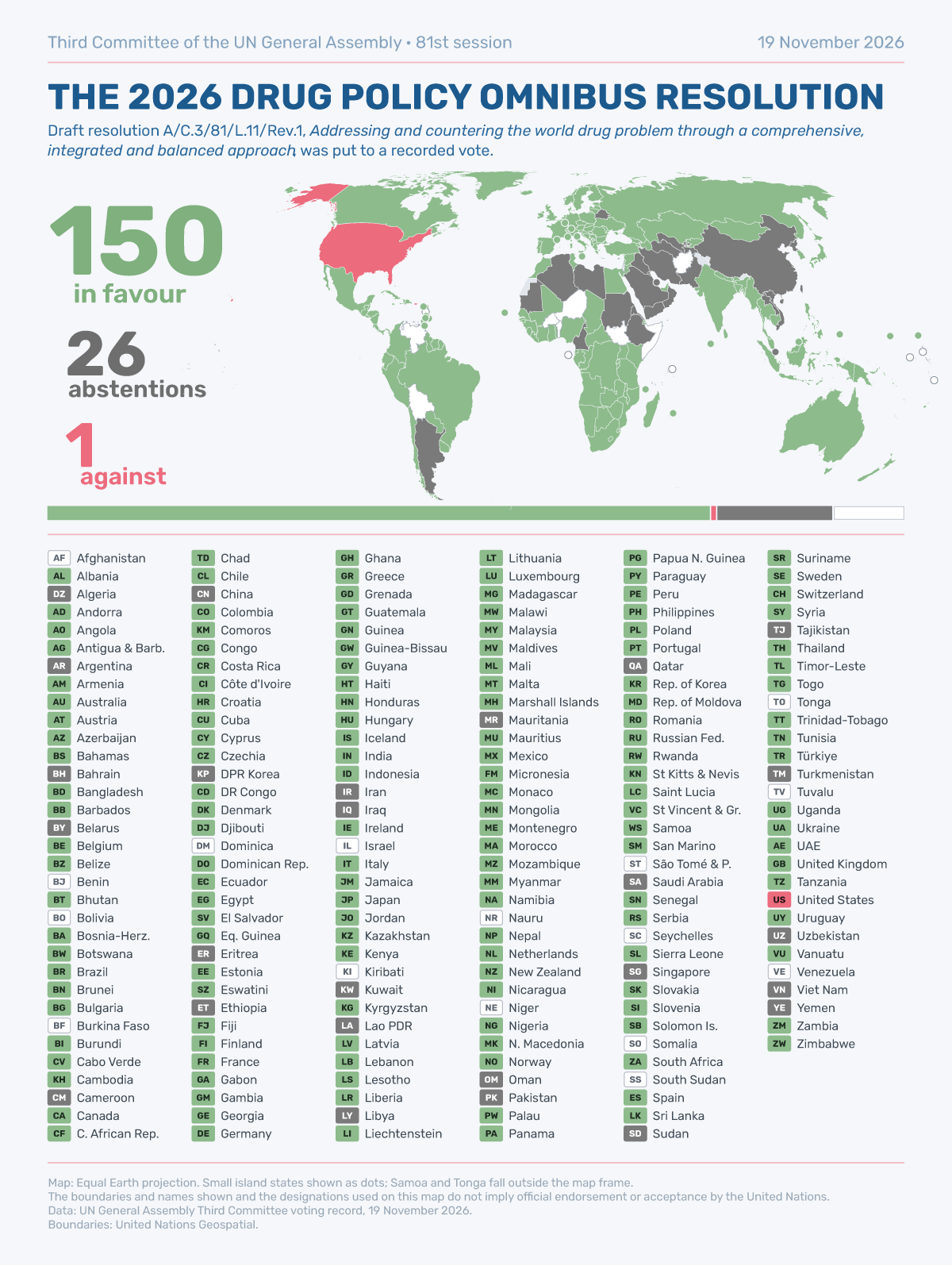
Argentina: Gracias. Thank you, Mr. Chairman. Argentina recognizes the efforts that all delegations made during the negotiations, and we reaffirm our commitment to international cooperation to address the world drug problem. This requires a comprehensive, integrated and balanced approach that is evidence based and that takes into account national realities and sovereign rights, and allows for effective responses to be rolled out to address problems pertaining to drugs. Nevertheless, the resolution does not adequately reflect Argentina’s position, and that is why we abstained in the vote First of all, we are concerned by the inclusion of references to the so-called gender perspective in drug related programs. We must bear in mind the specific needs of persons, bearing in mind objective criteria and the particularities of each state of affairs. White without a recurring to concepts that have not been agreed internationally Secondly, the reaffirmation of the 2030 agenda and the SDGs as a yardstick to refer to this issue does not reflect our country’s position. International cooperation should be based on legal foundations and agreements that states have signed up to without making political programs binding in nature. In addition, references to financing international organizations should respect the budget competencies of each state and the voluntary nature of contributions. That is why we cannot support provisions that urge countries to increase financial contributions, or to provide support to them, without bearing in mind national priorities and the budget capabilities of each state. We believe that multilateral cooperation should be focused on specific results respecting each country’s sovereignty, the diversity of our legal systems, and the priorities that each country may have. The effectiveness of international efforts does not hinge on including problematic references or categories that do not have adequate support. Lastly, Mr. Chairman, ah, abstention does not mean that we do not understand the importance of international cooperation to address the global drug problem, but rather we have specific reservations on specific parts of the text that we are not able to support And we would like to reaffirm our commitment to effective solutions, which respect state sovereignty and the international obligations that states have assumed. Thank you.
Chair: Thank you. Argentina. Um, our final speaker for this morning, uh, before we resume at 3 p.m. this afternoon, uh, is China. China, you have the floor.
China: Chair I present. The global drug problem is complex and is complex and grave. Synthetic drugs, drug abuse and drug related organized crime and other new issues and challenges continue to emerge, posing serious threats to people’s health, security, and well-being. There is an urgent need for the international community to consolidate consensus, strengthen unity and jointly counter the world drug problem. China actively participated in the consultations on the draft resolution introduced by Mexico We thank the facilitator for facilitating these consultations in an open, transparent manner. The draft resolution reaffirms the goals and objectives of the three international drug control conventions, Maintains an overall balance between reducing drug supply and demand and recognizes the principle of common shared responsibility. China acknowledges these efforts at the same time, in terms of clearly affirming the authoritative status of three international conventions and other areas, there remains room for with regard to policy concepts, relevant documents and institutional arrangements were clear. Differences remain to the international community. A more prudent and inclusive approach should be held. Positions within individual mechanisms or specific policy frameworks should not be simply extended to the international drug control system as a whole. In view of the above, China abstained from the voting on the draft resolution. Chair, the Chinese government maintains a firm position on drug control and adopts a comprehensive and systematic approach to the drug problem, which has achieved notable results. China earnestly fulfills international obligations on drug control, continues to deepen practical cooperation with relevant UN agencies and countries, and actively carries out cooperation in drug law enforcement, information exchange and experience sharing Making positive contributions to addressing global drug challenges. China is ready to continue working with the international community to firmly uphold the international drug control system, based on the three international drug control conventions, and advance the global governance of the drug problem. Thank you chair.
Chair: Thank you. China. The committee will reconvene at 3 p.m. to continue our consideration of this item and hear the remaining speakers. Uh I adjourn the meeting and we will resume at three.
Afternoon session
Chair: Very good colleagues. Um, the 50th meeting of the Third Committee of the General Assembly at its 81st session is called to order. Uh, the documentation before the committee is listed on iGov. I remind you of our three minute rule. Uh, we’re also reminded of rule 128 in relation to, uh, sponsors of proposals not being permitted to speak in explanation of the vote of proposals. And, uh, we are here to continue consideration of agenda item 111 entitled International Drug Control. In order to hear the remaining speakers who will make a general statement or an explanation of vote after the vote, we’ve already taken on, uh, resolution a slash c3 slash 81/11/ Rev one on addressing and countering the world drug problem through a comprehensive integrated and balanced approach. And the first speaker we had, uh, remaining from the morning session or as Switzerland to be followed by Canada. Switzerland, you have the floor.
Switzerland: Monsieur le président. Mr. chair, Switzerland. Thanks. Mexico, as well as all the delegations for their constructive and inclusive work throughout this process. We commend the facilitators efforts to achieve a balanced outcome and to preserve consensus. Switzerland therefore, supported the adoption of the resolution and voted in favor by co-sponsoring the resolution. Switzerland expresses its support for the text as a whole, as well as for maintaining a comprehensive multilateral framework to address the global drug situation. We regret, however, that the final text makes no explicit reference to harm reduction. For Switzerland, harm reduction is essential to an effective, evidence based and public health oriented drug policy. It is included in the relevant resolutions of the Commission on Narcotic Drugs and in the work of several UN entities. Its explicit recognition would have strengthened coherence within the UN system and better reflected the available evidence and experience gained. Mr. chair, we also note with concern the wording of paragraphs P 22 and OP 51, which refer to applicable human rights obligations, and Switzerland’s view. The term applicable introduces an unjustified restriction on the universality of human rights. It risks implying that certain rights or obligations might not apply in the context of drug policies. Switzerland reiterates that human rights are universal, indivisible, interdependent and interrelated and that all human rights must be respected, protected and fulfilled without exception in the development and implementation of drug policies Switzerland remains committed to evidence based, health focused and human rights based drug policies, as well as to effective international cooperation. I thank you.
Chair: I thank Switzerland, uh, Canada to be followed by Algeria.
Canada: Thank you, Mr. Chair. On behalf of Canada, I would like to extend our sincere appreciation to Mexico for their valuable work and facilitating negotiation of this resolution. Canada recognizes the complex and multifaceted nature of the world drug situation, and commends the chair’s dedication to fostering productive dialogue to advance the resolution. A balanced approach to addressing the world drug situation requires evidence and efforts to address both demand and supply anchored in international law, including respect for international human rights obligations and instruments. An integrated approach to address the increasingly complex drug related issues and threats facing the international community is essential from both public health and public safety perspectives. Canada remains steadfast in its commitment to a balanced, comprehensive and coordinated approach to both eradicate supply and demand domestically and internationally, one that marshals all players across the ecosystem to reduce risks and harms, protect communities, strengthen prevention, expand pathways to treatment and recovery, enhance the capacity of law enforcement to disrupt illegal drug production and trafficking, and hold those who choose to profit from the illegal drug crisis to account. In closing, Canada reaffirms its commitment to collaborating with member states to address the world drug situation through evidence based approaches that address both public health and public safety We remain hopeful that this resolution can help foster continued progress in building a comprehensive response to this unprecedented global challenge.
Chair: Thank you. Thank you Uh, let me call on Colombia to be followed by Algeria. Colombia? You have the floor.
Colombia: Gracias, senor. Thank you. Chair, the delegation of Colombia would like to indicate that this resolution is the reflection of constructive negotiations. Maintaining a comprehensive approach to common shared responsibility. With a focus on international cooperation and law enforcement We thank the facilitators for their initiative, and we recognize their valuable work. We would also like to stress that no provision in this resolution should be interpreted as recognition or legitimation under any circumstances. Uh, of actions related to illicit drug use. We support this resolution on the understanding that its implementation must respect the priorities, capacities, and national legal frameworks of states. At the same time, we reiterate that the world drug problem continues to pose a great threat to security, institutional stability, and the well-being of our societies It therefore requires comprehensive responses that combine supply and demand reduction, strengthening justice and the rule of law and effective international cooperation. Consequently, our support for international consensus in this regard should not be interpreted as unconditional support for various proposals or initiatives that are not in line with our national realities or specific concerns of countries most affected by drug trafficking, its socio economic consequences and related criminal activity. Our adhesion to multilateral consensus does not prejudge our position regarding norms or interpretations that could limit or prejudge states abilities to protect its national security, develop its own policies and channel its national resources, strengthen the rule of law, and effectively combat drug trafficking, as well as criminal transnational organizations and activities related to the drug trade.
Chair: Thank you. Thank you. Colombia. Algeria. To be followed by Islamic Republic of Iran.
Algeria: Mr. chair, at the outset, I wish to express our sincere appreciation to the delegation of Mexico for its efforts in facilitating this resolution. Its presentation on a biennial basis reflects Mexico’s continued commitment to addressing and countering the world drug problem. Mr. chair, we would like to reaffirm that the three international drug control conventions constitute the cornerstone of the international drug control system. Algeria remains deeply concerned by the magnitude and evolving nature of the world drug problem, which continues to pose a serious threat to the security of our countries and to to the health and well-being of our populations, particularly young people who represent the wealth and future of our nations. We fully recognize that public health and human rights are essential dimensions of any effective response to this challenge. However, we believe that there is room to further work towards a comprehensive and balanced approach without prioritizing one dimension at the expense of another. In this regard, we wish to underline that supply reduction, particularly through effective law enforcement measures, is equally important as demand reduction. The findings, presented in the 2026 World Drug Report are particularly concerning. Cannabis remains the most widely used illicit drug worldwide. Cocaine production has reached unprecedented levels, while the manufacture and trafficking of synthetic drugs have become increasingly alarming. These realities clearly demonstrate that prevention, treatment and rehabilitation, while indispensable, cannot be sufficient on their own. We must strengthen our collective capacity to combat drug trafficking, dismantle transnational organized criminal groups, and reinforce border controls. In this regard effective law enforcement measures are, are are essential for a comprehensive response to the world drug problem. Alongside public health and human rights considerations, we don’t have red lines in the. In this resolution, and Algeria’s abstention should not be understood as questioning the importance of objectives pursued by this resolution. Rather, it reflects our conviction that strengthening the law enforcement dimension would contribute to a more robust text and provide a more effective and efficient approach to addressing this global challenge. Algeria remains committed to working constructively with all member states to address the world drug problem in all its dimensions. In accordance with international law and with full respect for national sovereignty, I thank you.
Chair: Thank you. Algeria. Islamic Republic of Iran to be followed by Malaysia. Iran.
Iran: Thank you, Mr. Chair. The Islamic Republic of Iran abstained on the resolution. Iran remains firmly committed to the three international drug control conventions and supports balanced, integrated and evidence based international cooperation in full respect for national sovereignty and territorial integrity. As a country that has borne a particularly heavy burden in combating transnational drug trafficking, Iran underscores the need for sustained, effective, and non-discriminatory international support for countries of origin, transit, and destination, in particular transit countries, including equitable access to financial, technical, technological and equipment related assistance, as well as controlled medicines and substances for legitimate medical and scientific scientific purposes. Iran has reservations regarding elements of the text that go beyond the conventions could prescribe uniform policy approaches or restrict national prerogatives. Recommendations concerning prevention, treatment, harm reduction, non-custodial measures, gender mainstreaming, civil society participation, criminal justice policies, and human rights related references must be implemented in accordance with the convention’s national legislation. Legal systems, public morality, cultural values and religious principles of each state. Nothing in the resolution should be interpreted as requiring decriminalization, legalization or measures inconsistent with national laws and priorities. International cooperation, including information sharing, law enforcement, judicial cooperation and joint cross-border operations must fully respect national sovereignty. Domestic legislation, the jurisdiction of competent authorities, confidentiality and reciprocity assistance must be provided upon request without political conditionality, conditionalities, politicized benchmarks or new financial obligations for developing countries. Iran stresses the need to balance demand reduction with equal attention to supply reduction, border control and dismantling criminal networks, guided by the principle of common but differentiated responsibilities namely cbdr. It also regrets the selective invocation of human rights without addressing the adverse impact of unilateral coercive measures, which undermine countries capacity to combat drug trafficking and organized crime Iran’s abstention does not diminish its commitment to international drug control cooperation. It reflects its reservations and its position that such efforts must remain balanced, non-discriminatory and fully consistent with the three conventions national sovereignty and domestic legal frameworks and priorities. Mr. chair, as the committee’s work draws to a close, and since this is my final opportunity to take the floor, I would like to thank, uh, a moment to thank the interpreters for their marvelous efforts. Thank you.
Chair: Uh, Iran. I’m sure that wasn’t deliberate. Uh. Um. Malaysia to be followed by Egypt.
Malaysia: Thank you, Mr. Chair. Malaysia. Thanks, Mexico, for facilitating this resolution and for its efforts to accommodate the different views of member states. We have voted in favor in a spirit of constructive engagement, recognizing that addressing the world drug problem requires sustained international cooperation and shared responsibility. The three international drug control conventions remain the foundation of the international drug control system. Malaysia reaffirms the principled, policy making role of the Commission on Narcotic Drugs, the leading role of UNODC in addressing the world drug problem and the treaty mandated functions of the International Narcotics Control Board. Malaysia supports a comprehensive and balanced response that combines effective prevention, treatment rehabilitation and social reintegration with firm action against illicit drug production trafficking and related organized crime. These efforts must reinforce one another and be pursued with respect for human rights and the dignity of all individuals. Mr. chair, Malaysia nevertheless wishes to place two considerations on record. First, we note that the resolution does not expressly reaffirm the long standing goal of promoting a society free of drug abuse. This objective, reaffirmed in the 2024 high level declaration of the Commission on Narcotic Drugs, remains a priority for Malaysia Protecting human rights and implementing evidence based measures to reduce drug related harm are compatible with this goal. We hope that future iterations of this resolution will explicitly reaffirm it. Second, concerning PP 11, Malaysia understands that taking note of reports of the office of the United Nations High Commissioner for Human Rights and the Special Rapporteur on the right to health does not constitute an endorsement of all the observations, conclusions or recommendations contained therein. Our participation in supporting the resolution is without prejudice to Malaysia’s position on those recommendations, including those concerning decriminalisation. Malaysia further understands that the measures envisaged in this resolution will be implemented in accordance with national legislation and circumstances consistent with the three international drug control conventions and our applicable international obligations. The qualifications reflected in the text are important in enabling Member States to develop effective responses suited to their national contexts. Malaysia remains committed to working constructively with all member States and relevant United Nations entities to prevent drug abuse, support recovery, combat illicit trafficking and protect the health, safety and well-being of our communities. I thank you Mr. Chair.
Chair: Thank you. Malaysia Egypt, followed by the United Kingdom.
Egypt: Mr. chairperson, Egypt wishes to thank Mexico for its relentless efforts throughout the negotiation process. Egypt reiterates its commitment to upholding and implementing the three international drug control conventions, reaffirmed the central role of these conventions as the primary legal instruments underpinning the international response to the world drug problem. Furthermore, Egypt stresses that addressing this global challenge requires a balanced and integrated approach founded on three key pillars the reduction of both drugs demand and drug supply. Alongside strengthened international cooperation. These elements are indispensable to advancing our common objective of achieving a society free from drug abuse. However, we continue to have reservations on some elements in the resolution and against this backdrop. My delegation disassociates itself from P 12, referencing Human Rights Council resolution 60/26 and P 36, referencing the political declaration on HIV Aids that has been adopted by vote. We also disassociate from OP three BIS and op 11 in light of their dilution to their to the aspect of law enforcement and criminal prevention. I thank you.
Chair: Thank you. Egypt, United Kingdom, to be followed by Niger.
United Kingdom: Thank you Mr. Chair. The United Kingdom thanks Mexico and commends their approach to facilitating the negotiations on this important text on addressing and countering the world drug problem. We regret that this text was called to a vote. The United Kingdom is pleased to vote in favour of this resolution. It reaffirms the international framework for drug control and emphasizes the need for a balanced approach, which stresses both drug supply and drug demand while also tackling the health, social security, justice, human rights and economic dimensions of the world drug problem. It rightly places human rights at the centre of the response to the world drug problem. Stresses the importance of prevention and notes the particular need for action against new synthetic drugs. I thank you, chair.
Chair: Thank you, United Kingdom, Niger to be followed by Mexico.
Niger: Thank you. Chair. Our delegation voted in favor of draft resolution L.11/Rev.1. This vote reflects our firm, unwavering commitment to combating illicit drug trafficking, drug abuse and organised crime associated with this trade. The impacts threaten public health and the security and stability of our states. In this regard, Niger’s resolutely pursuing its effort, in particular through its Central Office for Combating Drugs. These efforts have allowed to seize more than millions of pills and psychotropic substances in 20 2025, as well as a significant amount of cocaine in 2026. These shows are determination to combat the scourge in the context of regional and international cooperation on this topic. Chair, we recall that Niger voted against. Chair having supported the adoption of this resolution, my delegation regrets the proposed amendment, which would have removed a reference to the political declaration on HIV Aids of 2026. We recall that Niger voted against that political declaration when it was adopted due to certain terminology and, uh, controversial concepts that do not enjoy consensus among member states. This includes key populations in paragraph 26 of the declaration, which covers people that have already been clearly categorized. Niger also reaffirms its firm position regarding gender and associated terminologies. Gender for refers exclusively to the male and female sex. We reject any interpretation that would introduce new gender identity or sexual orientation concepts that do not enjoy consensus consensus. We therefore expressly disassociate ourselves from the reference to the 2026 HIV Aids declaration. In particular, the paragraph that has been referenced. Our positive vote should not be voted as supporting the controversial terminology and notions in this resolution or any other resolutions. Our support for this resolution remains founded on our conviction that the global drug problem requires a collective response that respects, however, the points of national positions of Member States. Thank you.
Chair: Niger. Mexico. To be followed by Singapore.
Mexico: Thank you very much, chair. Mexico. Thanks. All delegations that voted in favor of this resolution. Their support reflects staunch commitment on the part of the international community to tackling the world drug problem This is a transnational challenge that knows no borders and that by its very nature, no country can tackle in isolation in this endeavor. It is therefore vital to strengthen international cooperation to combat transnational organized crime, as well as to dismantle networks devoted to the illicit trafficking of drug and trafficking, and tackle criminal networks that threaten the well-being of our people and societies. At the same time we regret that some delegations decided to abstain from the vote or to vote against. This resolution was from the very beginning, designed to garner consensus. Our purpose is to send a clear message of unity and to demonstrate that, beyond our differences, the international community can work together to tackle a problem which affects us all. Turning now to the amendment that proposed to incorporate a reference to the negative effects of unilateral coercive measures on the enjoyment of human rights, Mexico wishes to place on record that we fully share the concern that underpins this issue, as demonstrated by our vote in favor of the resolution presented by the mission of Cuba. On this matter, however, we are of the view that the importance of an issue does not justify its forced incorporation into a text whose goal is something else. Neither should it become a bargaining chip in negotiations. This resolution must not become a space for confrontation between member states. Rather, it must be a platform to develop solutions and to bolster international cooperation a cooperation rooted in the principle of common but different, common and shared responsibility. Rather, we cannot lose sight of the fact that behind every figure there are faces, families and communities affected by violence and by problems related to the consumption of controlled substances. However, they’re also affected by the lack of availability of precursors and substances for the development of medicines, including those devoted to palliative care. Against that backdrop, we are particularly struck by the fact that Singapore decided to abstain from negotiation. Abstain. Mexico took duly into consideration during negotiations. Singapore’s proposals and incorporated a significant number of them in the text. We value the active and constructive participation shown throughout the process, and we expect that this spirit will translate into their support for the resolution. Or rather, that is what we’d hoped would happen. It’s a shame that it didn’t. We are ready to continue working with all delegations. We hope that those that today voted against the text or abstained can, in the future, accede to this initiative. We hope that in the near future, we will be able to garner consensus around a genuinely collective response to the world drug problem. Thank you.
Chair: Thank you. Mexico. Singapore. To be followed by Russian Federation.
Singapore: As a small and densely populated city state situated close to major drug production centers, Singapore is vulnerable to the scourge of drugs. We take the world drug problem seriously and remain firmly committed to addressing it in close, close partnership with the international community. It was in this spirit that Singapore engaged constructively throughout the negotiations. We thank Mexico for its facilitation and efforts to bridge the diverse positions of member states. We welcome the resolution’s continued affirmation of the three international drug control conventions as the cornerstone of the international drug control system. However, Singapore has reservations about the overall balance and direction of the resolution. In our view, the text places undue emphasis on public health and human rights approaches, drug abuse, illicit drug trafficking and organized criminal groups cause serious harm not only to individuals but also to families, communities and societies. While public health responses are an important component of efforts to address the world drug problem, they should be balanced with public safety, criminal justice and other dimensions of drug policy In keeping with a comprehensive integrated and balanced approach, a balanced text should give equal weight to law enforcement, supply reduction and the harms arising from drug trafficking and organized crime Singapore is also concerned that where language is drawn from external documents such as resolutions of the Commission on Narcotic Drugs, its full context, balance and important qualifications should be faithfully reflected. Our broader concern is that negotiated language should not be selectively incorporated in a manner that does not fully reflect the original text. For these reasons, Singapore abstained on this resolution. Singapore remains committed to international cooperation against illicit drugs and will continue to work constructively with the Commission on Narcotic Drugs, the UNODC, and the international community to strengthen international cooperation against the world drug problem. I thank you.
Chair: Thank you. Singapore Russian Federation to be followed by Cuba.
Russian Federation: Thank you, chair, distinguished delegates. This year, the international legal drug control regime marks 65 years of its existence. Having proven its effectiveness, our task is to continue working to strengthen it on the basis of more effective and responsible implementation of the obligations arising from the three global drug control conventions. The world is facing increasingly significant and complex threats. These are caused by the spread of synthetic drugs as well as new psychoactive substances, as well as the growing adaptability of criminal networks and the expansion of drug markets, and the use of digital technologies by drug traffickers. The omnibus anti-drug resolution should be devoted primarily to these most significant challenges, rather than the liberalization of the global anti-drug agenda or to niche medical issues. The Russian Federation regrets that a resolution addressing an issue of such importance for all member states did not receive consensus support. This is the result, the clear results of a disruption of the necessary balance within the text, which had been achieved in the previous version of the resolution at the 79th session of the General Assembly. Russia remains committed to combating the world drug problem and therefore voted in favor of the resolution. However, we disassociate ourselves from Preambular paragraphs 12 and 37 for reasons we have previously indicated. We express our profound gratitude to all states that supported the amendments proposed by Russia. We trust that the necessary lessons will be drawn from the situation that arose around the resolution this year, and that next time we will be able to return to consensus. Thank you.
Chair: Thank you, Russian Federation. And the last speaker on my list is Cuba. You have the floor.
Cuba: Muchas gracias. Thank you very much, Mr. Chairman. Cuba wishes to thank the delegation of Mexico for its efforts and readiness to engage in dialogue throughout the consultation process that led to the establishment of this draft resolution. We reiterate our country’s commitment to the fight against the world drug problem. It requires an integrated, balanced approach, which is based on the principle of common and shared responsibility in accordance with international law and the purposes and principles of the UN charter. Our country maintains a zero tolerance policy when tackling the scourge of drugs. We are of the view that this fight should be waged from a multidimensional perspective, with priority being given to prevention policies. Policies also of education, treatment and rehabilitation. Priority should also be given to strengthening national capacities to combat the illicit trafficking of drugs and related crimes. We reaffirm, moreover, that international cooperation, technical assistance, and capacity building for developing countries are all vital if we are to effectively tackle this phenomenon. These acts must be undertaken on the basis of unfettered respect for sovereignty, territorial integrity, sovereign equality, also of all states, and the principle of non-interference in domestic affairs. The fight against drugs cannot be used as justification for interventions unilateral coercive measures or actions which violate international law. Chair, the economic, commercial and financial blockade imposed by the government of the United States ratchet up by the oil siege against our country today stands as one of the primary obstacles to the development of our national capacity to combat this scourge. In spite of the aforementioned difficulties, Cuba reiterates its will to continuing to uphold its international commitments, as well as its desire to continue to promote cooperation and information exchange with other countries on the basis of mutual respect and reciprocity. We reiterate that the fight against the world drug problem demands genuine cooperation, political will and shared responsibility, not blockades, threats or unilateral coercive measures. Thank you.
Chair: Thank you Cuba, that unless any other delegation wishes to speak, that concludes our consideration of agenda item 111.